 |
Subscribe / Renew |
 |
Contact Us |
| ► Subscribe to our Free Weekly Newsletter | |

Construction Bids
| home | Welcome, sign in or click here to subscribe. | login |


 print print  email to a friend email to a friend  reprints add to mydjc reprints add to mydjc |  |
November 16, 1999
By JON SAVELLE
Journal Environment Editor
For all the talk about saving salmon, there has to be someplace where the eggs meet the gravel -- so to speak.
|
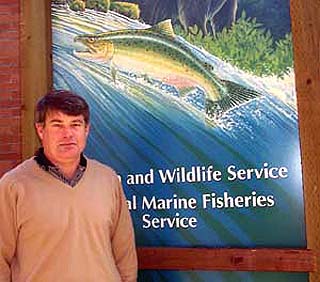
In a recent interview, Turner explained how his office is trying to accomplish that task.
Much of the work involves review of habitat conservation plans. These plans spell out how property owners will protect habitat for threatened species in the course of developing -- or even using land in the case of timber harvesting. Producing such plans is voluntary, for both private and public landowners, and they usually are undertaken by people who would rather do it themselves than have NMFS step in.
What many people don't realize, however, is that NMFS also prefers voluntary plans. Turner said that under Section 4(d) of the Endangered Species Act, "take," or killing fish, is acceptable if the habitat conservation plan provides for the long-term health of the species.
Allowing fish to be destroyed is essentially an exemption to Section 9 of the Endangered Species Act, which imposes a strict "no take" decree if a conservation plan is not adopted.
"We want to use the 4(d) rule to exempt certain activities for conservation," Turner said. "That does not mean no take. We're looking for conditions in the habitat that fish need -- cold water, large woody debris, no sediment.
"We know what fish need, and we negotiate how jurisdictions can provide for those needs."
The NMFS Olympia office is reviewing and negotiating several habitat conservation plans simultaneously, including the city of Seattle's plan for its Cedar River Watershed; Tacoma's Green River watershed plan; Chelan and Douglas counties' plans for operation of Rocky Reach, Wells and Rock Island dams; Simpson Timber Co.'s plan for operations in Mason County; and the Tri-County Salmon Recovery Effort of King, Snohomish and Pierce counties.
Turner said voluntary habitat conservation plans have other advantages. If approved by the government, they guarantee "no surprises," or further regulatory action. This provides a valuable degree of certainty to the parties who set up such plans for their property.
By contrast, Section 9 provides no assurance of future peace. It offers no shield against new regulations, and it is enforceable by government or private citizens.
Local governments and private landowners must decide whether they want to go to the trouble of developing habitat conservation plans, or whether they'll just wait for the axe of Section 9 to fall on their necks.
"Those who come here and say they want to negotiate have made that calculation," Turner said. "The plans that come in generally have lots of take. We're in the business of selling take."
Though it will manage take, a habitat conservation plan under Section 4(d) doesn't guarantee recovery for a threatened species. Turner said there are usually too many external factors involved that a plan can't control. So the primary function of the plan is to permit activities to go forward, with the expectation that they won't further harm the threatened species.
"The [Section 9] alternative is pretty harsh," Turner said. "There is no middle ground. The ESA is not very good at rewarding incremental progress."
The Olympia office of NMFS has its hands full with habitat conservation plans, but they are not the biggest item on the plate. A bigger one comes under Section 7 of the Endangered Species Act, namely the requirement that all federal agencies that propose potentially species-threatening projects must consult with the appropriate regulatory agency before those projects can be approved.
In the case of salmon, that agency is NMFS. For bull trout, it's the U.S. Fish and Wildlife Service, located just down the hall from the NMFS offices in Lacey.
As with local governments and private landowners, government agencies that want to build something -- say a road -- will have an easier time of it if they prepare a habitat conservation plan up front.
If NMFS receives similar plans from different proponents, it is sometimes possible to "bundle" them for more efficient Section 7 consultations, Turner said.
"We love efficiency," he said. "But we recognize that the hard consultations are the ones that don't fit in a bundle or work program anyway."
So far, Turner's office has not had to jump into the harvest issue, although he says that may be coming. The reason it hasn't been addressed yet, he said, is that fishing is a "short-term impact" compared to habitat degradation. And, thanks to the complex life cycles of salmon, there are many more types of habitat to worry about than there are for, say, spotted owls.
Turner noted that salmon need abundant clear, cold water in streams; they require separate spawning and rearing areas; they move from streams through rivers and estuaries, where they change into marine animals; they then swim to Alaska for a couple of years; and then they return to spawn.
"Chronic overharvest has clearly contributed to the decline of the fish," Turner said. "But it's an element that may not have any more to contribute to recovery. You may not be able to squeeze any more water out of the sponge.
"In many cases, you can't actually manage harvest to recover fish, because there isn't any harvest to manage."
Hatcheries are another thorny issue. While some salmon runs are so depleted that hatcheries might be the only hope of recovery, Turner said it depends on site-by-site analysis.
The trouble is, hatchery fish are at best hybrids of wild fish. And while you can presume that wild fish are the best adapted to a particular river system, you cannot make the same assumption about hybrids. So "seeding" a river with hatchery fish "is not the best result," Turner said.
Despite these challenges, Turner is confident that his agency can do the job required of it under the Endangered Species Act.
"People can look at our history of habitat conservation plans, and [they] can gain confidence that we can pull this off," he said.


