 |
Subscribe / Renew |
 |
Contact Us |
| ► Subscribe to our Free Weekly Newsletter | |

Construction Bids
| home | Welcome, sign in or click here to subscribe. | login |


 print print  email to a friend email to a friend  reprints add to mydjc reprints add to mydjc |  |
May 23, 2000
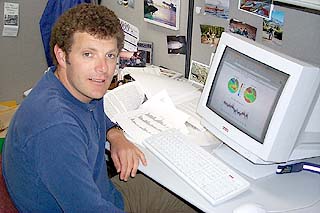
Dr. Nathan J. Mantua is a climatologist who orchestrates mergers between science and government.
Mantua has taken on the role of "atmospheric ambassador" for two of the most critical issues of our time: global warming and endangered species. He was recently recognized by President Clinton as the lead author of a paper that describes how climate cycles affect marine ecosystems in the Pacific Northwest and thus, the lifecycles of salmon in fisheries.
Mantua is quick to dispel myths connected with both issues, but he says arguing over details can be a waste of time.
"There's a mountain of information people do agree on that can take us far. Still, some people want to pull out issues of contention and trash all of the research. This is not productive," said Mantua.
|
"Forecasts are like dice; they're always cast in probabilities," Mantua explained. "For El Nino in 1997, we spoke in terms of '70/30' or '80/20' ... The question is, how do we make it attractive for politicians to talk about these things? There are no political rewards for taking this on. We are trying to improve our look into the future -- with uncertainty attached. Now we've learned enough to reduce uncertainty a little bit."
Weather and temperature trends serve as indicators upon which climatologists build forecasts. Climate changes affect water supply and the availability of other natural resources. To make predictions, Mantua integrates research across disciplines and time periods and searches for patterns.
"We are trying to say, 'Here's a blurred view of the future. ... Now we are working to inject this information into the public policy process," Mantua said. He presented the most recent El Nino as an example of how climate forecasts can affect public policy.
"Scientists have gotten to the point of understanding El Nino. The science has matured. We recognized it in the summer and had a six-month window of time to communicate information," said Mantua. Based on the El Nino forecast, government leaders were able to develop a plan to address potential floods, mudslides and other damage.
Another example is a recent situation in Yakima. Individuals had obtained permits for irrigation in the 1960s, a period in which water was abundant relative to demand. In the 1970s, drought occurred and a flurry of new legislation followed. Public policy is shaped by the expectations of a given place and time, Mantua said. "Thirty to 40-year cycles can alter your perception of normal."
At 34, Mantua is a research scientist with the University of Washington's Joint Institute for the Study of the Atmosphere and Oceans. Although he began his academic career studying mechanical engineering, El Nino of 1983 changed the coastal habitat in Northern California, where he lived. Fascinated with this experience, Mantua to switched his area of study to atmospheric science.
Mantua received the Presidential Early Career Awards for Scientists and Engineers from the Department of Commerce last month. The honor includes $10,000 for each of the next five years. Mantua said he'd like to use the additional funds to hire staff and purchase computer equipment. Currently, funding for the Climate Impact Group, of which Mantua is a part, is about $1 million annually.
Specifically, Mantua was recognized for describing Pacific Decadal Oscillation, a prediction method that will help Northwest climatologists develop forecasts based on regional climate changes over a decade. "It's a new label for an existing body of research that hadn't been synthesized," said Mantua.
Northwest climatologists can now use the PDO to better predict conditions that will affect people and salmon.
On the issue of global warming, Mantua said, "What's not known is how natural patterns will relate to increasing greenhouse gases. This is an important mystery that muddies our view of the future."
He also addressed predictions that Northwest salmon runs will increase this year, due to colder ocean temperatures. "We might get lucky with ocean conditions that can buy us some time, but the danger is stagnation will continue. The biggest thing is that people come to the table and be willing to sacrifice. But the history is one of finger-pointing and the politics of blame. ...It comes down to a question of values."
Finally, Mantua provided a brief look at our regional forecast.
"The El Ninos and La Ninas are not as mysterious as they were before. We've got a handle on how it works, based on climate in the tropics. The latest forecast is that La Nina will fade. The question is, will the coast warm up or will there be a cooler change in the PDO cycle for the next 20-30 years? There's no answer yet."


