 |
Subscribe / Renew |
 |
Contact Us |
| ► Subscribe to our Free Weekly Newsletter | |

Construction Bids
| home | Welcome, sign in or click here to subscribe. | login |


 print print  email to a friend email to a friend  reprints add to mydjc reprints add to mydjc |  |
October 19, 2000
It may or may not be "world class," but it is the only project of its type in the country. And it's not a library, aquarium or other public edifice.
It's a Redmond apartment building.
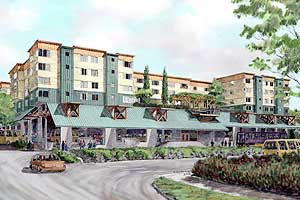
The Village at Overlake Station, which hosts a ceremonial groundbreaking tomorrow, is the first multifamily project in the United States to be built over a park-and-ride lot and bus transit center.
|
Currently under construction, its 308 units of affordable housing will be set aside for tenants whose incomes are at or below 60 percent of the area's median income of $65,800.
Studios will rent for $650 per month and three-bedroom apartments will lease at $936 per month. Completion is expected in early 2002.
As a transit-oriented development, the Village is designed to maximize its location at the transit hub. New residents will get free bus passes for two years to encourage transit use. FlexCar is planned, but not finalized, for the site. And there will be a 2,400-square-foot day care facility on-site.
Also, the option of walking to work is viable. There are about 22,000 people working in the Overlake area, and the project, at 152nd Avenue Northeast and Northeast 24th Street, is next to Group Health Cooperative's Eastside Hospital.
McCarthy Construction is doing concrete work on the foundation, the transit center and structured parking portion of the building. When that is complete, Walsh Construction will take over and build four floors of wood-frame apartments above concrete podiums. KPFF is the structural engineer. Building design and landscape architecture was by Hewitt Architects.
Langly Properties is acting as turn-key developer and construction manager; when finished, Langly will turn the project over to King County Housing Authority, the developer.
At completion, the transit portion of the project will comprise two bus loading platforms and four layover areas. The park-and-ride lot will have structured parking for 250 cars on the lower level of the garage.
Getting this project off the ground, however, required a broad coalition of partners and some creative financing.
"It was a very complex financial puzzle because of the number of partners and the sources of funds," says project manager Jan Briggs in the transit-oriented development division of the King County Department of Transportation.
Two sources emerged to provide the majority of financing for the $38 million project. The King County Housing Authority issued $21.5 million worth of tax-exempt bonds underwritten by the Bank of America. And Columbia Housing and Fannie Mae provided $13.5 million in equity investment.
The county's Housing and Community Development Program in the Department of Community and Housing Services also helped reduce the interest costs of the project through a process called credit enhancement.
The mechanism allows the project to borrow at a low rate afforded by King County's high-grade bond rating. To mitigate risk to the county, the developer must pledge substantial upfront money to the project. According to Vincent Tom of the county, the credit enhancement represents approximately a $3.4 million contribution to the project in today's dollars.
Other key players include the city of Redmond which waived $1.7 million in development fees. The King County Department of Transportation, which is leasing the land to the housing authority, contributed $1.3 million, including funds toward the construction of 30 barrier-free apartments for the disabled.
Unlikely sources for funds were found as well. As part of the mitigation for its expansion, the Washington State Convention and Trade Center contributed $1 million to the project.
The fullscale involvement of the King County Housing Authority as general partner in the project came about in April because of the advantageous types of financing instruments the authority has available. Each time the Federal Reserve raised interest rates during the project's planning, it sent the financial plan back to the drawing board.
Said Briggs, "There were so many varying sources of funds, and they all had conditions. And sometimes they conflicted."
One hurdle was that the Federal Transit Administration had contributed to development of the original park-and-ride lot. Under the terms of that grant, the agency gets to approve any incidental or non-transit use of the property. Otherwise, the grantee, in this case King County, would have to reimburse the money to the federal government.
Although permitted in its regulations, the FTA did not immediately approve the apartment development.
"This had not been done before," said Briggs, "Every institution we faced had their misgivings about the project."
Eventually, the FTA relented, but only after extensive lobbying of the U.S. Department of Transportation by County Executive Ron Sims and his staff.
Sims believes that Overlake is smart use of county land.
In a statement of support for the project he said, "By thinking up... not out, we've tripled the use of this valuable space."
Dan Watson, assistant executive director of the King County Housing Authority, says that while the Village at Overlake was a very complex project, it is a model that bears repeating.
"It's not altogether different from Portland and other places where transit-oriented development has been done," he said. "It's certainly replicable, though presumably future projects might not be so large."


