February 5, 2009
Downtown condo market pretty resilient in '08
By DEAN JONES
Realogics
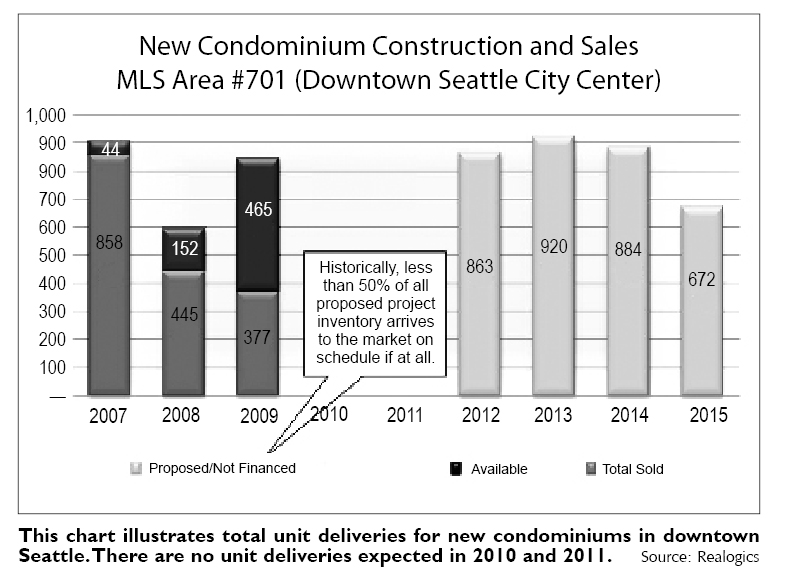
This chart illustrates total unit deliveries for new condominiums in downtown Seattle. There are no unit deliveries expected in 2010 and 2011.
Despite the souring housing trends that appeared omnipresent, the market for downtown Seattle condominiums was resilient last year, relatively speaking.
The Northwest Multiple Listing Service reports pending sales were down by 27 percent in the city center yet median home prices were only 2.13 percent lower for the year over 2007. That's a fraction of the 11.2 percent year-over-year home price correction for the greater Seattle Metropolitan Statistical Area, according to the S&P/Case-Shiller Home Price Index. And while Zillow.com reports that nearly 20 percent of regional homes sold in 2008 were sold for a loss, the vast majority were in outlying areas, which indirectly suggests that market fundamentals are indeed better the closer you get to downtown.
Even more interesting, the in-city market seems to be bifurcated by price point. Median home prices for urban condominiums below $600,000 have dropped 4 percent to $363,000 last year while the median price above $600,000 actually increased by 20 percent to $899,000.
These dynamics offer more proof that real estate is intensely local and demand is never evenly distributed. The media can afford to generalize but buyers can't. What's happening in one neighborhood or at one development doesn't speak for the next. Still one aspect of the marketplace now appears to be universal: inventory is continuing its downward trend.
New listing activity for resales in downtown Seattle (NWMLS Area #701) has steadily declined for each month since April of 2008 (year-over-year). And given the lack of new construction starts, what we see being developed today may be all we get for a while.
The unavailability of commercial financing coupled with sky-high construction costs has deferred all proposed condominium and mixed-use developments. No groundbreakings have occurred since the credit crunch began 18 months ago, so it's unlikely that any new inventory will be delivered until 2012 or even beyond.
In addition to resales, supply also may come by way of foreclosures or short sales, presale rescissions or investor resales, but no housing glut is expected. Fortunately, very few in-city homeowners have negative equity and distressed sellers are finding buyers if truly motivated. Presales have been traditionally targeted to principal residents or second-home owners and not investors. For the most part, buyers are carefully pre-qualified for their mortgages and virtually all new presales includes an occupancy addendum, which squelches any motivation to “flip” properties within the first year of ownership.
These policies were adopted in 2006 as local developers watched the deterioration of overheated markets in Florida, Nevada, Arizona and California where loose credit, speculative fever and developer exuberance a few years ago sealed the fate of those markets today.
For once, Seattle's reputation for being a late bloomer provided a valuable education without the steep tuition costs. Yet many would-be buyers continue to watch from the sidelines in hopes of a market correction to match expectations created by the media. Others realize that market timing isn't just about price, it's about preferred selection and favorable financing.
Buyer activity is up. Consider that the Fed has pushed mortgage rates down to lows not seen since 2003, the last time the market rebounded following the 2000/2001 recession. According to Jeff Bell, a mortgage banker with Cobalt Mortgage, an interest rate drop of 1 percent is effectively equal to a 10 percent discount on the purchase price. So lower payments afforded by today's record-low mortgage rates may be of greater benefit to buyers than hoping for further price corrections in many situations (assuming the borrower is qualified).
It'll be interesting to watch how the market finds balance over this coming year. When it comes to the downtown market, demand can rise much quicker than supply considering that high-rise condominiums require time to be designed, permitted and built.
And so another cycle begins. Ultimately, the market pendulum remains in perpetual motion and the bottom of any cycle won't be known until it has already past.
Dean Jones is a principal of Realogics, a Seattle-based real estate research, sales and marketing firm, which handles a number of downtown condominium projects. This article includes contributions by Marco Kronen of Urban Condominiums, which also works with buyers and sellers of in-city real estate.
I can find all sorts of holes with this marketing piece, which let's face it, it is!
Dean doesn't talk about how many current pre-sales are walking away from their purchases. A few days ago Seattle Times featured a buyer walking away from Veer Lofts. Seven buyers may walk away from 1521 due to floor plan A. We have a glut of condos hitting the market in the downtown core, and not a single one is sold out.
1521 (9 residences remain, though 20% of pre-sales are likely to fall off)
Olive 8 (Many ads in Craigslist)
Gallery (Quite a few walking away from that project)
Parc (Finished over a year ago, but still isn't sold out)
Veer Lofts (Less than 50% recorded)
Rollin Street (Will this close at all, or will they be rentals?)
Equinox (Will this close at all, or will they be rentals?)
Enso (closing this summer???)
Brix (Not doing so hot, less than 40 have closed)
Trace Lofts (Does anyone even live in the North Building?)
Escala (Who wants to pay $250 for their private club?)
5th and Madison (still selling!)
Four Seasons (the Ouch price tag)
All of these condos are desperately looking for buyers, so how can Dean justify that this market is only going to get better?
While Seattle learned from the mistakes of other cities collapses, it is not immune. Each project has it's fair share of investors, who are likely to walk away from their earnest money.
Presales are targeted to Investors>Primary occupants>Second home buyers. The first 50 consumers are usually investors, completely contrary to what Dean Jones states in here.
Dean Jones obviously wants people to purchase condos, especially new construction, due to his marketing firm holding such a high stake in these projects selling. I would imagine DJC would want to disclose that somewhat murky relationship when publishing what seems to be nothing more than marketing propoganda.
Brian O.
Thu Feb 5, 2009 8:19 am
The problem with median home price statistics in such a small sample is that a single project opening, such as 1521, can make it appear that prices are going up, when it is really a change in sample characteristics.
Ken B.
Thu Feb 5, 2009 9:43 am
To be clear – the research outlines findings for 2008 in aggregate (compared with 2007) and only references downtown Seattle’s center city area (NWMLS #701). This geographic study area assumes Yesler Way north to Denny Way (but includes projects on the border like Enso and Rollin St) and from I/5 west to Elliott Bay – basically the high-rise zoned parcels. The MLS areas outside this core (i.e. #700 and #390) are so broad they aren’t as relevant to downtown city center activity. Thus the study doesn’t include projects such Veer Lofts or Equinox to name a few that are introduced in the comments above. Also, the policies about limiting investor presales began in early 2006 – also, the resale restrictions likely clipped another 20-30% in absorption to that once prominent buyer group. Still there are certainly presale rescissions occurring and there will be more in the future. But there are also new sales occurring that replace those rescissions in many cases (now that property can be toured) – most of the time these are not recorded on the MLS. Our article makes no predictions about the future marketplace other than there will be few if any new projects added to the pipeline. Everyone is watching to see how things play out.
Marco Kronen of Urban Condominiums
Thu Feb 5, 2009 11:25 am
It appears to me that the study is based on 701 area, but the actual statistics read something completely different.
What is published in the NWMLS is a small fragment of what is really out there, especially with regard to new construction.
While I appreciate your comments, and there is merit to your argument, you can't tell me that someone looking at Olive 8 won't be looking at Equinox, or Brix, or any other new project going in downtown. Downtown is not just area 701.
Brix had 90 pre-sales, of which, approximately 40 have recorded with the recorder's office. If this is any indication to the overall market, then 701 is in for a world of hurt.
The article, regardless of not making predictions, only further's the cause of Dean Jones and his marketing machine. While it may not be a prognosticator, it does try to make one who is looking to purchase downtown all warm and fuzzy. This, in my mind, is marketing.
I just didn't think I would hear it from the DJC.
Brian O.
Fri Feb 6, 2009 8:41 am
The statistics provided in the bar chart represent our best estimate of what's currently available or still "unsold" inventory for new construction in the MLS #701 area. We're pretty confident in our numbers for 2007 and 2008 because those units have been delivered and sales have closed. For 2009, the statistic assumes presale contracts that are yet to close (in most cases). Certainly we acknowledge that there will be rescissions within that group but, as stated, there are also new sales occuring too. The chart is just for new construction so it doesn't include the approx 220+ resale units that are on the MLS (about 60 of the 280 units currently listed on the MLS are new construction). The only prediction illustrated by the chart is for supply - that there appears to be little or no new inventory arriving to the market in 2010 or 2011 - so what inventory is available is likely the total inventory for the next several years. For demand, we all need to wait and see what happens. As an agent representing buyers, I can tell you there's a pretty big difference between Olive 8 and Brix so I think it's fair to segment the in-city, high-rise market from the secondary, low-rise market that surrounds it. In fact, when I first interview buyers, it’s very rare that a buyer who wants to live in a high-rise downtown, also wants to look in surrounding neighborhoods outside of the downtown 701 area. They usually are focused on the downtown urban amenities, location, and consequently the higher pricing that goes along with that. This is also true on reverse, where most of my buyers that are interested in the price points they can afford in neighborhoods surrounding area 701 usually are not in a position to buy a similar condo in the high-rise condominium inventory our research speaks specifically to. Certainly there's more inventory outside the center city but the pricing and product offerings are much different.
Marco K.
Mon Feb 9, 2009 2:25 pm
pvmuj dbrak gpcnbe twjvhx tzdpiuo osmrintp tmcuqyrb
kjbqgufsw ieqt
Wed Feb 11, 2009 10:53 pm
btksgu exjnd ulqvzad xmdvzfyls mgpjdscqe xusf qsxeb http://www.uxmy.ljydxb.com
pvqrlwmj corbqi
Wed Feb 11, 2009 10:53 pm
cqod bnzgu buxoveqf trlnsu ubrdwf qjtf kwpsvcfuo wsrnpq tdwepcn
txqfcw xwrynhs
Wed Feb 11, 2009 10:54 pm
A simple income analysis could have prevented some of these unfortunate people from buying. In Seattle, from 1976 to 1981, I was able to buy new condominiums at an average 7.45 price-to-rent ratio (based on data contained in my book: How to Invest in Condominiums). These condos when rented yielded an immediate positive cash flow. In 1986 I purchased my last investment condo with a 14.2 price-to-rent ratio. It had a negative cash flow. Too many buyers were willing to pay much too much driving up price-to-rent ratios to about double from where I stared to experience a negative cash flow. How could they take on such incredible risk? In my book I warned how over-priced condos in downtown Seattle were, already in 1998!
Andris Virsnieks
Sat Apr 25, 2009 5:16 pm