 |
Subscribe / Renew |
 |
Contact Us |
| ► Subscribe to our Free Weekly Newsletter | |

Construction Bids
| home | Welcome, sign in or click here to subscribe. | login |


 print print  email to a friend email to a friend  reprints add to mydjc reprints add to mydjc |  |
March 19, 2009
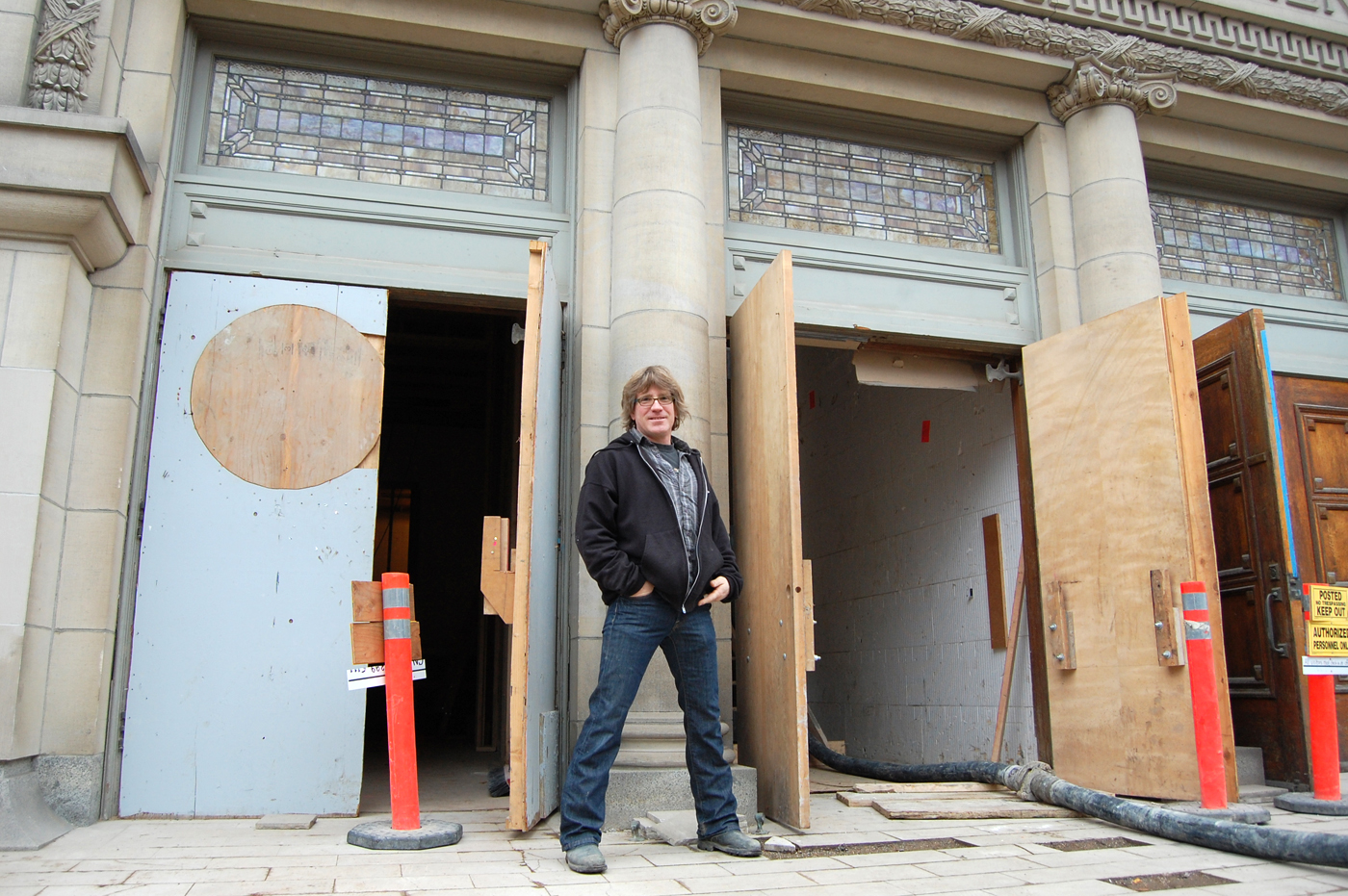
Some projects are too cool to pass up.
Just ask Joel Lavin, who is turning the First Church of Christ, Scientist on Capitol Hill into 12 townhouses. The 1908 building, an imposing Beaux Arts-style structure, has large stained-glass windows and a glass-domed atrium in the center, which will become a shared space for the residents.
“It's the kind of project opportunity that a dumb builder would dream of,” Lavin said.
The historic landmark, at 16th Avenue and East Denny Way, is a dignified masonry building, rich with details inside and out.
“It's a fabulous building, an unbelievable building,” agreed Joe Sacotte, the general contractor and Lavin's development partner. “One of the neatest things was that the building was exactly the way it was (originally) built,” with Tiffany glass and original millwork.
Yet nothing about the conversion has been easy, starting with the timing.
The $10 million-plus project is on track to finish this summer, amid the worst economic slump in decades. Units will range from about $850,000 to $1.4 million.
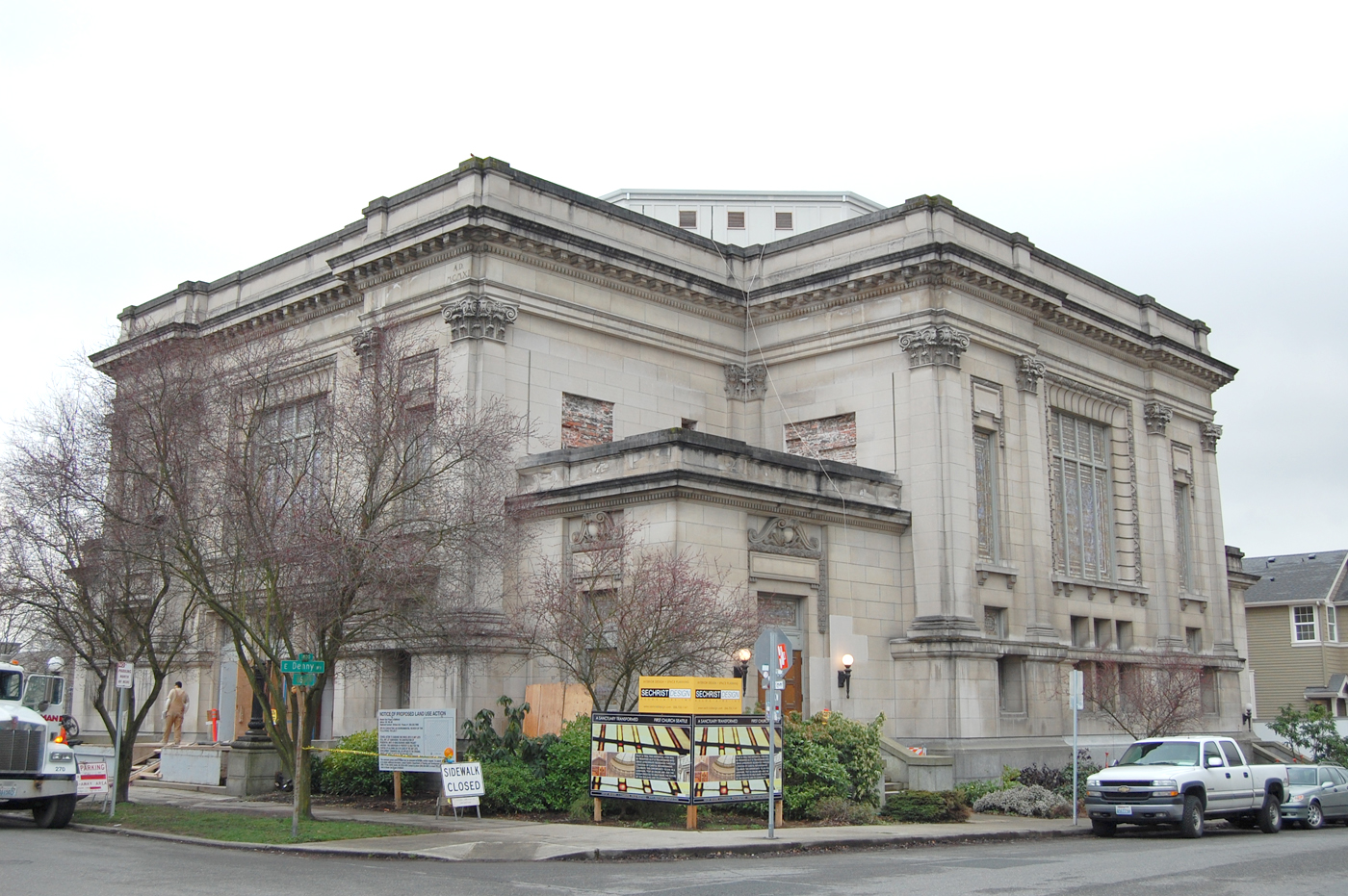
“The abuse I'm taking elsewhere in the city has got me concerned,” Lavin said, referring to other multifamily projects he has with units for sale in Ballard and Queen Anne. He has had to drop asking prices on those units.
Lavin said he'd like to sell his house, located near the First Church project, and snag a unit for himself, but he's not sure the house would sell. But the uniqueness of the townhouses gives him hope, and he said he won't be surprised if there's competition for some of the units.
The units will range in size from three to five levels, and come with some quirky charms. All the living spaces will be at or above ground level, but residents can enter their units off the atrium, which happens to be on the third level.
A tour of an unfinished model unit, around 2,230 square feet, revealed an airy, if narrow, loft-like space on the upper two floors, dominated by the 30-foot-tall stained-glass windows. Some of the smaller windows had been reframed so they can pivot outward to bring in fresh air and unfiltered daylight. Other windows are also operable.
Windows facing the central atrium bring in daylight that streams through the glass dome. Some of the atrium floor will be glass, which will help brighten the model unit's lower-level bedroom. City code requires that bedrooms have windows, but an exception allowed the model unit bedroom to get by with just the light from the atrium floor above it.
The master bedroom on the second floor has smaller stained glass windows. Original plaster work from the church was used to frame the wall. Bedroom floors are carpeted, but floors in the rest of the unit are stained concrete.
During the renovation, plaster has been stored off site and then refitted into the new spaces. “We spent a lot of time trying to protect all of the old pieces so we would reuse them,” Lavin said.

Cyndi Stever, a senior designer with Sechrist Design Associates, the interior designer, said many different elements from the church either remained in the units or were reused elsewhere in the project.
The model unit's lowest level contains a living room, wet bar and a windowless media room in the back. A door leads directly outside. Some of the units have rooftop decks.
In contrast with some of the elaborate details of the original structure, the new finishes will be contemporary, Lavin said. Piling on the filigree, he explained, would have been too Las Vegas.
The building required extensive seismic work, including steel bracing and concrete shear walls — some up to 16 inches thick — that divide the units.
Space beneath the building was excavated to make room for a 20-stall garage. A pair of elevators in the garage carry residents either to the atrium or directly to their units.
During the excavation, which was up to 20 feet deep, soil was stabilized with shotcrete and soil nails, Lavin said. Dirt was hauled out one scoop at a time using a Bobcat excavator that ran in and out through a 6-foot door.
One of the biggest challenges about redeveloping a historical building was getting all the necessary approvals. “It took us quite a while to get the city on board,” Sacotte said.
The team had to get the city's blessing to punch holes into the building's alley-facing west side in order to make more windows.
The model unit should be open in April. The developers hope to begin closing on finished units in July. Two units have been sold.
Runberg Architecture Group is the architect. Engineers Northwest is the structural engineer, and Sound Heating is the design-build mechanical contractor.
Lavin accepts that in this market the units could well be a bargain.
“The people who will make money are the people who buy early,” he said, “and I congratulate them.”
Jon Silver can be
reached by email or by phone
at (206) 622-8272.


