 |
Subscribe / Renew |
 |
Contact Us |
| ► Subscribe to our Free Weekly Newsletter | |

Construction Bids
| home | Welcome, sign in or click here to subscribe. | login |


 print print  email to a friend email to a friend  reprints add to mydjc reprints add to mydjc |  |
October 21, 1999

|
By DOUGLAS A. BORS, P.E.
Sparling
Imagine a place where you can negotiate with and entertain clients while transmitting instructions to your office in Chicago or Washington, D.C. Imagine a place where you can simultaneously give a visual "thumbs up" to your assistant and read your investment portfolio, all without leaving your steaming cup of joe.
This place exists, and it's a lot closer than you might think.
This article is about change in the workplace, change that involves and depends on businesses, people and technology. Technology offers new possibilities. People explore new tools to harness technology. And business exploits peoples' new skills, and then demands continually new and better technology to support those skills.
The way we design workplaces must change to meet the needs and demands of the business-people-technology interrelationship. However, the rules are changing fast. As designers, we frequently must forget some of what we know in order to move ahead.
Perhaps a thousand experiments on workplace design -- conducted by a wide variety of experts, including architects, engineers, furniture manufacturers, business consultants and teachers -- confirm these dynamics and support some common conclusions:
Although most of these trends have been evolving over the past 20 years, resulting changes in workplace design have occurred in just the last few years, such as teleconferencing spaces, portable work stations, plug-and-play technologies, and others.
Productivity has played a role in this focus on design. In the office environment, the study of productivity connects results to several factors: the business structure or process, the people or culture, information and communications technology tools, and the built environment. On one hand, each of these components must be present to support desired results. On the other hand, when each of these elements is balanced and integrated, productivity and business results radically improve.
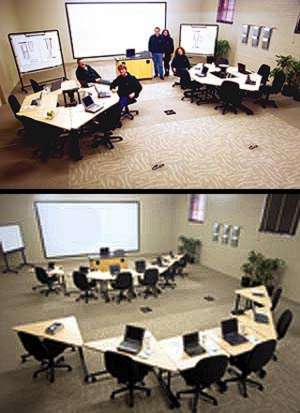 Designing "smart rooms" is key to optimizing computer connectivity in the workplace, according to Brad Barrett, president of the Georgia-based, high-tech firm Connect Center. A smart room combines low-profile cable floor systems with network-friendly office layouts that can easily be upgraded as technology advances.
The rooms shown are examples of offices designed to maximize high-tech components in a shared work space. Computer-driven "white boards," data and video conference equipment and group collaboration software are now reaching broader markets, according to Barrett. Typically, the office use and layout are set before the room is "wired" to handle computer systems. Applying connectivity first, however, makes the room more flexible for adjustments later on. |
Information Design is a new topic in many university programs. Many universities include computer display applications in their curricula, and multimedia has become a component of many communications arts programs.
Growing interest also is reflected in numerous conferences and organizations. For example, the international conference, "Media in Transition," that was recently held at the Massachusetts Institute of Technology, included, among the many topics covering media -- including copyright, social impacts, interactive tools, digital kids, and virtual places -- a report on MIT's "New Literacy Project" that promises to have great implications to the modern workplace environment.
That project combines the study of traditional media, such as text for books or newspaper, and new media, which includes combinations of still images, video, moving diagrams, audio and computer graphics. The intent in "meshing" the old and the new is to help students identify the strengths and weaknesses of each, since they frequently compete with one another to hold our attention.
Consider, for instance, competition among newspapers, radio, network television and cable to attract audiences and advertisers.
The MIT project shows that, as a new class of trained workers graduates from college with the skills to produce messages that grab our attention, and communicate them more efficiently, they will demand the tools to produce their messages and the resources to share them.
So we come full circle. Everywhere we turn, there is pressure to change, pressure to communicate, pressure to continue to improve technology, and pressure to support people within our business structure and at the places we work.
If we agree we must change what we build, we still must discover what to build. But we do not have those answers. Instead, we must change the way we plan our spaces so we can find the answers. Here are some guidelines:
But these guidelines require us to throw out much of our past experience, even though this makes the task of designing new places more difficult. We'll need new concepts, new models, new methods and new rules. We'll need to be innovative and visionary in our approaches.
As the design and construction community invests in knowledge about technology, they are also investing in their own workplaces so they can help their clients make decisions that support their strategic goals. Then we can all drink our joe while it is still hot. Imagine that place.
Here are several places to find information and practical suggestions about the workplace:
Douglas Bors is vice president of Technology Consulting and Research for Sparling, an electrical engineering and technology consulting firm in Seattle.


