 |
Subscribe / Renew |
 |
Contact Us |
| ► Subscribe to our Free Weekly Newsletter | |

Construction Bids
| home | Welcome, sign in or click here to subscribe. | login |


 print print  email to a friend email to a friend  reprints add to mydjc reprints add to mydjc |  |

June 28, 2000
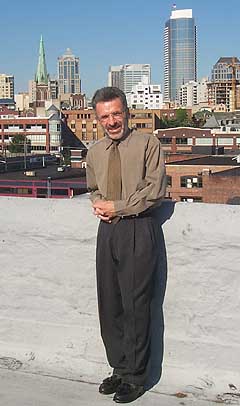
Stan Lokting, principal
|
Q: How is the design process of a community-based project influenced by public process?
A: The design process is not linear, no matter how hard we try to shape it into standard phases. We find that community-based projects are the most unpredictable and, therefore, the least linear. In many cases, this is positive -- more frames of reference allow a better definition of a project and more involvement can help garner public support.
One challenge that is greater for community-based projects is distinguishing between needs and wants and prioritizing these. One common problem is interest group wishes -- which often surface at public meetings, sometimes with little forewarning -- that can get a project far off the mark. Another challenge is the politics of a project. Mayors, city councils and elected officials hear and respond to constituencies that don’t necessarily show up at public meetings. This isn’t bad; it just needs to be known.
The result of these challenges is a design process that requires developing options, and being open to having to develop more. Designs and costs are evaluated publicly, and we find it necessary that our egos are held in check. We also state clearly what our best professional judgements are, in order to guide decision making.
Q: What buildings have you recently designed and how were they influenced by public input?
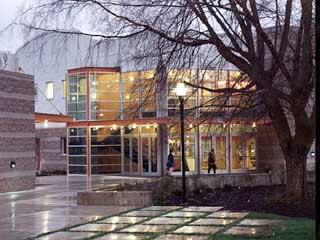
A: One is the Richland Community Center. Public input came from workshops we ran with a Development Team, which included citizens and city staff, and from public presentations. What was crystal clear was the need for assurance that we understood the significance of the site, which is the city’s premier park, along the Columbia River. We heard their concerns and responded with a design that reflects Richland and the site. The site design will, over time, visually expand the edge of the park. The building’s design recalls the geology of the Columbia River Basin, and the mid-twentieth century architecture responds dramatically to views and solar orientation, and, like a good park building, clearly expresses its structure.
|
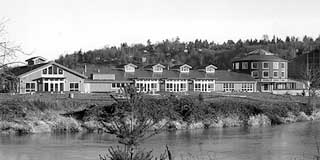
Another form of public input was used at the Tukwila Community Center. This was a competition, and we didn’t have the benefit of direct public input. We won the competition, we think, because we took seriously indirect input, in the form of understanding the town’s agrarian past. Our design response was a building form that is a mixture of familiar farm forms -- silos, barns, sheds and farmhouse dormers -- put together in an inspired way.
Q: What tools do you use to engage the community?
A: Early in a public process we educate the community about the project's potential. We often have a slide show that presents examples of what other communities have done for similar kinds of projects. We get participants to think about what it means to be a community by asking questions like "What made you feel part of your community when you were growing up?" and "What is missing in your community today that keeps you from having that same feeling?"
One of our favorite tools is "Community Center Monopoly." It is a bit like the popular board game and is used in public workshops. Briefly, it involves program elements -- for example a gym or meeting room -- each with an associated cost. Those at the workshop break into small groups that, with a limited amount of money, need to work together to develop a program that fulfills their dreams and wishes -- and is within budget.
Q: What sort of trends have you seen in design of community projects?
A: One trend is public-private partnering. We are working on a community center for the city of Bellevue where it’s likely the city will partner with the Bellevue Boys and Girls Club. The relationship has fiscal benefits and allows each partner to run the programs that match their mission and skills. Another example of public/private partnerships is the Snoqualmie Valley Community Center, where the town of Snoqualmie and Weyerhaeuser are sharing development costs.
We are also seeing a greater dependency on pay-for-use and "membership" fees for public facilities, to help offset the on-going costs to operate and maintain them. The goal is to enhance the "cost recovery" ability of a project.
Q: How has sustainable design been incorporated in your projects?
A: We are active in developing building forms that maximize daylighting potential, balanced against minimizing heat gain. Like many of our peers, we are searching out how to best integrate recycled and reused materials in our designs. One example for us is a large park structure for Lake Oswego, Ore., that was designed around the reuse of larger timbers the city had stockpiled.
|
For the Northshore School District, we are designing a library that will have energy benefits by virtue of being partially below grade. Instead of air conditioning, there will be operable windows on all sides and within a high clerestory roof. These will allow natural ventilation and convection to cool the building.
We tried a similar strategy at the Richland Community Center. However, it gets to be over 100 degrees regularly in the Tri-Cities area, which means that buildings are air conditioned. Operable windows are left open, causing mechanical equipment to run harder and longer, actually raising energy use. We have responded by using high-performance glazing in conjunction with deep overhangs. We are also using stormwater to help serve some of the irrigation needs.
We find ourselves increasingly involved with environmental issues as they relate to site design. For the Tukwila Community Center, an extensive series of biofiltration swales cleans stormwater runoff before it reaches the Duwamish River. We also created new fish habitat along the river’s edge. Issues of biodiversity, stormwater management and the preservation and creation of habitat for endangered species often come into play. These issues were not historically thought to be within the purview of architecture. However, they are part of the milieu in which we practice and we find that we have a growing responsibility to understand them, and to consciously incorporate environmental stewardship into our design process.
Lisa Lannigan can be
reached by email or by phone
at (206) 622-8272.
Previous columns:


