 |
Subscribe / Renew |
 |
Contact Us |
| ► Subscribe to our Free Weekly Newsletter | |

Construction Bids
| home | Welcome, sign in or click here to subscribe. | login |


 print print  email to a friend email to a friend  reprints add to mydjc reprints add to mydjc |  |

July 18, 2002
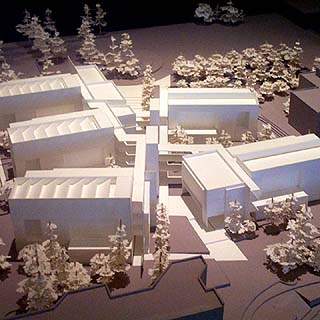
Rendering courtesy of Mahlum Architects The Evergreen State College's $41 million Seminar II complex will be one of Washington's first gold LEED-certified projects. The environmentally sensitive buildings feature green roofs, recycled materials and natural ventilation. |
Even colleges like getting gold stars for a project well done.
When The Evergreen State College set out to build a new classroom complex on its woodsy campus in Olympia, planners sought to create the state's first gold LEED-certified building.
The U.S. Green Building Council, based in Washington, D.C., awards its four Leadership in Energy and Environmental Design ratings -- LEED certified, silver, gold and platinum -- to environmentally sensitive projects, which are determined by a 69-point list of criteria that covers sustainable site planning, water and energy efficiency, material and resource conservation, and indoor environmental quality.
The 159,000-square-foot project includes five classroom buildings and a pair of supplemental structures that will hold lecture halls, faculty office space and a cafe. Seminar II, as the $41 million complex is called, will be the first new academic project on the 4,100-student campus to be built in over 25 years. Crews from DPR Construction broke ground in January.
Outside, the concrete-exterior complex will look much like other buildings on campus, including the nearby Seminar I complex, said Nancy Johns, Evergreen's assistant director for project management. But inside, the building will be "green" galore with recycled and locally produced materials, few finishes like paint, carpet or sheet rock, and construction materials generally free of the volatile organic compounds that threaten indoor air quality.
Other environmentally-friendly features include natural ventilation throughout at least 50 percent of the complex (which reduces fuel consumption) and a roof that will have greenery on over 40 percent of its surface to reduce stormwater runoff.
Finding the right materials for such an exacting project can be a challenge, according to Ken Schmidt, a project engineer at DPR. Adding to the difficulty is the fact that public projects such as Seminar II are usually designed before the general contractor is selected.
Problems crop up when designers specify materials that aren't readily available, he said.
For example, contractors rushing to supply bids for the project may accept substitute materials from subcontractors without first checking to see if the materials meet all the environmental requirements. The resulting project bids can be thousands of dollars off if the substitute materials aren't up to snuff.
Ideally, the general contractor serves as a liaison between the architect and subcontractors from the very beginning of the planning stage, ensuring the right materials will be available at the right time. "Long delivery times may affect the project time," Schmidt said. "When a specific designer suggests a material, we can check with the subcontractor to see if it's available.
"Normally what DPR prefers to do is to facilitate subcontractors' input to make sure the design is the best it can be," he said. "We had very little input as far as material selection (for this project)."
Educating subcontractors about green building is another challenge general contractors face. "Many subs are totally unaware of what green building is," Schmidt said, and they're often scared off by the documentation demands.
Despite the headaches, DPR actively pursues LEED-certified projects, Schmidt said. "We definitely seek out LEED projects, particularly with return clients."
The company is currently building a trio of residence halls at Portland's Lewis & Clark College that will conform to LEED standards when they're completed this summer.
The contractor's own activities figure in to the LEED ratings, Schmidt said. Projects are awarded a point if the contractor recycles at least 50 percent of its waste. Another point is awarded if the contractor recycles 75 percent. DPR sometimes hits the 90 percent range, though that depends on the location of the project and the local recycling market.
"It's often cheaper to recycle than to dump everything," he said. "We commingle all our construction debris and it's removed and sorted offsite and then recycled. In doing that, we obtain a higher recycling rate." Just 7 points can separate a LEED certified project from a LEED gold project.
Seminar II is slated for completion in November next year. The designer is Mahlum Architects. Other project participants include Martens/Chan (structural), Wood/Harbinger (mechanical), Sparling (electrical), SVR Design Co. (civil) and Murase Associates (landscape).
Previous columns:


