 |
Subscribe / Renew |
 |
Contact Us |
| ► Subscribe to our Free Weekly Newsletter | |

Construction Bids
| home | Welcome, sign in or click here to subscribe. | login |


 print print  email to a friend email to a friend  reprints add to mydjc reprints add to mydjc |  |

December 5, 2002
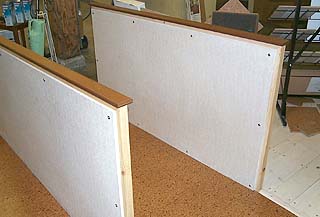
Photo by D.W. Toomey Straw panels on display at Environmental Home Center in Seattle have been whitewashed to reveal the natural color of the formaldehyde-free board. |
With world population expected to hit 8 billion-10 billion by 2050, more and more limits on tree farming, and intense environmental pressure, what is to be done?
For some, the answer is an alternative to wood -- straw board.
Straw board is manufactured from the agricultural waste of wheat, rye, rice or flax farming.
The process takes straw from the field and uses a purifying step to remove unwanted parts. Straw is then compressed under high temperature, sometimes without adhesives, into .5- to .625-inch-thick panels. A finish can be added to produce a smooth panel.
Initial thermal tests point to the conclusion that the product is better suited for interior use than exterior, although the material is rated well for resistance to fire, water and termites. Thermal tests rate a typical panel from R-1.4 to R-2 per inch.
Boards can be manufactured up to 4 inches thick, with heavier panels requiring lifting equipment for placement. The cost of a typical 4-by-8-foot sheet of .5-inch-thick straw board panel is about $12.
At Washington State University, a group of researchers in the department of civil and environmental engineering have developed a process using microscopic fungi to degrade wheat straw and biologically remove unwanted compounds. The research has resulted in successful pressing of straw into plywood-like panels, and now the researchers are looking to the marketplace to use the process on a large scale.
Straw board panels have been received warmly by consumers. Manufacturers suggest the material is suited for floor underlayment, cabinetry and paneling. Some users have used the board as finished flooring and shelving. But sometimes supply is uncertain on the retail level and it is not uncommon for agricultural waste plants developing the product to close operations.
Peter Colburn of Environmental Home Center says he has seen this happen. The Seattle store, which specializes in alternative building materials and products, is switching to a new supplier for that reason.
Colburn said consumer demand for straw board products is high. "We have had some downtime on supply and its been a source of frustration," he said. The store has 4-by-8-foot sheets in stock and is assuring customers its supply should be secure for several months.
Straw board is becoming more available, thanks to investments in manufacturing plants. Currently, there are 11 plants in the United States making straw board.
Parkland Panel Products recently opened a large mill in the Saskatchewan province of Canada that is converting wheat straw into board for worldwide distribution. At peak capacity, the plant could manufacture 32 million square feet of panel board per year.
Also in Canada, a program is in place to entice manufacturers to locate near farms that produce the field by-product. The result is beneficial to the manufacturer and farmer, and recycling straw eliminates field burning.
There is no doubt that the use of agricultural waste to manufacture building materials will continue to expand. Fiber-based products have been made into textiles, pallets, roofing shingles and siding products. In the U.S alone, some officials estimate if 25 percent of the supply of wheat, rye, oats and barley were recycled to board, the annual resource would be about 35 million tons in materials.
Previous columns:


