|
Subscribe / Renew |
 |
Contact Us |
| ► Subscribe to our Free Weekly Newsletter | |

Construction Bids
| home | Welcome, sign in or click here to subscribe. | login |


 print print  email to a friend email to a friend  reprints add to mydjc reprints add to mydjc |  |
October 16, 2013
Emerson Lamb loves whiskey. Just ask his friend Matt Hofmann, with whom he has toured more than 100 distilleries in the U.S. and Europe since 2009, beginning in Scotland.
“Part of the reason we started in Scotland to visit distilleries is we were not yet 21,” Lamb said.
In 2010 in Seattle's South Park neighborhood the Washington natives founded Westland Distillery, a low-key production-only facility with no public face.
Their new digs are different.
On Oct. 27, the pair will release their first whiskey in a 13,000-square-foot single malt whiskey distillery at 2931 First Ave. S. in Sodo.
“We have long maintained you only get the chance to be the belle of the ball once,” Lamb said.
The distillery was designed by Mark Ward, Jim Brown and Adam Pearce of Urbanadd in Seattle, and built by J.R. Abbott Construction.
| More winners |
|
Westland Distillery was recently honored in the INawards 2013
competition by the International Interior Design Association.
To see all the winners, click here.
|
Other team members are McKinstry, MEP design/build engineer and contractor; Coughlin Porter Lundeen, structural engineer; Associate Earth Sciences, geotechnical engineer; Vendome Copper and Brass Works, copper stills; Newlands Systems, mash house and brewing equipment; Collette Collins Designs, casework; and O.B. Williams Woodworking, reclaimed wood milling.
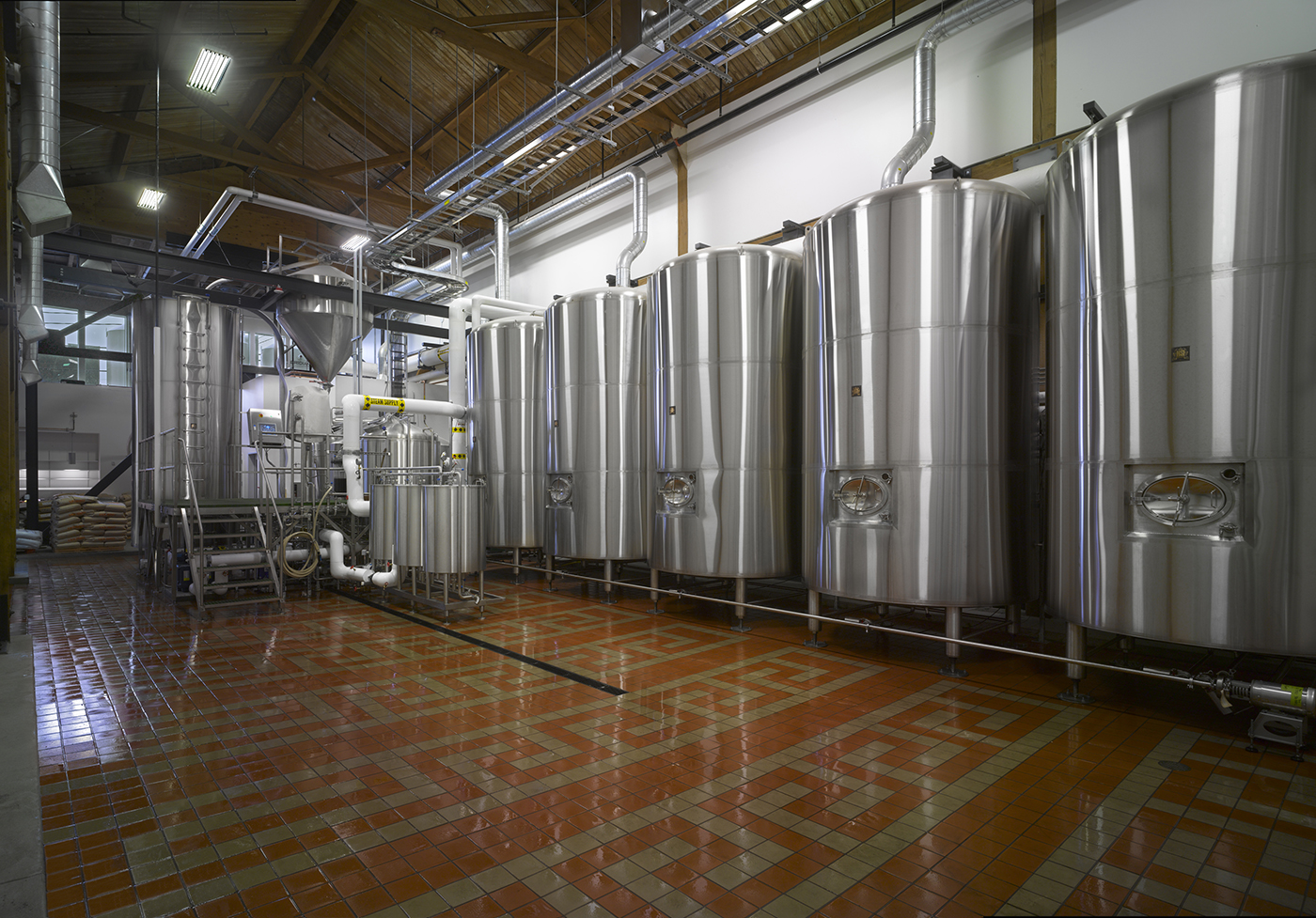
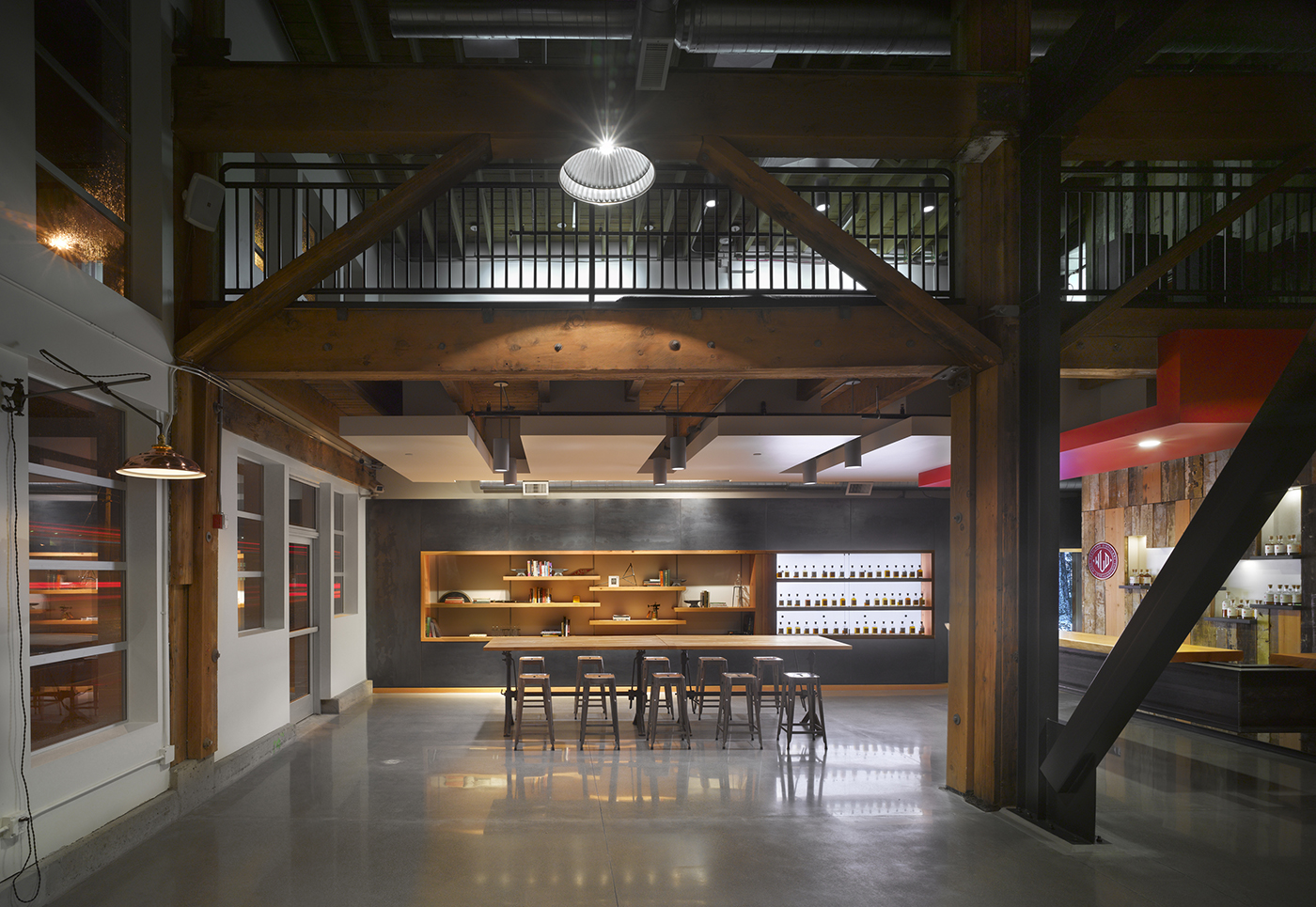
Westland is in a 1919 warehouse once used by the Ederer Co. for making cranes. On the first floor is a mash house with five fermentation vessels, along with a still room with a 7,560-liter wash still and a 5,670-liter spirit still. Offices are on the mezzanine, above a lab, break room, tasting bar and whiskey library.
Materials were selected to respect the Lamb family's history in the timber industry and the warehouse's timber structure, said Mark Ward, a founding principal of Urbanadd. He called the aesthetic a contemporary reinterpretation of the Northwest logging heritage.
The reception desk and tasting bar are made of a fir tree felled by Emerson Lamb on his family's property in Mason County. The supports are cantilevered steel beams.
The distillery has new polished concrete floors in the reception and tasting room. The building came with dirt floors, which allowed Westland to put in utilities and speciality drainage, and to create a sloped floor in the mash house and still room.
A steel and wood screen separates the tasting bar from the cask room.
Some of the wood used in the distillery was reclaimed from the Boise Cascade mill in Yakima by Urbanadd and milled by O.B. Williams Woodworking.
The mash house floor is a takeoff on a mosaic pattern usually seen on a small scale. Westland used larger tiles, Ward said, because alcohol produced in a distillery is hard on small tiles — and because the big tiles look dramatic.
The distillery has a large Westland flag on a 60-foot pole that pokes through the entry and roof because Lamb wanted something that could be seen from far away, Ward said, including Interstate 5, the West Seattle Bridge and Highway 99.
Lamb said Westland is leasing the building from Seattle-based American Life Inc. for 15 years, with options to renew. The landlord had sandblasted the internal timber structure and roof decking, and did a seismic upgrade.
Lamb said the architecture helps tell the story of Westland — the largest malt whiskey distillery by production west of the Mississippi.
When Ward started on the project, “there was nothing to copy,” he said, and Urbanadd had never designed a distillery. So the staff read about the distillation process and learned from Lamb. “It's complicated, but it's not that complicated,” Ward said.
The firm knows retail design. Ward said Lamb is a fan of a store Ward and his wife, designer Erin Ward, opened in Rainier Square called Ward&Co., which sells men's grooming products and accessories. Mark Ward has also worked at other architecture firms on accounts that include Bank of America and Volkswagen.
Ward said the Westland project lets the team show people the manufacturing process, something that is rare in retail.
Here's how the distillery came about: Lamb was building high-tech racing yachts when he approached Hofmann about opening a distillery in Seattle. A law passed in 2007 made it viable for distilleries to get a foothold in Washington and the pair knew the Northwest had the components for great single malt, including two world class barley growing regions and great water from the Cedar River, Lamb said.
Lamb met Hofmann in high school at Bellarmine Preparatory in Tacoma. When Lamb approached him, Hofmann was an economics major at the University of Washington who had been accepted to the Harriet Watt University master's program in brewing and distilling in Edinburgh, Scotland.
In 2009, the two men started visiting distilleries to learn. “To learn how to distill, one must be at a distillery,” Lamb said.
Getting the money to finance Westland was another matter.
The cash to build and initially run it comes from Lamb's family, which has been in the timber industry — now mainly pulp and paper in Hoquiam — for 130 years. The family's holdings are diversified and it has a history of entrepreneurship, Lamb said, but “the family took some convincing. The blank checks were not forthwith.”
Westland makes American single malt whiskey distilled in the Scottish style and aged in American oak casks. On Oct. 27, it will release a flagship product called Westland American Single Malt Whiskey and a limited edition called Deacon Seat, which is named after the bunkhouse bench where loggers used to hang out.
Deacon Seat will cost $40 for a 375-milliliter bottle. The flagship will be $68 for a 750-milliliter bottle, including state taxes. Westland Peated Malt will be released later this year or early next year.
The whiskey will be sold at Westland, Lamb said, and eventually at local bars and restaurants.
The Westland whiskey-making process starts with malted barley in three 25,000-pound silos. The barley is crushed in the mash house and cooked in a vessel called the mashtun to extract the sugar. A ton of malted barley makes 5,000 liters of malted sugar water.
The sugar water is put into five fermentation tanks. Saison-style yeast is added to covert the sugar to alcohol. The alcohol is then put in a 2,000-gallon copper pot wash still, where the first distillation process happens.
Alcohols that come off that process are re-distilled in a 1,500-gallon copper pot spirit still.
The resulting “new Make spirit” goes into charred American oak casks for two to six years in Westland's 20,000-square-foot facility in Hoquiam.
The distillery will make about 1,200 casks of whiskey a year.
Spent grain is recycled for cattle feed and spirit that doesn't work for whiskey is sold for cleaning products.
Making whiskey is part art, science and nuance.
“There's a bit of serendipity involved in each distillery's house style,” said Lamb.
But marketing Westland's whiskey is spot on. To give the tasting room a Northwest feel, there are photos of a logging camp and people fording the Quinault River in 1897.
Jackets and vests sold at the distillery and produced in partnership with Seattle-based Filson appeal to the inner timber baron in customers. A notebook for people to record their experience of whiskey is also on sale.
The marketing of what Westland calls its “thoughtfully made” whiskey is designed to attract “malt heads.” “We are about the substance and the science of making whiskey,” Lamb said. “That's part of the nerdiness in it. We're not just making things for the romance.”
Westland does tastings, and tours by appointment.
Hofmann and Lamb, both now 24 years old, say they are fortunate to have created Westland. Hofmann said he's always been interested in flavor, and could have become a cook.
But he likes distilling and producing high quality whiskey with just four ingredients: malted barley grain, yeast, oak and water.
The master distiller for Westland, Hofmann said he feels a responsibility that comes with living his dream: “Complacency is what I fear the most.”
Lynn Porter can be
reached by email or by phone
at (206) 622-8272.