 |
Subscribe / Renew |
 |
Contact Us |
| ► Subscribe to our Free Weekly Newsletter | |

Construction Bids
| home | Welcome, sign in or click here to subscribe. | login |


 print print  email to a friend email to a friend  reprints add to mydjc reprints add to mydjc |  |
 |
January 27, 2020
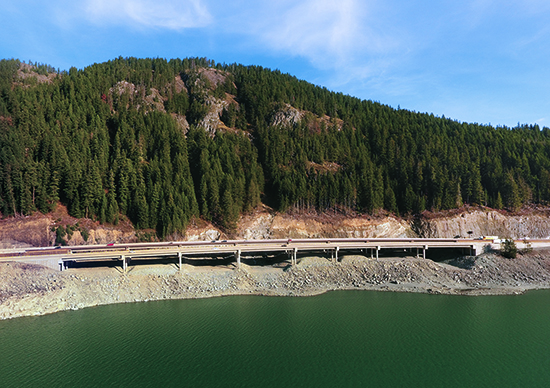
Project: Keechelus Lake avalanche bridges
Client: Washington State Department of Transportation
When the Washington State Department of Transportation was considering widening a portion of Interstate 90 along Keechelus Lake at Snoqualmie Pass, its advertised project design called for replacing the existing westbound snowshed with a longer structure that covered all lanes to protect drivers from avalanches. But the Atkinson/Jacobs design-build team had a better idea.
Once the Atkinson/Jacobs team was awarded the contract, it submitted a Cost Reduction Incentive Proposal (CRIP) to replace the contract snowshed with twin 1,200-foot-long bridges that span the avalanche hazard. Not only do the elevated bridges virtually eliminate road closures due to avalanches, rockfall and snow removal, but they remove millions in long-term operations and maintenance costs for the owner.
The Jacobs design team worked with nature — rather than against it — to design a span that would create a safe passage between a steep mountainside and a lake amidst winter snowfall and often heavy traffic.
The horizontal and vertical alignment of the bridge superstructure was critical in making an avalanche bridge meet project goals for improved safety against avalanches and rock fall. The bridge had to be high enough to clear avalanches and snow accumulation, yet not so high that the grades would be dangerous during icy conditions. The horizontal location had to provide room for falling rock to miss the roadway, yet stay out of the lake, which was too deep to accommodate bridge foundations.
A major step in the development of the avalanche bridges was development of design criteria for avalanches in the Cascade Mountains. The project team brought in world-renowned snow behavior experts to help develop an avalanche model that could predict conditions unique to the Cascade mountain range.
The result was two man-made structures that do not attempt to stop nature — avalanches pass under the highway and into the lake, just like they did before a highway was constructed across the pass.
The new bridges allow for year-round use of the interstate without fear of closure due to rockfall or avalanches.
The avalanche bridges provide a combined savings of approximately $37 million over the life of the structures, a cost largely attributed to the difference in operations and maintenance costs between a snowshed (which requires upkeep of electrical, lighting, ventilation and other systems) and bridges (requiring routine inspections, plowing and de-icing).
Other Stories:


