 |
Subscribe / Renew |
 |
Contact Us |
| ► Subscribe to our Free Weekly Newsletter | |

Construction Bids
| home | Welcome, sign in or click here to subscribe. | login |


 print print  email to a friend email to a friend  reprints add to mydjc reprints add to mydjc |  |
 |
May 30, 2024

Berg
|

Graham
|
When we got the call to design the Seattle Storm Center for Basketball Performance, it seemed natural to build a team of women to create a practice facility for one of the most successful women’s sports franchises. We asked our consultants and construction partners to do the same, and as a result, the team we assembled was 85% women. The Storm’s owners stood tall behind the plan. Their mission is to empower women and girls through sport, so building upon that foundation to advance the careers of the women working on the new facility aligned perfectly.
PUTTING TOGETHER THE TEAM
The late Spero Valavanis of Shive-Hattery started the project with the team’s owners and the Storm’s chief executive officer and president, his daughter Alisha Valavanis. He brought ZGF Architects on board to tap into the firm’s experience designing sports facilities, including training centers for the San Antonio Spurs and Phoenix Suns of the National Basketball Association.
As a project team, we identified with the team aspect of sport — the requirement that everybody needs to be heading in the same direction and working towards a common goal. We think it’s analogous to what we do as designers. A great project doesn’t come from one great person, it comes from everybody on the team contributing.
At the start of the project, the team benchmarked the history of NBA practice facilities as no WNBA franchise currently had one of their own. Over the last few decades, the size of men’s facilities doubled from an average of 35,000 gross square feet to an average of 75,000 gross square feet. Women athletes today are often cobbling together training space or sharing with other teams, resulting in less-than-optimal training routines and loss of training time. It was this inequity that fueled our team.
DESIGNING OPTIMIZED SPACES
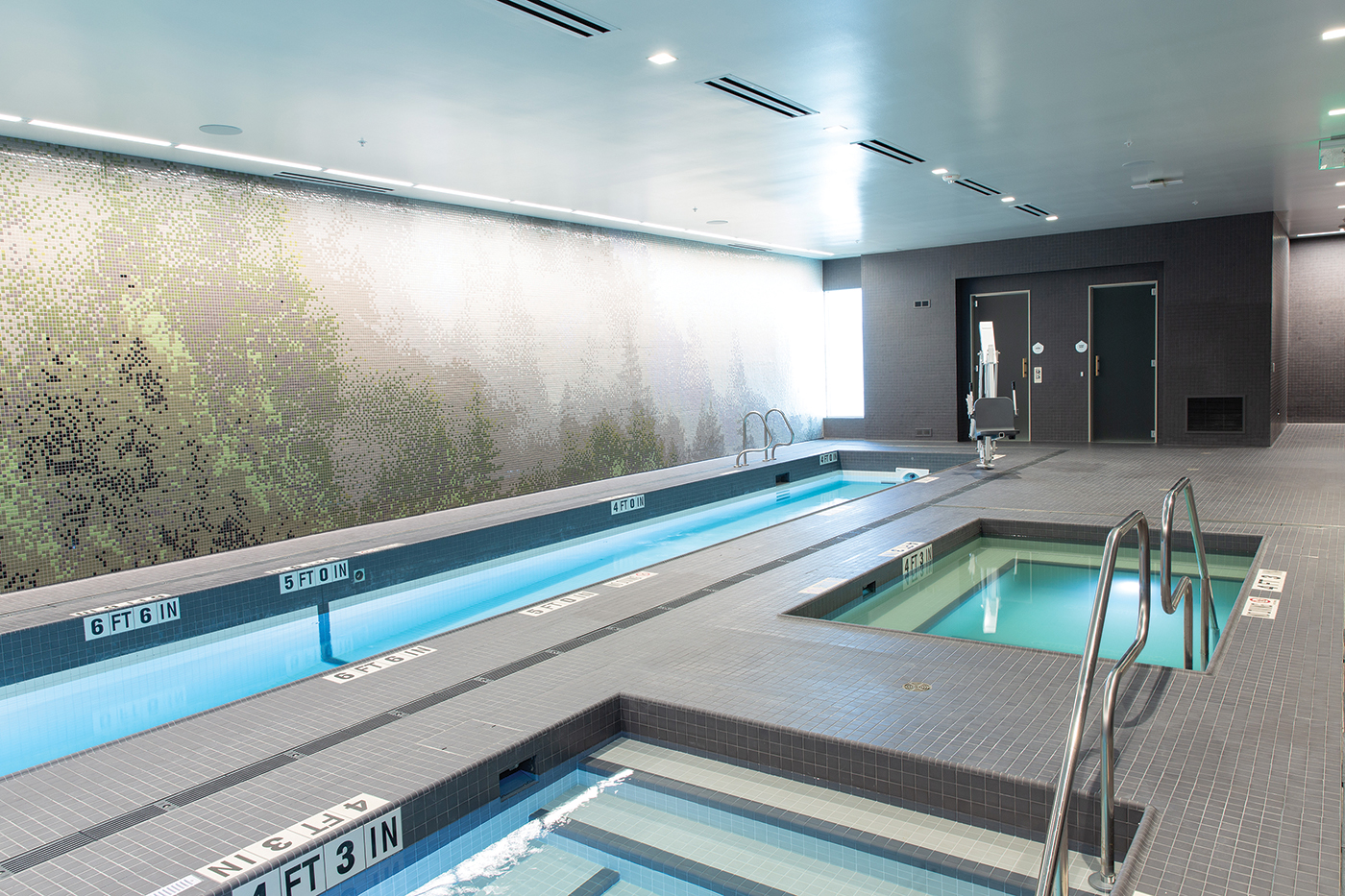
We were determined to make every inch of our 50,000-square-foot facility — the largest allowable building on the selected site — count by designing a best-in-class facility. We created a first floor focused on the players and their support network of trainers and coaches, with two courts, locker rooms, a players’ lounge, a strength and conditioning center, training and treatment spaces, hot and cold plunge pools, and recovery spaces. The second floor is focused on offices for the coaches and the team’s administration.
From a design standpoint, we focused on efficiency by streamlining the players’ movements between spaces and eliminating corridors. For example, from the trainer’s area you can see everything from the aquatics room to the treatment tables, through the strength and conditioning space and out to the courts. The idea is that at any given moment, the trainers, physicians, and other staff monitoring the health of the players can see them, connect with them, and anticipate their needs while assuring player safety.

There were other benefits to eliminating corridors. Making it easier to move throughout the building saves time, giving the player additional minutes to train or recover. In addition, when the players move through the training spaces to reach the courts, it creates opportunities for interactions, feeding the concept of team. Rather than going down a long corridor to exit, players walk through the player lounge where food and spaces to stop and chat create a sense of home and encourage team communication.
We’ve already heard the players say that this feels much more like a space where they want to hang out, and one where they can see each other and be seen. That was something the ownership felt was important: creating a space where the players would be willing to stay longer and fostering team building on and off the court.
CREATING A SENSE OF PLACE
The gritty, industrial site in Interbay between two hills was once used as a landfill. The design team wanted to reflect the history of the site and reference its former existence as wetlands. We thought that carrying some of the industrial nature of the neighborhood through the project would reinforce the work ethic of a training facility. We also wanted to craft an environment that was truly “Pacific Northwest” and reflected the city of Seattle.
The sloped site provided the opportunity to create a private player entrance on level one with a separate public entrance located a half level up on the opposite side of the site. The building features a tilt-up concrete sandwich panel wall assembly with a custom concrete finish that is exposed both inside the training spaces and outside as a building finish. Between the panels, glass and metal vertical bands bring light into the building and create shadow and texture on the façade.
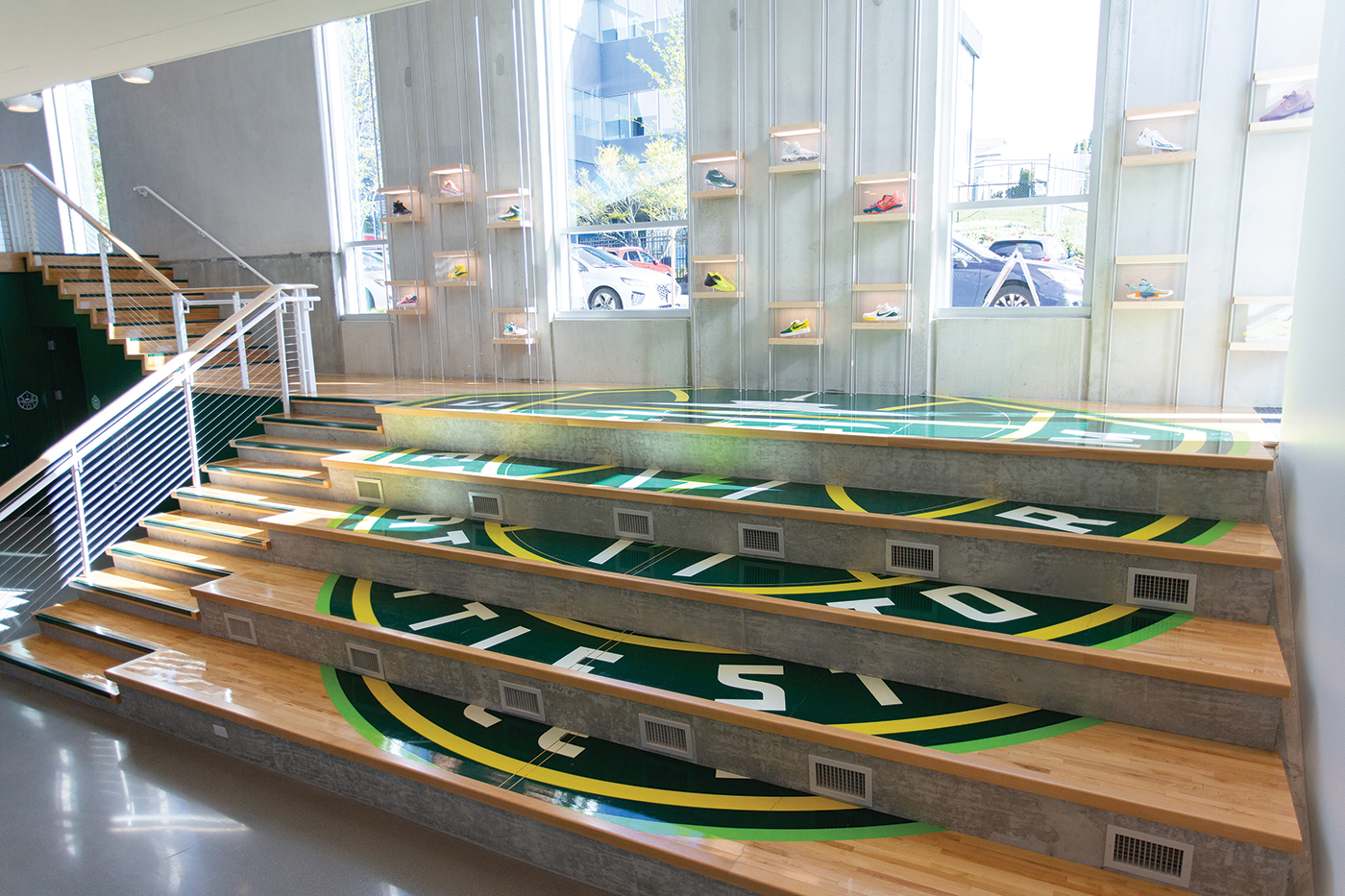
Inside, wood elements create contrast with the concrete. Bleacher stairs in the lobby are made from the reclaimed basketball court, affectionately known as the “Championship Floors.” The Storm won three championships playing on these exact maple boards in Key Arena.
Inside the practice court, a long, high concrete wall — like many spaces in the building — serves more than one purpose. We needed a finish that would mute the noise of players shouting and bouncing balls on the courts, and wanted to anchor the space in Seattle. To solve for this, we crafted a skyline from felt acoustic material and stained the concrete to mirror the surrounding mountain ranges, depicting the Olympic Mountains to the west and Mount Rainier and Mount Baker to the east.
Outside, our drive to make spaces efficient resulted in a parking lot that doubles as a court, with two 3x3 half courts laid out in the parking lot. The lot is also part of the stormwater drainage system. City code requires the stormwater manhole covers to be labeled “storm.” We were able to get approval for each of them — approximately 30 — to be customized and labeled “Seattle Storm” with the outline of the Space Needle from the team’s logo.
LISTENING TO AND DESIGNING FOR ATHLETES
Our team consulted with current and former players, including Jewell Loyd, Breanna Stewart, and Storm Leadership, many of whom had played basketball collegiately or professionally, to get the details right. That meant large, service-rich locker rooms, custom locker designs, a fully equipped weight room, and a players’ lounge focused on nutrition and community.
Prior to Title IX, the federal civil rights law enacted in 1972 that prohibits sex-based discrimination, and requires athletic departments to provide equitable treatment to men and women, there were sports that were not open to women. Even when sports were available for women, facilities were rarely equal to what men were provided. Many of the owners, leaders, and team members for this project experienced inequity over their sports careers, and inequity endures to this day in different forms. As such, the team was passionate about creating a great space for this WNBA team.
We are often asked how we designed the center differently for women. We think that is the wrong question. In any building we design, there is always a diverse community that needs to be considered and reflected.
In this case, we focused on the needs of the athletes, their trainers, coaches, administration, and everyone who supports what they represent. As the first ground-up practice facility designed and built for a professional women’s franchise, The Seattle Storm Center for Basketball Performance is not only another step forward in a five-decade quest to elevate not just women’s basketball, but also an important step towards equity in sport for everyone.
Kathy Shaloo Berg is a partner in the Portland office of ZGF Architects specializing in a diverse range of project types. Dan Graham is a senior architect in Shive-Hattery’s Valparaiso, Indiana office.
Other Stories:


