 |
Subscribe / Renew |
 |
Contact Us |
| ► Subscribe to our Free Weekly Newsletter | |

Construction Bids
| home | Welcome, sign in or click here to subscribe. | login |


 print print  email to a friend email to a friend  reprints add to mydjc reprints add to mydjc |  |

December 15, 2005
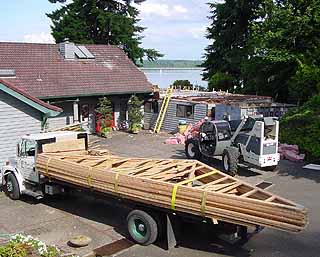
Photos courtesy of Olympia Salvage
Olympia Salvage crews removed the trusses from this house for reuse elsewhere.
|
IN DAVID MACAULAY'S richly illustrated fantasy book, "Unbuilding," the Empire State Building is taken apart piece by piece to be re-erected in the Saudi Arabian desert.
Quinn Vittum harbors no such grand plans, but he sees the potential in the market for deconstruction.
As co-director of Olympia Salvage, he takes apart entire commercial and residential buildings to salvage or recycle the materials. Almost nothing gets left behind.
Olympia Salvage also has a 2,000-square-foot salvage yard operated by volunteers, where customers can discover antique glass doorknobs or stock up on tile and lumber.
Unlike most contractors, Olympia Salvage is nonprofit, and Vittum describes the goals of the organization in environmental terms.
"Our mission is sort of three parts," he said. "To promote environmental sustainability, divert materials from the waste steam, and provide an alternative to consumption of limited natural resources."
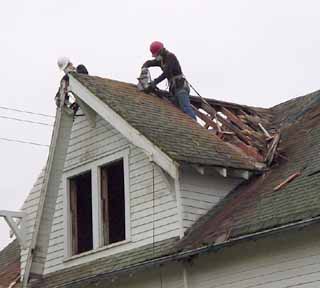
Workers are taking about three weeks to dismantle this 1920s farmhouse north of Olympia.
|
A newer home can be as much as 85 percent salvageable, an older home maybe 65 percent. A 1,000-square-foot house can yield 6 or 7 tons of salvageable material.
It's material that would otherwise be sent away by rail to Klickitat County for disposal, Vittum said, adding that "all that energy (expended) legitimizes what we're doing here."
Elizabeth Powers, a project manager at O'Brien and Co., an environmental consulting firm, cited a 1996 U.S. Environmental Protection Study that concluded the construction industry created 136 million tons of waste annually — about 35 percent to 40 percent of all waste.
"Amounts have probably not changed percentage-wise since then," she said, although recycling has increased.
Deconstruction is one step better than recycling, she said, "because you use a 2-by-4 eight times." Recycled materials don't enjoy the same durability.
Environmental focus
Vittum helped open Olympia Salvage with co-director Ted Drummond in July 2004 after a stint with Sound Builders' ReSource, a salvage firm operated in cooperation with the South Puget Sound Habitat for Humanity.
After Habitat decided to pull back on its salvage operations in 2004, Vittum sought to create an organization geared specifically for environmental work.
"It made sense to streamline the mission and focus on environmental aspects," he said.
Habitat's focus is on providing housing to low-income families. Its Sound Builders' ReSource now operates an 8,000-square-foot salvage store in downtown Olympia.
Vittum said much of his past 18 months at Olympia Salvage have been devoted to ramping up operations. The group has dismantled only five buildings so far, but the business plan calls for completing a couple of projects a month within the next two years. Another goal is to expand its salvage yard to 15,000 square feet.
To get going, the group is seeking $90,000 in startup funds, which it is looking to raise through grants and by turning to community members, businesses and banks.
An early start
Vittum was raised in New England, where his family owned a homebuilding business. "I was at it early — on site at the age of 5," he said.
Many of the homes his family built involved tearing down smaller homes to make way for larger structures.
"I always noticed what was happening around the Dumpster," he said.
After moving to the Northwest, Vittum studied up on deconstruction techniques, discovering an effective means to divert a significant amount of materials from the waste stream.
Salvage operations typically do only nonstructual work, he said, leaving behind a large part of the building to face demolition.
He describes his customers as people who either have a sentimental attachment to the building he's tearing down or people who have a commitment to the environment.
Olympia Salvage is currently dismantling a 1920s farmhouse on a 13-acre parcel on Boston Harbor Road, north of Olympia.
David Moody, the owner of the site, has parents that live on a neighboring parcel. When plans surfaced to develop a subdivision on the site, Moody bought it to preserve the open space. He decided to tear down the lone farmhouse and return the site to its original condition.
A call to Moody was not returned.
Olympia Salvage's crew of four to six workers expect to spend about three weeks on the site to take down the 1,750-square-foot structure.
The process of deconstructing a house is roughly the reverse of constructing one. The crew must decide ahead of time which parts of the structure will be dismantled when. Removal of a load-bearing beam at the wrong time could lead the structure to collapse.
The finishes — cabinets, fixtures, tiles — go first, including the floors, windows and any other nonstructural elements.
At the farmhouse, the crew is now stripping off the roof. Vittum estimates the project has another two weeks to go.
He describes deconstruction as a "delicate technique."
"We were taking out the flooring last week. If you don't know (salvage techniques), it's not coming up salvage."
While cabinets and doors are frequently the most valuable salvaged items, on this house it's the old-growth fir floor joists.
Crews rely on specialized equipment for deconstruction such as nail kickers, a pneumatic device that punches out nails.
"In stead of a speed square, you have a pair of horizontal nippers," he said, describing the tool kit.
Not a demolition contractor
One sore point in Vittum's line of work is the inevitable comparisons he faces with demolition contractors.
Olympia Salvage's bids can come in higher, and the work can take longer.
"It's not a very good comparison," Vittum said. "Of course, it's the same result, but the means are so far from each other."
For one, he sees his work imbued with an environmental purpose that speaks for itself. He also points out that because Olympia Salvage is a nonprofit corporation, donated salvaged materials are tax deductible.
"Depending on the tax bracket of the client, it can be a really important advantage," he said.
A project in Kent included dismantling 40,000 bricks with a fair-market value of 45 cents a piece, or $18,000.
"Occasionally we come in higher than a demo bid," he said. "But let's look at the tax benefit — at the end of the year, how does that affect the bottom line?"
Olympia Salvage is on the Web at http://www.olympiasalvage.org.
Previous columns:


