 |
Subscribe / Renew |
 |
Contact Us |
| ► Subscribe to our Free Weekly Newsletter | |

Construction Bids
| home | Welcome, sign in or click here to subscribe. | login |


 print print  email to a friend email to a friend  reprints add to mydjc reprints add to mydjc |  |

September 22, 1999

By SAM BENNETT
Journal Staff reporter
|
|
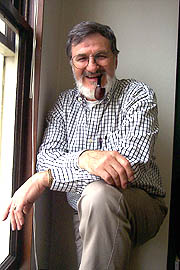
Nolan W. Watson |
Q: What does your firm do?
Our business is advanced scientific and laboratory planning. We're a consulting firm, so the bulk of our business is in laboratory planning and design. However, the emerging part of our business is program management. Although we're a small firm, we provide leadership for much larger projects by assembling teams of architectural and engineering firms, such as the work we did with Teledesic. In this particular project, we brought together nine different firms to program all of their "earth stations." It was an unusual project, requiring the conventional disciplines as well as atmospheric sciences.
Q: What projects are you particularly proud of?
A: Our piece de resistance is the Fred Hutchinson Cancer Research Center. We were instrumental in developing the laboratories and support facilities for the center in 1992. One of the things we were instrumental in was using a unique structural mechanical system called "interstitial space." It's basically a mechanical system in a horizontal shaft above the functional floor. It's a method of organizing building systems, for ease and accessibility in maintenance. In the traditional building, all the maintenance and alterations occur in the laboratory itself. In the interstitial space, maintenance work can go on without interrupting the scientists' work because all the work occurs in the insterstitial space.
|
|
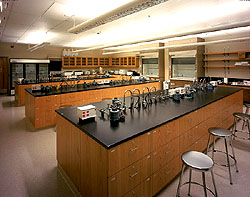
With Central Washington University's Biology/Chemistry Building, McLellan & Copenhagen provided programming and laboratory design services. |
Another project we're proud of is the Central Washington University Phase I Biology/Chemistry Building. This project started out simply to renovate an existing building. Our analysis of this building resulted in a report recommending against renovation due to the fact that the structure would not support modern research and teaching methodologies. As a result of this study, CWU went back to the Legislature and justified a new building. What we're pleased with is we were able to work closely with the client to identify the deficiencies of the old building in order to support the justification of building a new science complex.
Q: Is your use of interstitial space considered controversial in some design camps?
|
|
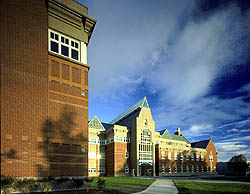
Central Washington's Biology/Chemistry Building houses the laboratories which McLellan & Copenhagen designed. |
Q: How do you stay abreast of recent scientific breakthroughs and how do they affect your approach to projects?
A: The major thing is the quality of my clients who are on the cutting edge of research as well as maintaining an interest in current scientific periodicals. In addition, I've been on the board of directors of the Prince William Sound Science Center in Cordova, Alaska. The science center has developed a whole systems approach to defining the Sound ecosystems. As a result of this research, they have developed a "predictive" computer model that balances sustainability with resource extraction. As a member of the board, we constantly review the research proposals and research progress of the resident scientist in Cordova. As a result of this, I'm obligated to keep informed.
Q: How did you reach this point in your career?
|
|
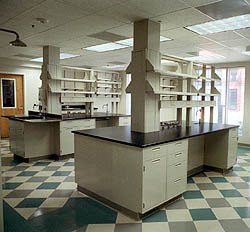
The firm won the 1994 Laboratory of the Year Award from R&D Magazine for its laboratory design in Phase I of the Fred Hutchinson Cancer Research Center. |
Q: What do you enjoy most about your field?
A: Two things. I love to see people achieve success and love to assist them with that process. I love to see people use buildings I've been involved with. To me, their success is my success. I revel in their success. That's where I get my kicks.
Previous columns:


