 |
Subscribe / Renew |
 |
Contact Us |
| ► Subscribe to our Free Weekly Newsletter | |

Construction Bids
| home | Welcome, sign in or click here to subscribe. | login |


 print print  email to a friend email to a friend  reprints add to mydjc reprints add to mydjc |  |

May 10, 2001
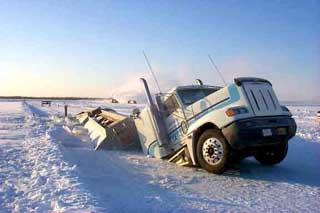
Photos by Jeff Philipp with permission from Faster Than Light Communications. |
When is water a better bridge-building material than concrete and steel? When it's frozen solid.
The idea of building a bridge out of nothing but ice may be a frightful concept for an engineer in warmer parts of the world. But in Alaska, an ice bridge is often the fastest, safest and most affordable way to move vehicles across land in the winter.
"It's pretty common in this part of the world," said Sarah Conn, an environmental analyst with the Alaska Department of Transportation and Public Facilities.
Conn is working on a project to upgrade and rehabilitate the Emmonak Airport, located at the mouth of the Yukon River near Kwiguk Pass, about 10 miles from the Bering Sea. The land there is very wet and muddy during the summer, making it difficult to build permanent roads or move heavy machinery.
"It's more water than land," Conn said.
The airport project will require about 300,000 cubic yards of fill material to expand the runway and widen the taxiway. The material will come from a site located south of the airport -- on the other side of Kwiguk Pass. What would be a difficult operation of moving heavy trucks through wetlands in the summer becomes much easier from October through early April when the whole area is frozen.
"It's hard to get material into that part of the world. It's just silty sand," Conn said. "So they move it around in the winter."
Winter, said Matt Desalernos, project manager for the Alaska DOT, means sub-zero weather for several months. "It's well below freezing from late October well into this time of year," he said. Most winters in Alaska will get prolonged stretches of 20, 30, and 40 below weather."
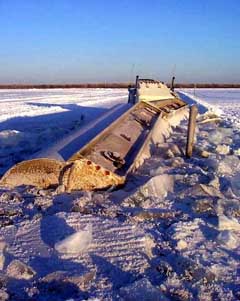
Photos by Jeff Philipp with permission from Faster Than Light Communications. |
The result is a build up of 2.5-3 feet of ice. "That's a good enough thickness to hold any vehicle," Desalernos said.
The ice has to be thick enough to hold your load, he said, but for the most part, the ice bridge operates like any other road. "(Ice) is just another material."
To build up the thickness, Desalernos said they will drill holes in the ice and use a pump to fill the cavity with water, "almost like you're making a hockey rink."
The cost of building an ice road is minimal. "It probably costs you more to get your permits," he said.
Conn said another advantage is the minimal effect ice roads have on the environment, as opposed to building a concrete or steel bridge. "You're not leaving a permanent feature once you're finished," she said. "We can access remote sites pretty easily without leaving too much of a trace. You can go across the snowbank and not affect the tundra directly."
The practice of building roads this way has been in use for a long time. "We actually have winter roads in Alaska that are traveled by the public," Desalernos said. "You can drive upriver several hundred miles in the winter."
He said the Alaska DOT plows the ice roads as if it was a regular road, building up a snow berm on either side of the road to keep vehicles within the safest and most solid ice.
There are some obvious difficulties to building with ice. For one, engineers must rely on the weather to provide the freezing temperatures to create and maintain the ice. "If you get some warming weather, you'll get some corrosion underneath," Desalernos said. "That's something that the contractor monitors closely."
In some cases, fluctuation of tidal conditions can also have an effect on ice roads. "The water level in the river can be raised anywhere from 3 to 5 feet," he said. When that happens, it can lift the ice in the center of the body of water. "You get flexing there along the river. You end up with a moat ... a flooded section 10 to 15 feet across and 5 feet deep with ice underneath it."
| More Photos Online |
|
Visit this Website for more frozen truck photos by Jeff Philipp. http://www.ssimicro.com/pub/icebridge |
The water on the surface will begin to freeze, mixing with snow, to create icy slush. "It's easy to get vehicles stuck in it," he said.
Then there's the danger of heavy vehicles breaking through the ice. In January 2000, a Super B train truck hauling diesel fuel broke through an ice bridge on the Mackenzie River near Fort Providence, Canada. While the driver was able to free himself, both the cab and the tanks were left half submerged in the partially-frozen ice.
In this case, the road had been restricted to light traffic only, with a limit of 4,000 kilograms, or about 8,820 pounds. The tanker truck weighed more than 60,000 kilograms, or 132,300 pounds. Recovery of the truck involved pumping the fuel out of the tanks and using small dynamite charges to free the truck so that it could be lifted out.
"It's a little unnerving the first time you see a truck driving down the middle of the river," Desalernos said, but a frozen-solid river of ice can be safer than an asphalt road in the winter. "All the (ice) roads are going to be straight, and there isn't going to be a lot of grade."
For many situations, Desalernos said, using ice roads is preferable to building an asphalt road. "We don't have other alternatives," he said, like with hauling material to the Emmonak Airport site. "In a lot of cases, it's the only viable alternative for getting a local borrow source."
Lisa Lannigan can be
reached by email or by phone
at (206) 622-8272.
Previous columns:


