 |
Subscribe / Renew |
 |
Contact Us |
| ► Subscribe to our Free Weekly Newsletter | |

Construction Bids
| home | Welcome, sign in or click here to subscribe. | login |


 print print  email to a friend email to a friend  reprints add to mydjc reprints add to mydjc |  |
 |
April 9, 2026

Kline
|
For many higher education campuses, legacy buildings present both intriguing opportunities and challenges. While often rich with history and architecturally significant, bringing these structures up to current codes and adapting them to new uses can require significant creativity and investment. This was true for The Evergreen State College (ESC) in Olympia, a unique institution known for its notable 1970s Brutalist architecture and unique interdisciplinary approach to education.
Evergreen was founded in 1967, with most buildings completed in the early 1970s at the height of the Brutalism period. The stark and simple structures are balanced by the natural beauty of the heavily wooded campus nestled among a sizable evergreen forest.
Our engineering team had the amazing opportunity to transform one of these buildings, constrained by its original purpose and structural layout into one that adds a thriving new center to campus.
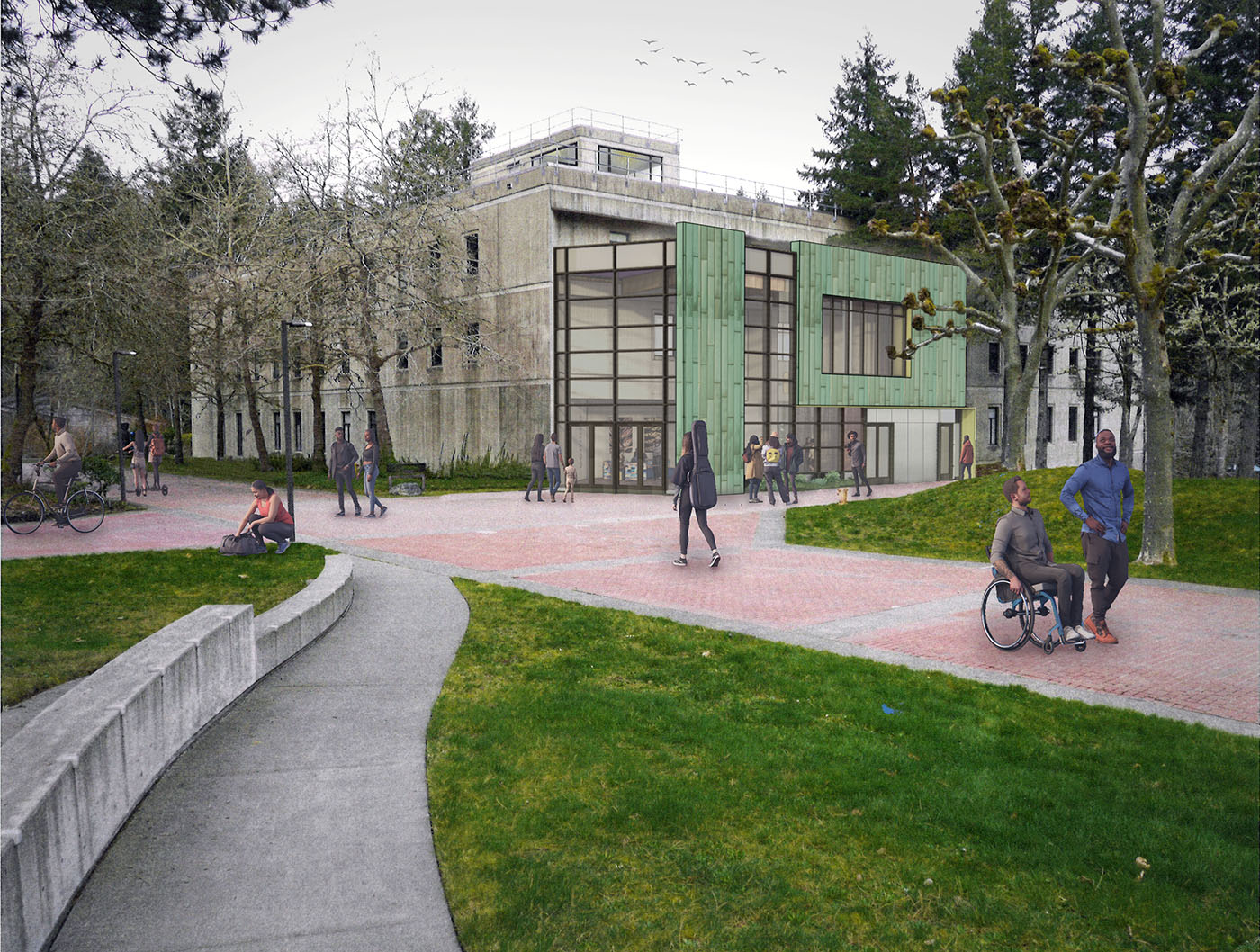
The transformation included the addition of welcoming new mass timber entryways that add texture and warmth to the Brutalist exterior, and a seismic upgrade that elevates the building’s classification to a Risk Category IV, designating it as an essential facility.
The solution that truly unlocked its potential removed eight columns within the five-story building. To fully understand this story, we need to start at the beginning, with the tale of two buildings: the one that was built and the dream building that was not.
TALE OF TWO BUILDINGS
In the early 1970s, the campus had an ambitious plan to build a large seminar facility, with several large lecture halls, classrooms and workrooms. We can only imagine the conversation going something like “While we don’t have the funds to build the full seminar facility, we do have enough resources to start. Let’s build a smaller support building first that will house the mechanical systems and facility offices needed for the future full seminar faculty. Creating the backbone for the larger vision to be completed when funding allows.”
Then they set out to do just that.
The smaller support building was built in 1972 and is referred to today as Seminar 1. In that building, two deep basement levels housed the large mechanical and plumbing systems sized for both the support building and the unbuilt future building.
A 31-foot-tall tunnel extends 78 feet towards the unbuilt building, still waiting to make a connection that would never happen. Three stories of offices designed to support those teaching in the unbuilt building sit over the tall basement floors.
The original envisioned full seminar facility was never built and never will be. The designated space is now occupied by two smaller buildings serving other purposes.
Over the years, Seminar 1 has served the campus in various capacities, including housing, a nurse’s office and student accounting department, but the building has never lived up to what it was meant to be. Eventually, the decision was made to turn the Seminar 1 building into the building that never was.
THE CONSTRAINT
The core challenge in transforming the Seminar 1 building into a thriving campus building was its concrete structural system. The occupiable portions of the building were primarily designed as office space. The 12 foot by 12 foot columns were spaced closely together, laid out along a corridor down the center of the building with offices on either side.
The layout and structure were efficient and economical for the time, but they constrained the building for years. Any attempt to revitalize Seminar 1 into an actual, useful instruction building had columns landing right in the middle of classrooms.
THE TRANSITION
Only two options were available to convert Seminar 1 into a building with suitable small and large classrooms: add on to the building or remove several concrete columns. To keep the project economical and to conserve resources, it was investigated whether any concrete columns could be removed.
The building has a flat concrete floor slab system, with a thin structural depth. This was a cost-effective strategy for the initial construction, but it made retrofits much more challenging as it left little to no room to add new beams or other framing to redistribute the loads in the ceiling space.
We had to think bigger and collaboratively.
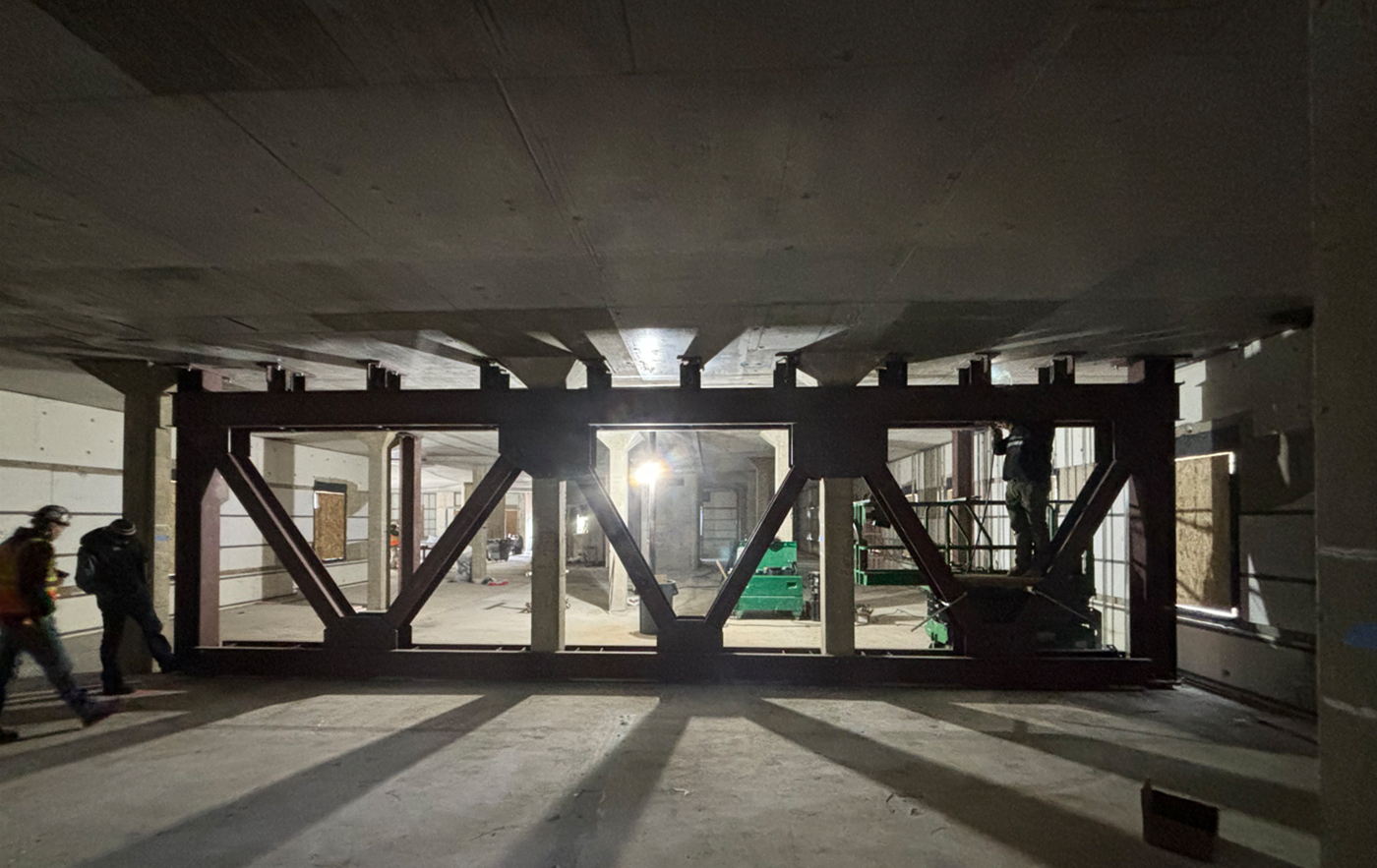
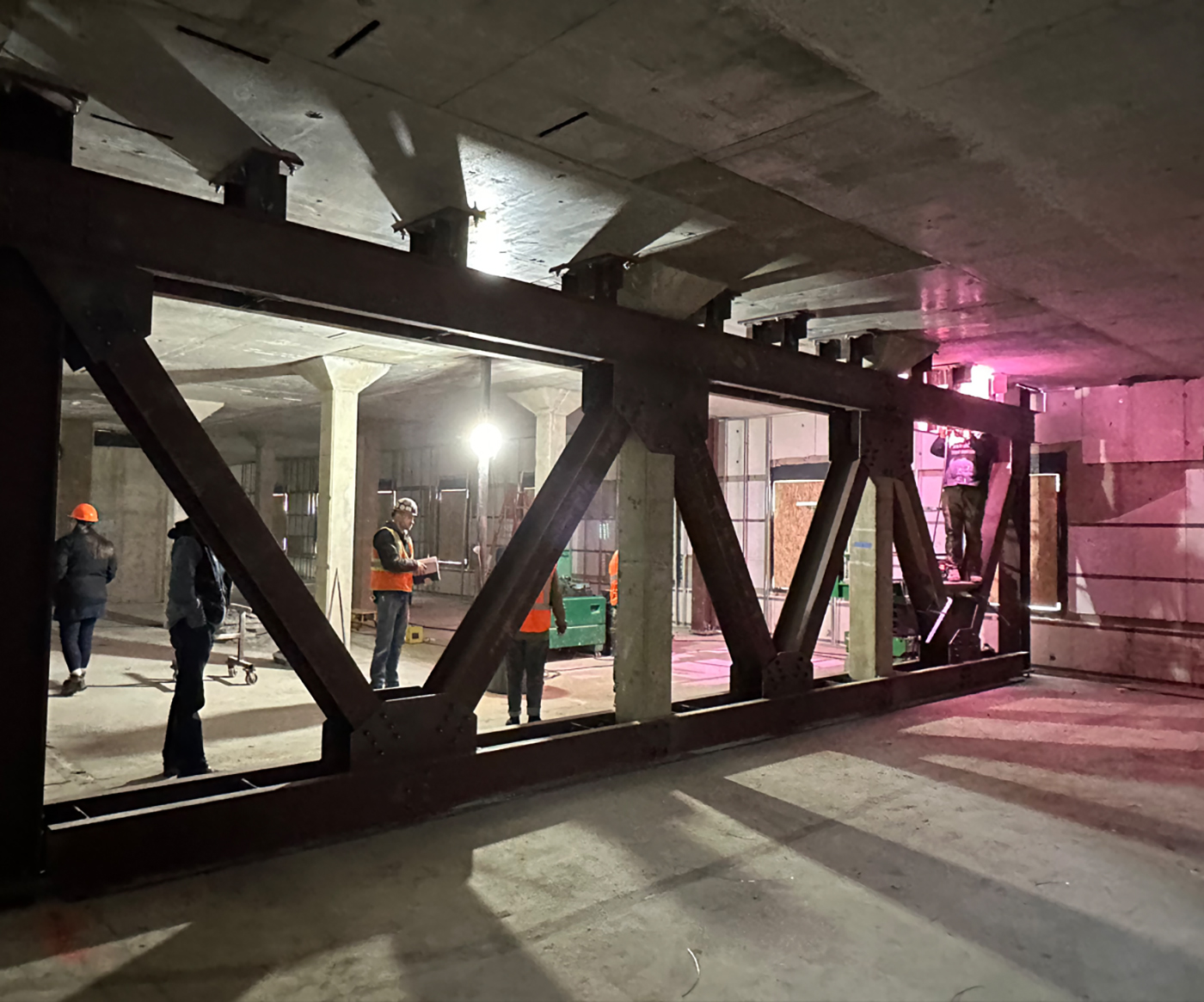
Enter the full-story truss. The solution was a steel truss that extends floor-to-floor and spans almost the entire width of the building. The bottom chord of the truss supports the existing concrete floor slab below, while the top chord supports the concrete floor above. The truss is then supported by new steel columns extending down through each floor to the footings below.
With each truss installed, two columns could be removed above and below. After installing three full-story trusses and adding a big beam on top of the roof, eight concrete columns were cut out of the building, providing space for eleven classrooms, both large and small.
This truss layout staggers horizontally as it works its way up the building. Following suit, the classroom layout staggers up through the building.
Achieving this staggered layout required close coordination across the team. The project had a great team of architects, and mechanical and electrical engineers up to the task. All worked to ensure the new and old systems functioned together to allow Seminar 1 to finally live up to its potential long into the future. It’s often said, but it remains true; the project team matters.
CONSTRUCTION EXECUTION
Every piece of steel was brought in through window openings and assembled inside the building. The steel members were installed in the shape of the truss on either side of a pair of concrete columns and then were tied together, effectively wrapping the truss around the existing structure. Once the trusses were secure, the columns above and below them were cut out and removed.
This configuration allowed the majority of the steel to be erected and engaged before any concrete was removed. By transferring loads into the new steel system first, the team was able to safely remove the columns without requiring extensive shoring, or disrupting the overall stability of the building.
Remarkably, shoring was only required on the day the concrete columns were cut out. This enabled the contractor to maintain open access to the building throughout construction, keeping the project on schedule and budget.
REACHING ITS UNIQUE POTENTIAL
Opening up larger spaces finally allows the Seminar 1 building to fulfill a purpose envisioned more than 50 years ago, providing modern large state-of-the-art classrooms and also housing the Native Pathways Program and the campus police station.
While the outcome looks different than what was originally planned and it has come decades later than expected, Seminar 1 has been transformed to fulfill the original vision of a thriving academic hub in its own unique way.
The project demonstrates how legacy buildings, even those constrained by their original design, can be successfully reimagined through creative engineering and strong collaboration. Preserving the building’s distinctive Brutalist character while adapting it for modern academic use ensures it will continue serving students and the campus community for decades to come.
Heather Kline leads structural engineering efforts on a wide variety of projects ranging from K12 schools, higher education buildings to U.S. embassies worldwide.
Other Stories:


