 |
Subscribe / Renew |
 |
Contact Us |
| ► Subscribe to our Free Weekly Newsletter | |

Construction Bids
| home | Welcome, sign in or click here to subscribe. | login |


 print print  email to a friend email to a friend  reprints add to mydjc reprints add to mydjc |  |
 |
October 14, 2024

Fraga
|
In today’s construction industry, the importance of diversity and inclusion extends beyond the workforce to the entire supply chain. Companies are recognizing that a more diverse supply chain doesn’t just meet compliance goals — it drives innovation, strengthens communities and creates a more sustainable business model. Skanska has embedded supplier diversity into its broader commitment to diversity and inclusion. Through a well-developed supplier diversity program, the company has made significant strides in supporting underrepresented businesses, including but not limited to minority-owned, women-owned, veteran-owned and small businesses.
Skanska’s supplier diversity program focuses on creating long-term relationships with diverse suppliers and equipping them with the tools, training, and support needed to thrive in a competitive marketplace. At the heart of Skanska’s approach is the belief that diversity within the supply chain is actively cultivated and integrated into every aspect of procurement — internal and external. This focus ensures that diverse businesses are not just given the opportunity to participate, but also are provided meaningful opportunities that foster innovation and growth in both the company and the communities they serve.
Below are key lessons from Skanska’s approach that businesses can adopt to create or improve their own supplier diversity efforts.
MAXIMIZE OPPORTUNITIES THROUGH INCLUSIVITY
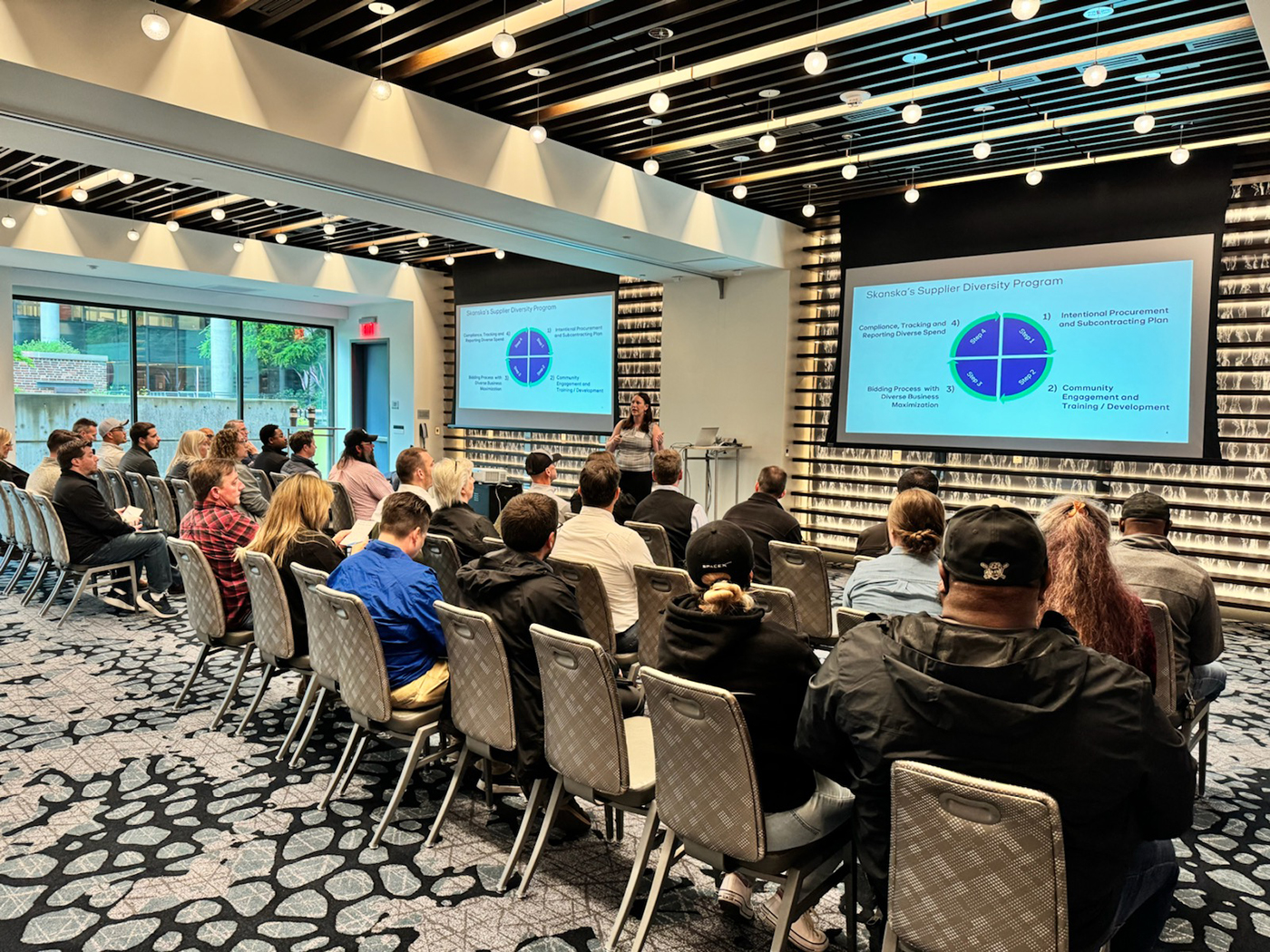
While many construction projects come with external diversity requirements, such as goals set from clients or public agencies, Skanska takes a proactive approach by assessing opportunities to maximize diverse spend on all projects. This tactic pushes project teams to consider diverse suppliers at every stage of the process, from project setup expenses, to construction supplies, to prime and multi-tier trade partner procurement, and ensures that diversity is consistently reflected in the company’s operations.
Outside of construction expenses, Skanska considers its internal needs for diverse spend opportunities as well — from buying office swag, to catering business meetings, to supporting its leadership with mental health trainings. Any financial investment made is another opening to buy diverse and local.
INVEST IN LONG-TERM RELATIONSHIPS
Supplier diversity programs thrive when companies move beyond transactional relationships and invest in the long-term success of diverse trade partners. Skanska exemplifies this by not only inviting diverse firms to bid on projects, but also offering the mentorship, training and networking to support their growth.
For example, Skanska’s Construction Management Building Blocks (CMBB) program connects diverse firms with Skanska professionals from various sides of the business — such as safety, preconstruction, and project management — helping them learn how to work with a large contractor like Skanska, while also building relationships and breaking down barriers.
The program has helped over 800 businesses secure more than $740 million in contracts since its inception in 2007.
The mutually beneficial nature of programs like CMBB should not be overlooked, providing great opportunities for suppliers and contractors alike. Working with entrepreneurial business owners brings fresh innovation and adaptability. Many small, diverse businesses excel at leveraging technology, using cutting-edge AI tools to respond to RFPs, summarize meetings and develop marketing strategies. Their ability to innovate with limited resources in a rapidly changing environment is truly impressive.
USE DATA TO DRIVE DECISION-MAKING
A data-driven approach is critical to the success of a supplier diversity program, as it helps track the internal and external impact, while also driving long-term improvement.
In this past six years, Skanska’s Seattle office has invested almost $420 million in efforts to increase diversity.
To provide a holistic picture of this investment, Skanska prioritizes regular audits of its vendor list, while analyzing the behaviors of its office and suppliers. Skanska evaluates factors including contract values, project performance and supplier engagement. This data-driven approach provides a clear understanding of which suppliers are overutilized and underutilized while also pinpointing gaps in the supply chain.
A key insight gained through this data-driven approach is the importance of balancing supplier workloads. Over-reliance on businesses can lead to overextension, potentially lowering performance on projects. Meanwhile, the data highlights diverse suppliers that may only have been engaged once but have demonstrated strong performance. These findings provide roadmaps to nurturing and expanding relationships with businesses, ensuring all suppliers the opportunity to grow.
This data has been critical to reforming Skanska’s supplier diversity program. In the Seattle office, from 2022 through 2023, we increased the number of diverse firms by 25% and boosted diverse spending by 72% since 2018.
ENGAGE WITH THE COMMUNITY
Building a diverse supply chain requires more than identifying diverse suppliers — it involves active engagement with local communities, industry networks and business associations. Through this collaboration, contractors can create a pipeline of businesses equipped with the resources and connections necessary to succeed in larger projects.
Skanska hosts events to connect with diverse suppliers, including industry forums, vendor spotlights, meet-and-greets, open houses and matchmaking events. These events allow suppliers to introduce themselves and showcase their capabilities to key Skanska decision-makers, while also providing diverse firms to make impactful connections between firms.
One matchmaking event brought together small subcontractors with prime trade partners, focusing on mechanical, electrical, plumbing, and demolition sectors — areas where smaller businesses struggle to compete for larger contracts. This successfully led to an immediate contract for a mechanical subcontractor and a minority plumbing supplier at Montlake Elementary school.
Furthermore, many smaller, diverse businesses are dedicated to giving back and advocating for their communities, underscoring yet another key benefit. Marcus Cola, owner of Apex Electrical Group, serves on the board of Q Missions, a nonprofit helping veterans with PTSD through missions to build homes in Mexico. Darci Henderson, owner of Alltrus, serves on the board of Tabor 100, a nonprofit supporting Black entrepreneurs with technical assistance, training, and scholarships.
Investing in these businesses means investing in the communities and the causes they support.
BUILD A CULTURE OF DIVERSITY AND INCLUSION
A supplier diversity program cannot succeed in isolation — it must be part of a broader company-wide commitment to diversity and inclusion. Embedding supplier diversity into the company’s culture ensures that it is not just a compliance checkbox but a core value that influences decision-making at every level.
Creating a culture of diversity involves educating staff, encouraging diverse perspectives in problem-solving and ensuring that supplier diversity goals are integrated into the overall business strategy. By fostering a culture that values inclusion, contractors can drive more innovative project outcomes, create stronger community relationships, and build a more resilient supply chain.
Supplier diversity is no longer just about compliance; it is a strategy that drives innovation, strengthens communities and builds a more resilient supply chain.
Courtney Fraga is supplier diversity manager for Skanska USA Building, working side by side with operations to implement best practices and procedures to maximize opportunity for diversely owned subcontractors and suppliers on Skanska’s construction projects.
Other Stories:


