 |
Subscribe / Renew |
 |
Contact Us |
| ► Subscribe to our Free Weekly Newsletter | |

Construction Bids
| home | Welcome, sign in or click here to subscribe. | login |


 print print  email to a friend email to a friend  reprints add to mydjc reprints add to mydjc |  |
 |
November 21, 2024

Abbott
|

Henry
|
Designing with the climate in mind can be a technical and financial challenge for any project typology, let alone an affordable housing project. How can projects such as these measure carbon impact within a limited budget? Are there cost effective and time efficient tools to mitigate carbon impacts?
Zooming in on the process of designing for sustainability reveals the complexity. Options become more layered and nuanced. To create more transparency and ease in this effort, Climate Positive Design —with grant support from the Landscape Architecture Foundation— launched a tool called Pathfinder in 2020. Pathfinder is a free, web-based app that provides project-specific guidance on reducing carbon footprints while increasing carbon sequestration.
The Climate Positive Design Challenge, designed by Pamela Conrad from CMG Landscape Architecture, is on par with the Paris Agreement, and sets targets for how many years project types should strive to be climate positive; five years for parks and gardens, 20 years for plazas and streetscapes, and 25 years for infrastructure projects, for example.
Berger Partnership is an early adopter of the program ( one of the seven biggest users in the first six months after launch) and has since leveraged our experience with the tool to apply it nimbly to more projects.
Today, designing for a climate positive outcome doesn’t require a separate phase of work, but instead a few days of analysis and subsequent evaluation with the client. Serving as the landscape architect for the Everett Housing Authority’s (EHA) Park District development offered us the opportunity to test Pathfinder on an affordable housing project. EHA’s willingness to embrace carbon positive site work is worth highlighting, because it shows the tool is efficient enough, and powerful enough, to both make a difference and be logistically viable for the project.
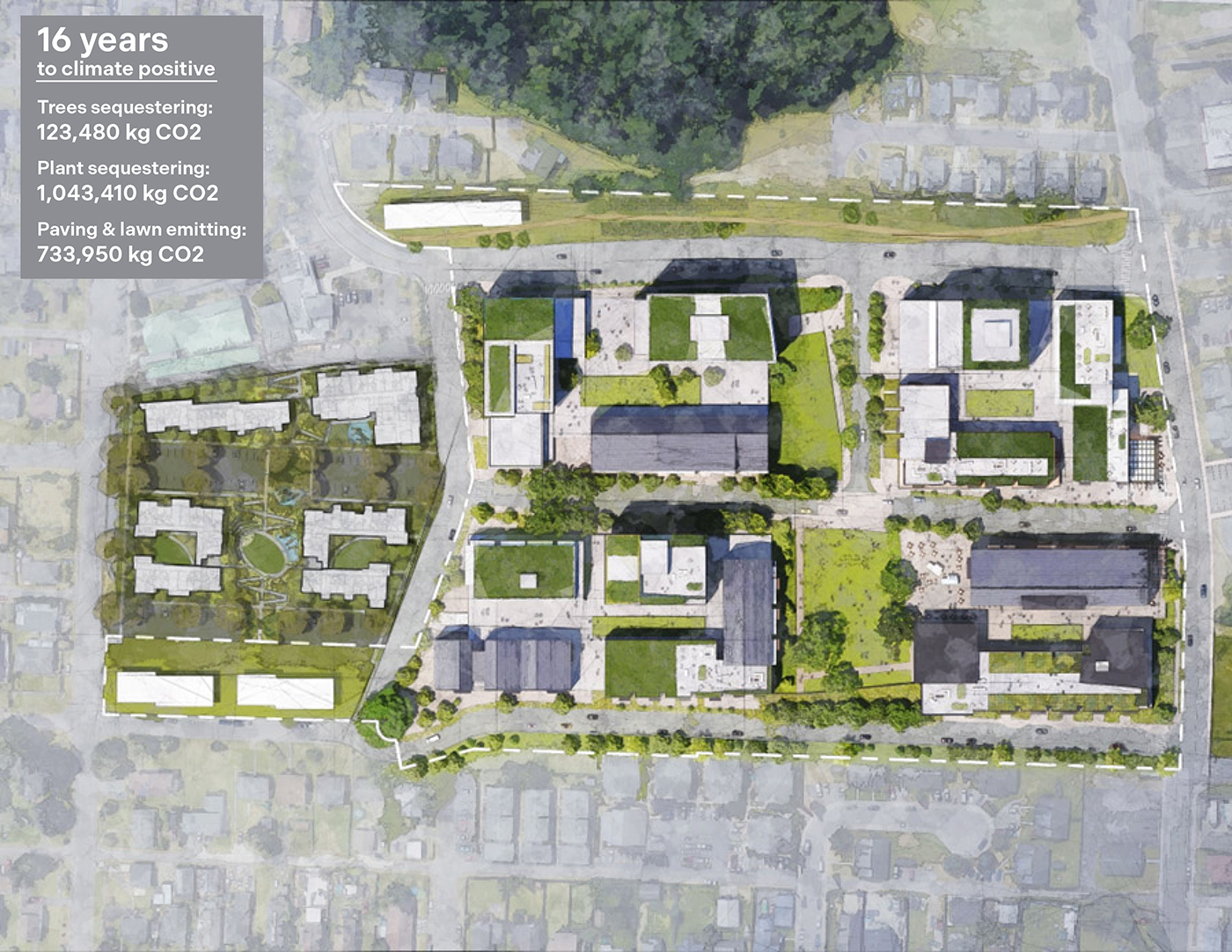
The Park District development, located in the Delta Neighborhood of Everett, will become a mixed-use and mixed-income community with 1,500 homes, 1.5 acres of park space and a mix of retail and civic programs. Previously known as Baker Heights, the 16-acre site has been vacant since 2019, and is now poised to become a mixed-use and mixed-income community with 20,200 square feet of retail/restaurant, 24,000 square feet of office, 26,400 square feet of non-profit space in addition to housing.
The housing authority is working towards a phased, 10-year design and construction process. Our team, brought on for the first Planned Development Overlay (PDO) Phase, has continued work on the Phase 2 for design and construction of the southeast block including the largest park space.
Using the Pathfinder tool, our team plugged in the specifics of the project to receive instant carbon feedback on a “Climate Positive Scorecard,” offering detailed statistics and a projection of how many years it would take for the project, as currently designed, to become climate positive, where carbon sequestration starts to outpace carbon emissions from building the project. After this point, the landscape sequestering elements - plants and trees in particular - render the project a net benefit to the carbon crisis. This feedback truly drove the design direction to improve carbon sequestration and reduce emissions.
In earlier discussions, the design team developed three options with input from EHA; options varied with more or less green space, a different number of trees of different tree sizes, and so on. EHA was leaning toward a preferred option with more park space, and when the Pathfinder analysis showed that the preferred option was indeed the most climate positive, it solidified a decision to move forward with that concept.
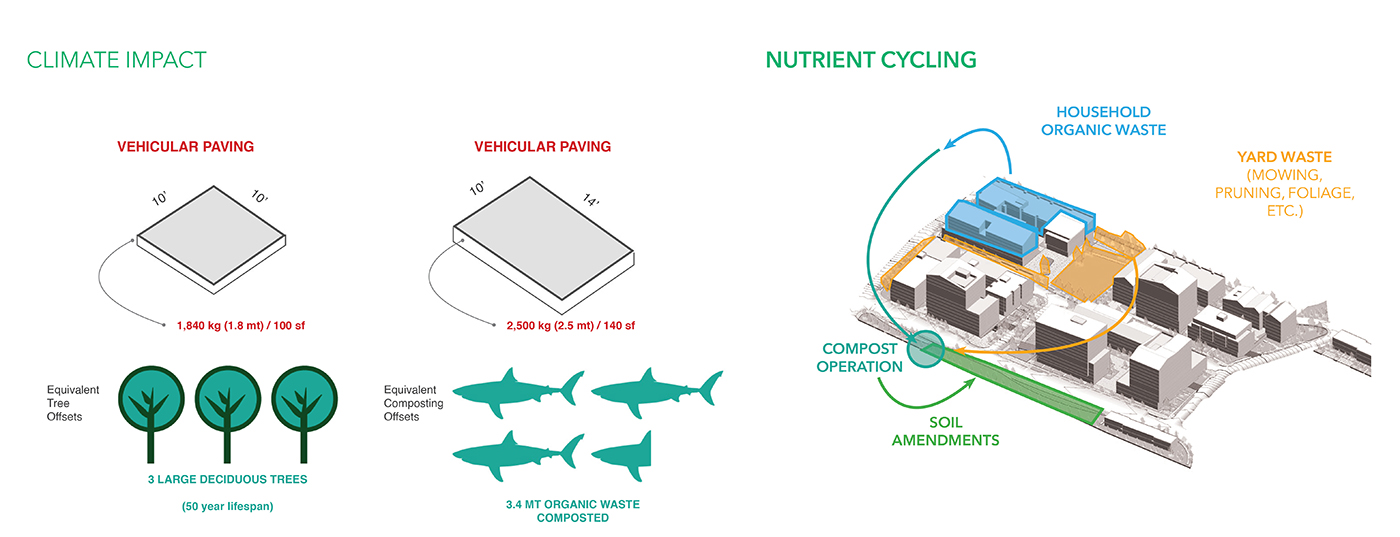
Using a first set of assumptions, Pathfinder determined the site would take 64 years to become climate positive, which is three times as long as the 20-year target for mixed-use development that the Climate Positive Design Challenge sets out. We began to investigate the full spectrum of what Pathfinder offers and to collaboratively assess the biggest contributors to carbon emissions in the design: concrete, especially vehicular, but also, somewhat surprisingly, maintained lawn. On the other hand, we looked at some of the hardest-working offset options: large leafy trees, large shrubs, and so on.
We achieved a significant reduction in carbon emissions by increasing deciduous trees by 20%, reducing vehicular concrete by 60%, and replacing half of a moderately maintained lawn with plantings and shrubbery. Also significant, this design option included taller buildings with smaller footprints to accommodate more green space.
These measures vary in their effort and impact; reducing the building footprint was a bigger effort, but replacing half the lawn with plantings was a minor effort with a big effect. Ultimately, the changes shaved 48 years off the timeline for Park District to become Climate Positive, now only taking 16 years, a commendable four years below the target set by the Climate Positive Design Challenge.
Moving toward carbon positive is imperative to slow the warming of our atmosphere, and the latest climate science underscores the urgency of building projects of all types to address carbon emissions.
Within landscape architecture, the Pathfinder tool offers emissions data with minimum effort and cost, allowing designers to make technically informed site design decisions that move the needle toward carbon sequestration and reduction. This reduction is critical to protect essential resources and people in the future.
Christine Abbott is project manager at Berger Partnership with a focus on sustainable site design. Jason Henry is a partner at Berger Partnership and leads the firm’s climate positive design efforts.
Other Stories:


