 |
Subscribe / Renew |
 |
Contact Us |
| ► Subscribe to our Free Weekly Newsletter | |

Construction Bids
| home | Welcome, sign in or click here to subscribe. | login |


 print print  email to a friend email to a friend  reprints add to mydjc reprints add to mydjc |  |

March 6, 2003

Photos courtesy of Six Flags A new roller coaster at Wild Waves/Enchanted Village in Federal Way will resemble this Six Flags ride in Maryland. |
Even though the completion date is months ahead, a new roller coaster being constructed at Wild Waves/Enchanted Village in Federal Way already has fans chatting it up and posting construction pictures on the Web. And that's good news for park owner Six Flags, which is banking on attracting coaster fans from around the world.
The roller coaster, called "TimberHawk," is modeled after one called "Roar" at Maryland's Six Flags amusement park. Both are wooden structures.
When completed, TimberHawk will stand 75 feet tall and reach speeds of more than 50 miles an hour on 2,635 feet of track. Riders in 24-passenger trains will get thrills from 20 crossovers, 12 drops, six reversals and a 60 degree high-speed turn.
TimberHawk will be the first wooden roller coaster built in Washington in 68 years -- and the largest. The only other wooden roller coaster in the state, operating at the Western Washington fairgrounds in Puyallup, is 65 feet tall and was built in 1935. Seattle's Luna Park boasted a popular wooden roller coaster called "Figure Eight" during the park's short life from 1906-1913 and North Seattle's Playland operated a wooden roller coaster called "Dipper" from 1930-1961.
Oklahoma-based Six Flags filed its land use permit for its new coaster last May. The buzz about the attraction started immediately. In July, a coaster fan's Web site posted an item about a visitor spotting a marking stake at the park with the words "coaster limits" written on it.
Construction started earlier this year and is projected to be complete by June. Drivers on Enchanted Parkway South are already getting a glimpse of the timbers rising above the east side of Enchanted Village in the new "Old West" section of the park.
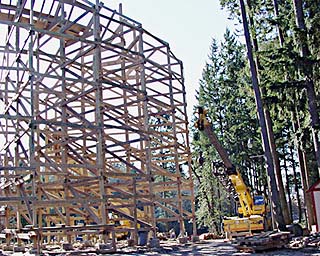
Timbers for the wooden coaster are quickly rising among the trees in Federal Way. |
The new coaster will be built from 514,000 board feet of treated southern yellow pine. More than 500,000 nails, screws, nuts and washers will hold it together as it sits atop 1,265 concrete pedestals.
TimberHawk's general contractor is S&S Power of Logan, Utah, and its subcontractor is Rocky Mountain Construction of Aspen, Colo. ESM Engineering of Federal Way assisted the park with planning and zoning requirements. Another Federal Way firm, Lloyd Enterprises, helped with site preparation and clearing. Other local companies will be brought on board throughout the construction process.
S&S has built thrill rides in 24 countries and recently acquired Arrow Dynamics, a roller coaster manufacturer that went bankrupt last year. With the acquisition, S&S started a new division to build wooden roller coasters. TimberHawk is the company's first wooden coaster.
Designing roller coasters is a collaboration between park owners and builders. The two main factors governing the design are how much the park is willing to spend and how much real estate is available for the ride. Enchanted Village has plenty of both for the new attraction, although Six Flags has not revealed the roller coaster's price.
The first steps of coaster development involve drafting a preliminary layout and style. Next, plans are drawn for the track, support structure, lift, station, transfer track, brakes, vehicles and control systems.
Roller coasters are designed using the law of conservation of energy and Newton's second law of physics. The laws govern energy of motion, kinetic energy, net force and acceleration. The height of the ride dictates the calculations of force, which dictates the design of the train, track and support system.
In the design process, computer programs calculate train speed and G-force, spreadsheets are used to design the track layout and a three-dimensional structural analysis program is used to design the support structure. Final drawings are generated using a program like AutoCAD.
Previous columns:


