 |
Subscribe / Renew |
 |
Contact Us |
| ► Subscribe to our Free Weekly Newsletter | |

Construction Bids
| home | Welcome, sign in or click here to subscribe. | login |


 print print  email to a friend email to a friend  reprints add to mydjc reprints add to mydjc |  |

May 15, 2003
Photos by Dick Milligan
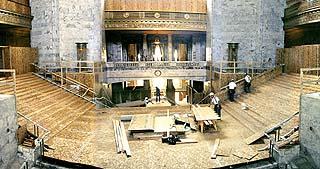
The Capitol's historic marble surfaces and state seal are being protected with chipboard sheets during reconstruction. After the job, the sheets will be donated to Habitat for Humanity.
|
This was never going to be a job for the faint hearted.
The 75-year-old Legislative Building is the state's most revered monument, and is listed on the National Register of Historic Places. The building's owners number 6 million, while its 455 tenants govern the state. By 2001, a long-planned, multi-year infrastructure and seismic upgrade program embodied considerable complexity. Add a magnitude-6.8 earthquake and "rehabilitation" took on a whole new character.
M.A. Mortenson won the bid to act as general contractor/construction manager for the $101 million upgrade program. On the morning of Feb. 28, 2001, Mortenson representatives signed contracts that included correcting problems resulting from corroded water and sewer pipes, undersized heating and air conditioning systems, inadequate telecommunication and electrical systems, and water infiltration from failed caulking and drains.
Virtually minutes later, the Nisqually earthquake struck.
"In the morning Mortenson had signed on to do pre-construction investigations and planning," said Patricia McLain, project manager of the rehabilitation effort for the state Department of General Administration. "By late afternoon they were into full construction mode. We were all impressed with how quickly they responded."
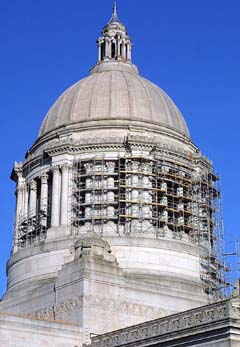
Extensive scaffolding is being used for exterior repair work.
|
After initial earthquake repairs, the occupants agreed to vacate for a 28-month period. Thus began the confluence of programmed upgrades and Mother Nature.
Marvin Doster, senior project manager for Mortenson, assumed operational ownership of the emptied building on June 3, 2002. "The earthquake helped us decide what to do first," he said. "We began by concentrating on tying the top of the dome to each element all the way down."
But first they had to ready the building. In preparation for the dome and interior work, Mortenson's workers erected scaffolding outside the dome, and covered the main stairs, public hallways, and much of the remaining interior in thousands of feet of chipboard to protect the beautiful marble, carpets and decorative pieces that could not be moved. When the project is over, Mortenson will donate the particleboard to Habitat for Humanity.
The earthquake knocked several of the dozen freestanding stone columns that surround the base of the dome as much as 6 inches off kilter. To strengthen these pillars and anchor them to their base, Doster's team drilled holes through the 46 feet of stone, fitted each hole with a metal shaft, anchored that to the tabletop, and filled the shaft with grout to strengthen resilience to sway. Workers also hand carried thousands of pounds of rebar up a narrow staircase where they used it to join the outside walls of the dome to the inside.
Following the 1949 quake, engineers designed a metal form and covered it with stones to replace the original masonry lantern at the top. Some of the original stones cracked in the 2001 earthquake.
Master carver Keith Phillips of Tenino carved replacement stone from the Wilkeson quarry. He also carved new decorative stone to replace those that had broken or lost definition. A ground-based crane operator deftly placed the largest stones on the dome, aided by nimble workers perched on the scaffolding.
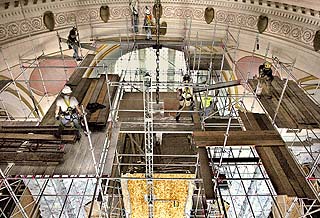
Scaffolding inside the dome reached 163 feet. Workers are shown removing scaffolding last month from the seventh floor.
|
The first phase of the rehab work -- stabilizing and repairing the dome and lantern -- has now ended. Doster evinces high regard for the original architects, builders and engineers, as well as those who intervened after the 1949 and 1965 earthquakes.
"Each effort taken has extended the life of this building," Doster said. "My duty is to ensure that we earn the respect of future construction managers for having done the right thing this time."
The architects are of the same mind. NBBJ of Seattle is the primary architectural and design firm. Because of the age of the building, and the priority given to preservation, the firm called on the expertise of one of the nation's preeminent historic preservation architecture firms, Einhorn, Yaffee, Prescott of Albany, N.Y. Together they pored over old blueprints, created new ones, and are diligently assuring all work meets state and national guidelines for historic structures.
The building's interior walls are primarily composed of terra cotta bricks, which were then plastered over and painted or affixed with marble. The marble was applied to the walls with a series of copper wires and a plaster containing horsehair. The construction has proved remarkably robust, but some damage has occurred as a result of the earthquakes and general wear.
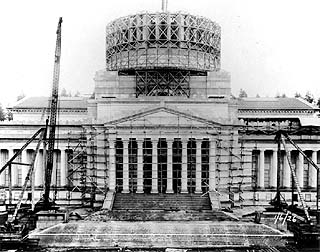
Photo courtesy of Washington State Archives
The original dome was built in 1926 by contractor Pratt-Watson.
|
Repairing delaminated plaster, funded in part by the Federal Emergency Management Agency, was added to the scope following the earthquake. In some areas, the bricks themselves have broken and will be repaired, but overall the terra cotta brick construction remains intact and strong -- a push test on an inside wall demonstrated the inherent strength of the building.
Over the next 18 months, contractors will upgrade electrical, mechanical and plumbing systems, repair delaminated plaster, and remodel the public spaces. By November 2004, the tenants are due to return.
Ruth Anderson is a freelance writer working for the state Department of General Administration. She is a retired Air Force colonel and has authored/coauthored five books on historical topics.
Previous columns:


