 |
Subscribe / Renew |
 |
Contact Us |
| ► Subscribe to our Free Weekly Newsletter | |

Construction Bids
| home | Welcome, sign in or click here to subscribe. | login |


 print print  email to a friend email to a friend  reprints add to mydjc reprints add to mydjc |  |
May 21, 2001
|
Driving along 23rd Avenue South through the South Jackson Street intersection in the Central Area, one sees signs of burgeoning prosperity in a neighborhood that has suffered from years of redlining, racial tension and economic depression.
On one corner, signs announce

|
Scratch the surface, though, and signs of distress are still evident: ragged storefronts, vacant lots and ramshackle apartments.
Investors and homeseekers are flocking to the neighborhood, which lies between 12th Avenue and Martin Luther King Jr. Way, south of Madison Street and north Interstate 90. Just a stone's throw from downtown, the Central Area boasts a convenient location and land values that have lagged behind Seattle's other close-in neighborhoods.
"The cat's out of the bag," said developer Kent Angier. "(The Central Area has) been depressed, so upside opportunities are definitely there."

|
Angier is president of Kauri Investments, which in January completed the 57-unit Main Street Condoniums at 23rd and Main. The project represents the first major residential development to be built in the area in the last 30 years. More than half of the market-rate units are sold, and Kauri expects to close a deal soon for one of its two commercial spaces.
| Central Area Projects |
|
Yesler houses: Covenant Housing is rehabilitating three circa-1900 houses to provide nine condominiums. To be completed this year.
John C. Cannon Retirement and Assisted Living Residence: 120 residential units developed by Global Health Management L.L.C. and Columbia Pacific Management for 13.5 million. To be completed this year. Main Street Condominiums: 57 residential units and retail space developed by Kauri Investments and the Central Area Development Association for $7 million. Completed January 2001. Main Street Place: 25 residential units and retail space developed by Judd Todd. To be completed this year. Welch Plaza: Three buildings developed by Lorig and Associates and the Central Area Development Association for $27 million containing 102 residential units, 60,000 square feet of office space and 14,000 square feet of retail space. To be completed in 2002. Wonder Bread factory site: Proposed development area. Jackson Place Cohousing: 27 multifamily units to be completed this year. Arts & Lofts: Two-phase, $32 million project developed by Arts & Lofts L.L.C., led by Kurt Feichtmeir, includes 145 condominiums and 15,000 square feet of commercial and retail space. To be completed in 2002. |
Kauri also wants to develop the 2 1/2-block Wonder Bread factory site that sits several blocks away. The project would bring a mix of residential, office and retail space to the area.
"From an access standpoint (the Central Area is) as good as it gets, just minutes from I-5, I-90 and downtown," Angier said. The views from the neighborhood, he adds, are extraordinary. Indeed, from the upper floors of Kauri's Main Street Condominiums, one can see Elliott Bay, the downtown skyline and the Olympics.
Residential and office projects are popping up like springtime dandelions, promising to introduce more residents and office workers clamoring for more restaurants, shops and services in an area that has seen little of such demand for decades.
Mike Scott of Dupre + Scott said apartment rents in the Central Area have been below the King County average, but in the past few years they have shot up and are now above average.
The renewal of interest in the Central Area didn't come all at once.
George Staggers, CEO of the Central Area Development Association, has been working to revitalize the neighborhood since the nonprofit organization was formed by the Central Area Action Plan in 1993.
Against the backdrop of exclusionary housing convenents enacted throughout Seattle in the late 1940s and 1950s that effectively coralled blacks into the neighborhood, the Central Area suffered a series of blows over the years that hammered away at its economic base, Staggers said. Civil unrest, failed urban renewal projects, the proposed R. H. Thomson Expressway, and regional economic ruts contributed to the neighborhood's high crime, declining business and dwindling housing stock.

|

|
"Toward the late '70s, things were starting to turn around slowly," Staggers said. That was when the Promenade 23 shopping center was built on the southeast corner of 23rd and Jackson. Businesses feared the location, however, and customers never materialized. A string of grocery stores anchored the center, but the development remained on shaky ground for years.
CADA's formation has proved a turning point for the neighborhood.
CADA was instrumental in a renovation and expansion of Promenade 23 to the north side of Jackson Street in the mid-'90s. The development landed national retailers such as Walgreen drug store, Hollywood Video and Starbucks as well as smaller franchised chains such as Magic Dragon Chinese Eatery and Papa Murphy's Pizza. Safeco also has a large presence at the center.
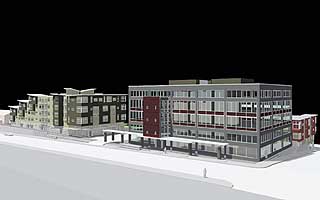
The biggest new project planned for the area is the $27 million, 216,000-square-foot Welch Plaza on the southwest corner of 23rd and Jackson.
The three-building project would sit on an L-shaped site, with a five-story office building fronting on 23rd. To its west, will be a four-story, mixed-use building with 30 residential units and 4,000 square feet of retail, and on the south, a five-story, 72-unit apartment building with 2,800 square feet of retail. Together, the buildings will hold 102 residential units, 14,000 square feet of retail and 60,000 square feet of office space.
Much of the project is designed for the site of the former Welch Hardware store. Originally, CADA had planned to develop only the city-owned lot south of the store, on 23rd, and sought out Lorig and Associates as consultants for the project.
The city's site -- now a fenced-off vacant lot -- didn't hold much potential on its own. Lorig advised CADA in 1997 to acquire the Welch site in order to bring the corner of 23rd and Jackson into the project, and give the neighborhood a focal point in the process. Lorig eventually signed on to develop the project.
Welch Plaza "is not a conventional site," said partner Bruce Lorig, "so everyone is apprehensive."
Construction costs are the same regardless of land prices, Lorig said, so to make the project more cost effective, CADA is assisting by building a 185-stall underground parking garage that will serve the three buildings.
Lorig has other doubts about the project, such as whether there's too much office space. "Would we be better off with 40,000 (square feet)? I don't know."
But the firm seems to have been long attracted to projects that carry an element of risk. When asked if he's concerned about being a sacrificial lamb, Lorig responded, "You're always worried that!"
The neighborhood has been supportive of the project, said Lorig, who's been careful to listen to neighbors, reshaping the project with Hewitt to fit the neighborhood's needs. Lorig also credits CADA for making sure the project "fits in with what the community wants."
Another big project on the horizon is development of the Wonder Bread site several blocks west on Jackson.
|
The 85-year-old factory, with its large neon sign, is a landmark overlooking the north end of the Rainier Valley. Its owner, Kansas City-based Interstate Bakeries Co., ceased operations there last year.
Four developers -- Kauri Investments, Fortune Group, Teutsch Partners and Lowe Enterprises -- are seeking to develop the two-square-block site and an additional undeveloped half-block lot with a mix of office, residential, retail and art space. The city acquired an interest in the half-block of undeveloped property in the mid-'70s through a federal urban renewal grant, but the land has sat idle.
CADA plans to develop 30,000 square feet of affordable rental housing on the half-block site, in addition to about 3,500 square feet of ground floor retail. The project is expected to cost $7 million.
A possible partner with any of the four developers is the Pratt Fine Arts Center, which is looking to move from its city-owned home at 19th Avenue South and South Main Street. Pratt wants upwards of 70,000 square feet in the new development for studio and classroom space as well as retail and a gallery, and possibly residential space.
Interstate Bakeries Co. is expected to pick a developer soon. Mick Flemming, an IBC representive in Seattle, estimates the land and factory will sell for $5 million to $6 million. The factory would likely be demolished, though the Fortune Group's plan, according to Staggers, includes renovation of the building.
At CADA's eight-year mark, Staggers sees his work cut for him. "We're doing OK," he said. "It hasn't been easy. Going forward, it's going to become more difficult." With construction and land costs rising, he says, CADA will require more funding to complete projects.
The development comes at a cost. "Because there's been so much gentrification," Staggers said, "it's been a problem getting the community to identify itself."
Mark Hinshaw, a principal at LMN Architects, suggests CADA could help the neighborhood build an identity by pushing for a stronger community focal point. A pedestrian-oriented village square lined with retail shops could make the area friendlier to passersby. The square, he says, could be used for community events and festivals.
Hinshaw emphasized that "it doesn't work when just one party tries to do it; it takes a half-dozen or eight" groups to nurture neighborhood development over time.
The area, he said, "needs a lot more development, but it's coming along."
CADA is getting there, Staggers says. The critical elements for the shaping the community are in place, including the interest of developers. "We're doing things to let people know we're coming back," he says.
It seems the cat is already out of the bag.
Jon Silver can be
reached by email or by phone
at (206) 622-8272.
Related Stories:
Previous columns:


