 |
Subscribe / Renew |
 |
Contact Us |
| ► Subscribe to our Free Weekly Newsletter | |

Construction Bids
| home | Welcome, sign in or click here to subscribe. | login |


 print print  email to a friend email to a friend  reprints add to mydjc reprints add to mydjc |  |

February 8, 2001
While not exactly an erector set for stormwater runoff, the various solutions offered by Portland-based Stormwater Management Inc. do offer a similar type of flexibility.
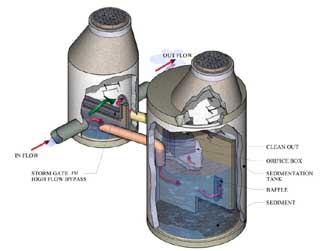
Graphic courtesy of Stormwater Management |
Their products -- the firm's flagship StormFilter filtration device, a special catch basin that can accommodate the StormFilter, the StormGate high-flow bypass manhole and the recently introduced StormGate Separator, an offline sedimentation chamber -- can be used independently or in concert. To target specific pollutants, the type and size of filter media used in the StormFilter can be customized.
Last summer, the firm introduced an iron-based filter media that removes phosphorous from stormwater flows. Currently, the firm is studying a new configuration of filter media that would target nutrients like algae bloom-causing nitrogen and fecal coliform, an application with blockbuster potential in this age of perennially closed beaches and ponds.
"The real advantage," says David Pollock, Stormwater Management's president and CEO, "is the ability to change filtration media based on the pollutant you are trying to capture."
Overall, he says, "It is a system, and what we want to provide to our customer base is an expertise."
Stormwater Management has developed its expertise by deploying its products in some of the more difficult regulatory environments in the country, including the Puget Sound region and Montgomery County, Md., outside of Washington, D.C.
Says Pollock, "Montgomery County recognizes that there is not one solution, not one size fits all." Thus, the variety of approaches available from Stormwater Management can be tailored site-by-site.
For landowners, especially in areas with high land costs, the StormFilter presents an opportunity to maximize site usage because it is installed underground and can be placed under a grate in a parking lot.
Stormwater Management has had a lot of success in utilizing the StormFilter in pad site development for McDonald's and Union 76 gas stations where space is at a premium. Also, Costco, which parks its sites at a high ratio, has used the StormFilter to minimize parking loss due to stormwater requirements.
Stormwater Management Vice President James Lenhart says that, once installed, keeping stormwater treatment facilities in working order is also becoming more of a concern.
"If stormwater devices are not maintained," Lenhart says, "they don't work, even ponds and swales." He says that some jurisdictions are requiring maintenance contracts for the stormwater facilities in new developments. Inspections ensure maintenance compliance.
Maintenance of a typical StormFilter installation takes just 2.5 hours.
Lenhart emphasizes that if a "StormFilter is used instead of a sand filter, it's half the footprint and less costly and easier to maintain." In cases of heavy sediment loads, the StormGate Separator can be used in-line prior to the StormFilter to extend filter life.
But Lenhart, a professional engineer, is a true believer in the product, having come up with the idea a decade ago. For a while the company existed only "as a file folder" in his desk. But in 1995, he got the privately-held company off the ground and in 1996 the StormFilter was introduced.
Pollock joined the company 2.5 years ago. He has more than a decade of experience in international business, including a long tenure with the materials handling company Hyster/NMHG Europe. Since coming on board, he has presided over what he terms "an aggressive rollout of market awareness and market coverage."
The firm now has eight regional offices around the country, hiring 18 new people out of a total staff of 40 in the past year.
Though, as Lenhart says, the Endangered Species Act and the Clean Water Act are "national policies that will really help drive our business," the firm is pushing forward with new ideas.
In addition to the fecal coliform filter, Stormwater Management is conducting pilot studies with Seattle-based environmental services firm Hart Crowser on removing heavy metals from stormwater at the National Shipyard in San Diego.
The study could have implications for the Northwest's port facilities, says Lenhart, as "port facilities are all impervious surface and discharge directly into Puget Sound."
Stormwater Management is also doing some exploratory work with the Washington State Department of Transportation on longterm stormwater best management practices for highway projects. Lenhart thinks that because of the space constraints of highway right-of-ways, his company's approaches could be effectively applied.
As concerns about water quality increase, be it for salmon or swimming, Stormwater Management should see business continue to grow.
Summarizes Pollock, "The more we sell, the more water we clean up... 100 percent of what we do is helping the environment."
The company's Web site is located at www.stormwatermgt.com.
Previous columns:


