 |
Subscribe / Renew |
 |
Contact Us |
| ► Subscribe to our Free Weekly Newsletter | |

Construction Bids
| home | Welcome, sign in or click here to subscribe. | login |


 print print  email to a friend email to a friend  reprints add to mydjc reprints add to mydjc |  |
 |
February 10, 2025
Magnusson Klemencic Associates
Seattle Aquarium’s Ocean Pavilion
LMN Architects
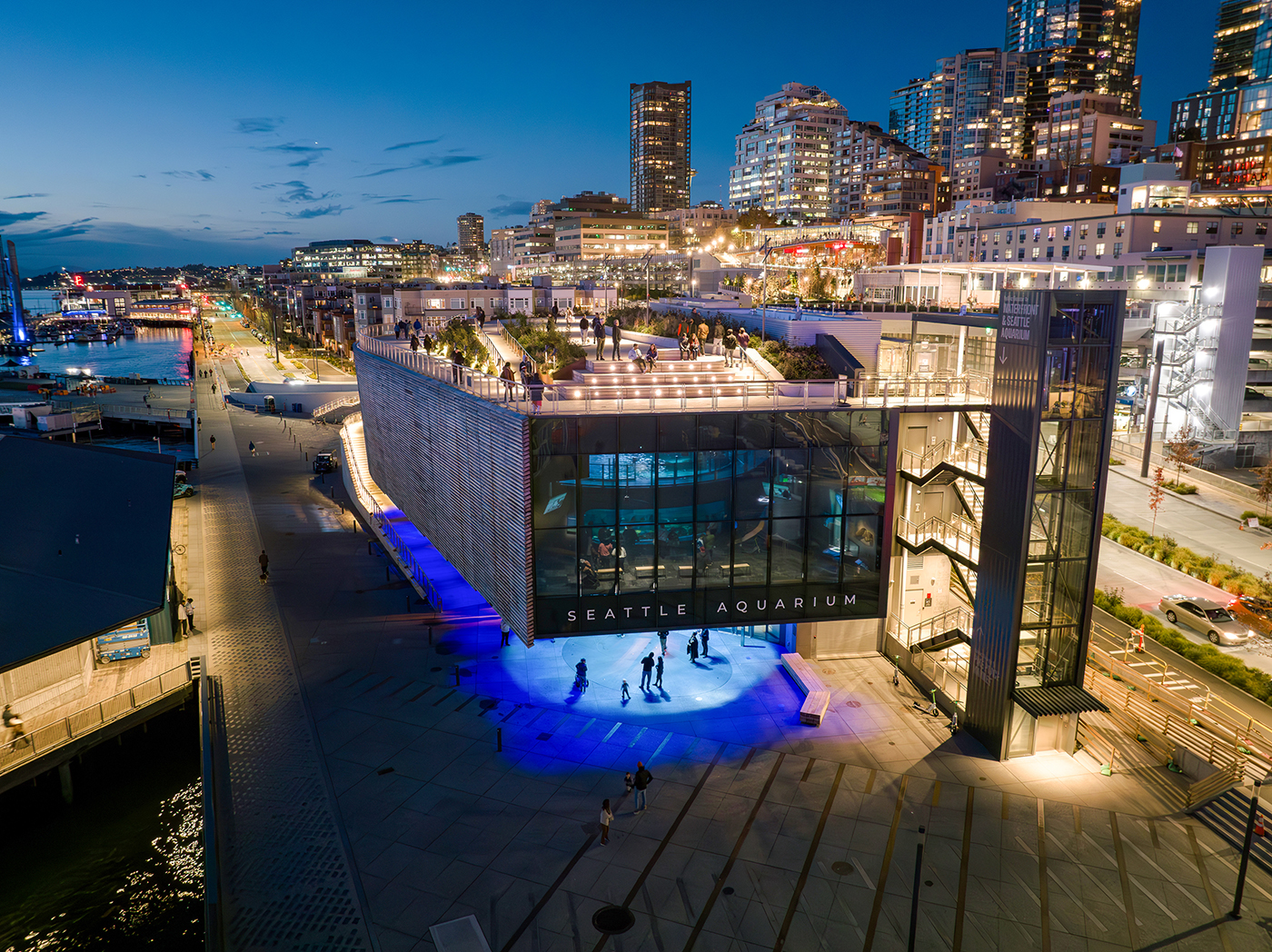
The Seattle Aquarium’s Ocean Pavilion has set a new benchmark in aquarium design with its innovative approach to architecture and engineering. At the heart of this groundbreaking project is the “Supertank,” a free-form concrete marvel that holds over four million pounds (500,000 gallons) of water. Not only is it an aquatic habitat, but it also plays a crucial role in the pavilion’s structural integrity, visitor experience and environmental resilience.
This multi-purpose design supports public viewing areas, animal care labs, and even seismic and windstorm resistance. The tank, which is integrated into the fabric of the building, addresses the site’s challenging conditions, including soft, liquefiable soil, and creates an accessible link between Pike Place Market and the Seattle waterfront. The Ocean Pavilion is not just a tank housed within a structure — it is the structure itself.
A collaboration between Magnusson Klemencic Associates (MKA) and LMN Architects brought this vision to life, featuring a cantilevered design where the Supertank extends 50 feet, becoming a key structural element that supports over 2,000 tons of weight. The tank’s south-facing side, spanning over 100 feet, uses its own weight to provide stability and balance, making it a feat of engineering. The complex geometry of the Supertank was meticulously crafted to suit the needs of various marine species, with hideaways and ample swimming space.
The construction of this free-form structure was an extraordinary challenge. The constantly changing curvature required more than three times the typical amount of rebar used in earthquake-resistant high-rise buildings in Seattle. To meet these demands, cutting-edge 3D modeling, data-driven formwork, a specialized concrete mix and a continuous 23-hour concrete pour were employed to ensure precision and durability.
Other Stories:


