 |
Subscribe / Renew |
 |
Contact Us |
| ► Subscribe to our Free Weekly Newsletter | |

Construction Bids
| home | Welcome, sign in or click here to subscribe. | login |


 print print  email to a friend email to a friend  reprints add to mydjc reprints add to mydjc |  |
 |
February 9, 2026
HDR
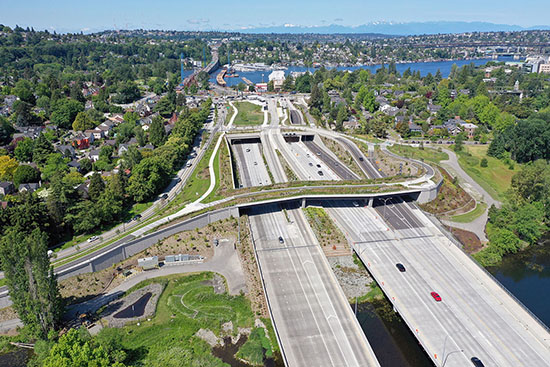
SR 520 Montlake Lid and Bridges
Washington State Department of Transportation
State Route 520 serves as a vital link across Union Bay. The old bridge, built in the 1960s on hollow columns, was vulnerable to earthquakes, divided the Montlake community, and reached capacity during peak periods.
The $487 million SR 520 Montlake Lid and Bridges project replaced the West Approach Bridge South (WABS) and reconnected the Montlake community with a block-long, landscaped lid over the highway, and a land bridge for bicyclists and pedestrians.
It’s the first phase of Washington State Department of Transportation’s “Rest of the West” — the final improvements to the $5.9 billion SR 520 program. Situated atop one of Washington’s most complex interchanges, the highway’s nine travel lanes rank third in the Seattle region for throughput, include multiple turning movements, and converge regional and local bus routes in a constrained footprint.
The project also connects to the floating bridge. The floating bridge’s southern approach structure integrates unique seismic isolation bearings that reduced the number of piers in the water; allowed longer, prestressed girders; and enables the structure to remain in service immediately following a 1,000-year earthquake.
The design integrates high-occupancy vehicle (HOV) lanes, transit stops, and a bike/pedestrian trail network, while setting the stage for future light rail. The three-acre green space reconnects the National Register of Historic Places-listed Montlake Historic District, improves the Washington Park Arboretum, uses sustainable stormwater strategies, and provides breathtaking views of the lake and Cascades.
Decades of public input obtained through a community engagement process, feedback from Native American tribes, and consultation with federal, state and local agencies and stakeholders shaped the design and resulted in significant design changes. Crossing from a highly urban to critically sensitive environment, the project team overcame a COVID shutdown, kept traffic moving, and appeased neighbors to deliver the historic project.
Other Stories:


