 |
Subscribe / Renew |
 |
Contact Us |
| ► Subscribe to our Free Weekly Newsletter | |

Construction Bids
| home | Welcome, sign in or click here to subscribe. | login |


 print print  email to a friend email to a friend  reprints add to mydjc reprints add to mydjc |  |
 |
February 9, 2026
Moffatt & Nichol
CTC Graving Dock Caisson Gate Replacement
Concrete Technology Corporation
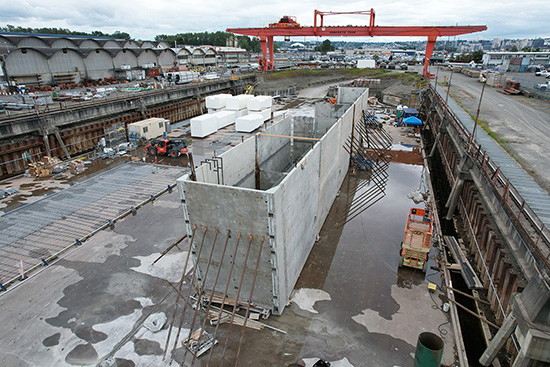
The CTC Graving Dock Caisson Gate Replacement project involved the design and manufacture of a new caisson gate for Concrete Technology Corporation’s (CTC) graving dry dock in Tacoma. Moffatt & Nichol (M&N) served as the project’s structural, stability, and launching design lead.
The caisson gate is a concrete floating structure that acts as a watertight lock at the dry dock’s entrance. It functions by sinking when the dry dock is empty by flooding its compartments with ballasting water and floating when the dry dock is flooded by emptying the water. After more than 100 operations over 45 years, a replacement was needed.
What makes this project noteworthy is the level of technical excellence combined with management of risks to achieve successful delivery of this important facility in the construction and infrastructure supply chain.
Moffatt & Nichol encountered three main challenges during this project:
1. Designing within restricted dimensions and weight limits for the caisson, which was 150 feet long, 16 feet wide, and 25 feet tall, to ensure that the dry dock remained watertight. This meant that the structure needed to be heavy enough to resist hydrostatic pressure, winds, waves, and currents when ballasted, yet light enough to float when de-ballasted.
To overcome this, lightweight concrete was used for the main structural material, allowing for tight dimensional control, ultra-thin walls, and low self-weight. Innovative use of shell-and-plate mechanics principles and precast flat plates for the hull, combined with cast-in-place joints and post-tensioning, simplified construction and reduced manufacturing time.
2. Managing the stability of the floating caisson at various water ballasting levels. To achieve this, the team developed hydrostatic curves to guarantee stability at various ballasting levels.
3. Executing the caisson launch, where there was insufficient under-keel clearance. To overcome this, a neutrally buoyant outrigger system was developed to maintain stability during launch without using ballasting water.
CTC, a PCI-certified precast concrete fabricator, manufactured the new caisson in house using its own dry dock. Construction of precast elements took about four months, and final assembly took approximately five months.
The new caisson is expected to outperform the previous one in service life due to improved design, better concrete admixture technology, and corrosion-resistant steel reinforcement
Other Stories:


