 |
Subscribe / Renew |
 |
Contact Us |
| ► Subscribe to our Free Weekly Newsletter | |

Construction Bids
| home | Welcome, sign in or click here to subscribe. | login |


 print print  email to a friend email to a friend  reprints add to mydjc reprints add to mydjc |  |
 |
February 9, 2026
David Evans and Associates
WSFSEP — Shore-to-Vessel Charging System
Hill International
Washington State Ferries, the largest ferry system in the United States, is undertaking a major transformation to reduce emissions, modernize its fleet, and improve long-term reliability. Through the Washington State Ferries System Electrification Program (WSFSEP), WSF is transitioning its fleet to hybrid-electric propulsion and upgrading terminal infrastructure across Puget Sound to support high-capacity shore charging. This effort represents the largest ferry electrification program of its kind in the nation, setting a new standard for large-scale maritime decarbonization.
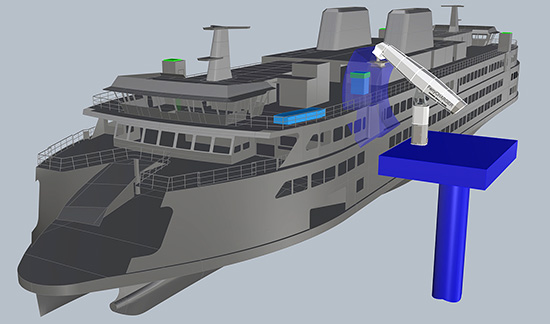
The larger program targets building 16 new hybrid-electric vessels, conversion of six existing vessels, and electrical service upgrades and charging capability at 16 terminals. The Shore-to-Vessel Charging System (SVCS) project represents the first major step in implementation. The goal is to deliver a standardized, medium-voltage charging system that enables interoperability across multiple vessel classes at the first five terminals, allowing rapid, safe, and reliable energy transfer during short docking windows.
No commercially available system is capable of delivering up to 15 megawatts of power under Puget Sound conditions. The project required a new shore-to-vessel charging solution that could perform reliably despite a 19-foot tidal range, short dwell times, vessel movement, and utility grid constraints.
Led by David Evans and Associates, the team guided the project from concept through procurement, developing functional requirements performance-based specifications, system architecture, and technical standards defining how 15 MW of power can be delivered within a 20-minute charging window. The design integrates vessels, terminals, and grid infrastructure into a cohesive system serving two vessel classes at the five terminals. Advanced 3-D motion analysis established operational envelopes for six degrees of vessel movement to achieve 95% connection reliability. Multidisciplinary collaboration among utilities, engineers, and naval architects produced a solution balancing safety, efficiency, reliability, and environmental protection.
The SVCS establishes a new standard for maritime electrification technical standards, enabling reliable hybrid-fleet operations while reducing diesel consumption, improving air quality, and increasing system resilience for millions of passengers annually.
Other Stories:


