 |
Subscribe / Renew |
 |
Contact Us |
| ► Subscribe to our Free Weekly Newsletter | |

Construction Bids
| home | Welcome, sign in or click here to subscribe. | login |


 print print  email to a friend email to a friend  reprints add to mydjc reprints add to mydjc |  |
 |
February 9, 2026
FSi Engineers
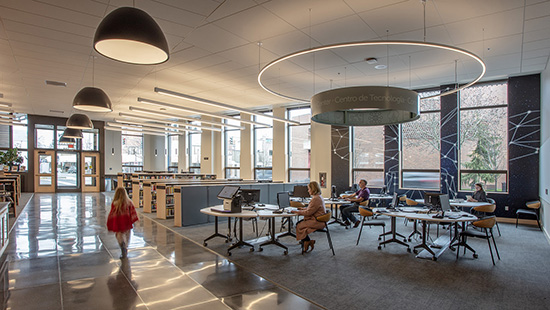
Mount Vernon Library Commons
HKP Architects
The city of Mount Vernon had not built a new building in 20 years. When they outgrew their library, they planned for a new facility to meet a multitude of local priorities. In addition to a new library, the community wanted services for young people, meeting and conference space, support for the local economy, better access to transit, and an environmentally-friendly design. Downtown parking was also a concern, for both commuters and businesses.
The city set out to develop the Mount Vernon Library Commons (MVLC), a library like no other. The building doubles the size of the library and includes teen STEM and maker rooms, story areas, and more space for books and other materials. The building also has a conference center and gathering areas, along with a commercial kitchen for catering. The kitchen can be rented by local food businesses, supporting both those businesses and local farmers. A total of 276 parking spaces above the library provide easy access to the downtown transit center and local businesses. The building hosts the largest EV charging facility in the country, providing a convenient stopping place for travelers between Seattle and Vancouver BC, who could visit local shops and restaurants while their vehicles charge.
The MVLC is the most sustainable public building in Skagit County, using 74% less energy than a code-minimum building. As a Phius-certified building in a small, economically disadvantaged city, its design as unique as its program.
The design team, led by HKP Architects with FSi Engineers as mechanical engineer, used passive house principles to achieve this performance. The extraordinarily-efficient envelope reduces heating and cooling loads. The team downsized the heating and cooling system, and achieved a level of comfort generally only possible with more expensive systems. Designers also developed a finely-tuned ventilation system with heat recovery to maximize efficiency while providing ample fresh air for building occupants.
The MVLC became one of the first publicly-bid buildings to receive passive house certification from Phius. Phius has exacting standards for both design and construction. The design-bid-build AEC team collaborated to a level uncommon on publicly bid jobs, ensuring construction met Phius requirements for envelope and air barrier testing, as well as unusually-strict balancing standards. The building’s high level of sustainability and multitude of services enabled the project to qualify for 20 sources of federal, state, and local funding, and the MVLC was built without raising local taxes.
Other Stories:


