 |
Subscribe / Renew |
 |
Contact Us |
| ► Subscribe to our Free Weekly Newsletter | |

Construction Bids
| home | Welcome, sign in or click here to subscribe. | login |


 print print  email to a friend email to a friend  reprints add to mydjc reprints add to mydjc |  |
 |
June 10, 2025

Wechsler
|
Affordable housing is often seen as constrained by tight budgets, minimal resources and complex funding mechanisms. Yet, two of Runberg Architecture Group’s recent projects prove that these developments can lead the way in pioneering energy-efficient solutions that benefit not only low-income residents but the multifamily housing sector at large.
A MILESTONE IN PASSIVE HOUSE AFFORDABLE HOUSING
Located in Seattle’s North Rainier Hub Urban Village within a few blocks of the soon-to-open Judkins Park Light Rail station, Hobson Place is a permanent supportive housing development that provides homes and comprehensive services for 177 individuals experiencing homelessness and disabilities.
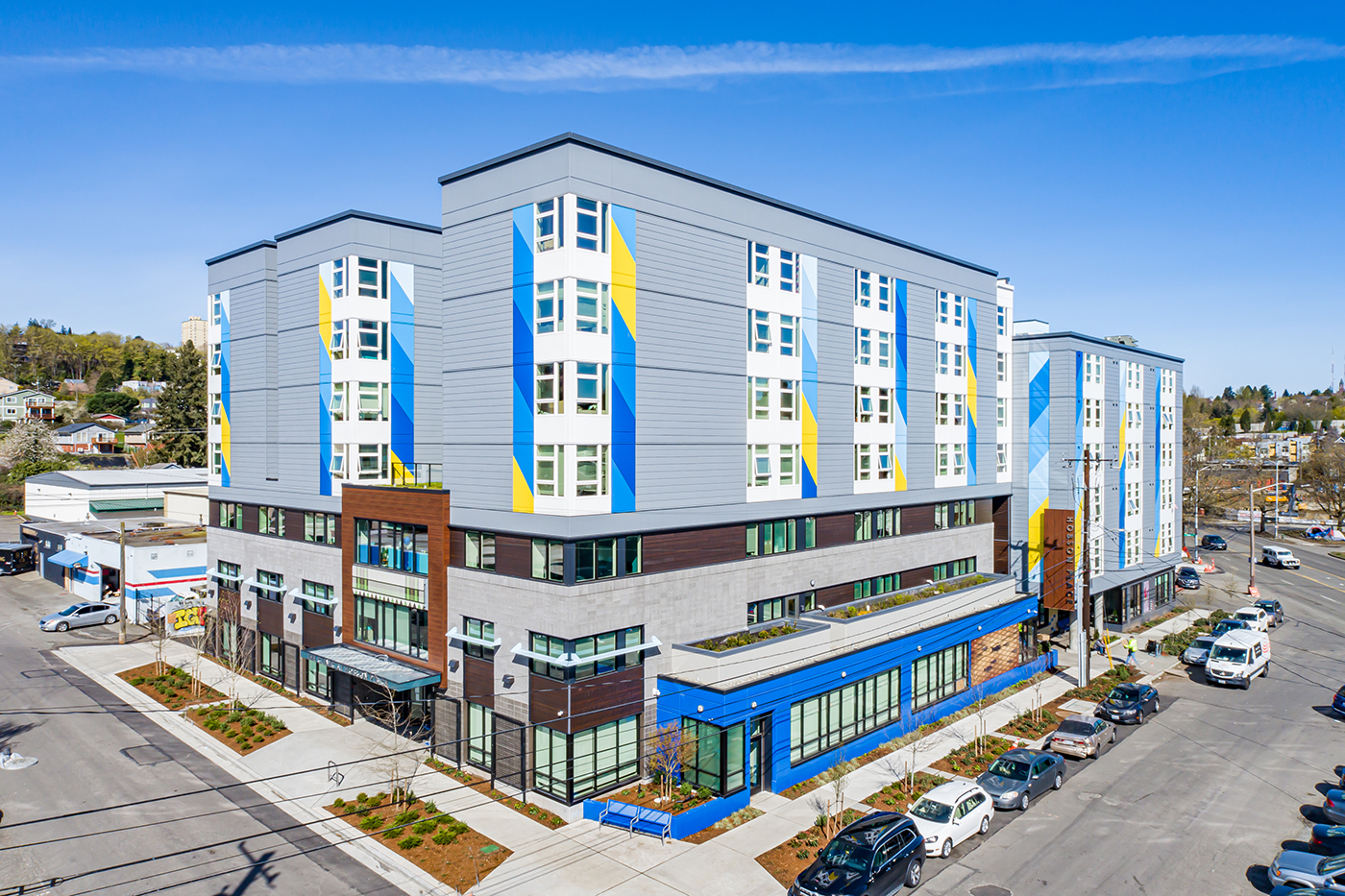
Developed by Downtown Emergency Services Center (DESC) and Lotus Development, the project is the first permanent supportive housing (PSH) development in Washington State to receive Passive House Institute US (Phius) certification. The project combines independent living with wrap-around services, including a 24,000-square-foot primary and behavioral healthcare center that serves the building’s residents and the local community.
Hobson Place was awarded Ultra High Energy Efficiency (UHEE) funding from the Washington State Housing Trust Fund, as well as grants from Seattle City Light and the King County Housing Development Consortium’s Exemplary Building Program. These funding sources allowed greater up-front capital investment to improve building systems and construction techniques, including installation of all-electric plumbing and mechanical systems.
By focusing sustainability efforts on the established Passive House program, the team used Phius certification as an organizational structure to capitalize on the innovative funding sources available and deliver a project that will benefit from a 60% reduction in energy usage over the life of the building.
LESSONS FROM THE FIELD: TECHNICAL TAKEAWAYS
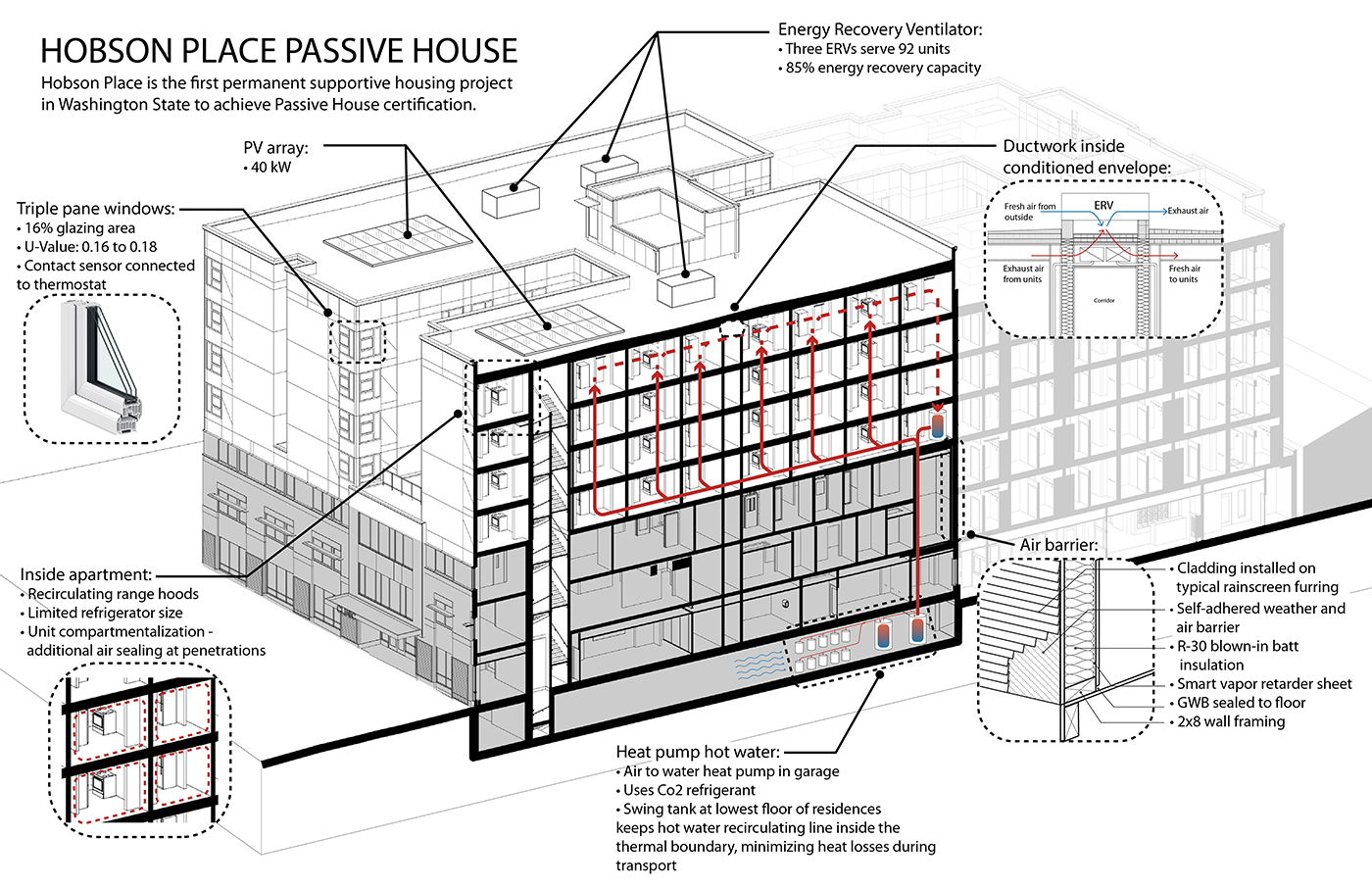
Meeting these high sustainability goals required close collaboration between experienced partners including Walsh Construction, O’Brien360, 4EA Building Science as the envelope consultant, and RDH as the Certified Passive House Consultant. Phius certification is known for its stringent performance metrics, particularly in terms of airtightness, insulation, and energy usage. But rather than being a hindrance, these rigorous standards became a framework for innovation.
Key components like a 40-kilowatt solar array, electric heat-pump water heaters, and rooftop Energy Recovery Ventilators (ERVs) made the biggest impact on overall energy efficiency. Although the project was permitted under the 2015 Seattle Building Code — before ERVs were required by the local Energy code in multifamily housing — it was among the first to install these systems proactively.
By centralizing rooftop ERVs and using vertical chases for air distribution, the team minimized penetrations in the building envelope, reduced equipment count and lowered maintenance burdens on the residents. These design strategies not only enhanced energy performance but also made long-term operations simpler and more cost-effective.
Ensuring airtightness was among the most challenging yet crucial aspects of the build. The residential building needed to be completely separated from the clinic space below, including complex transitions in stairwells and elevator shafts that connected wood-framed upper floors to the concrete levels.
Construction techniques employed to maintain the air barrier included:
• Platform-framed parapets to simplify air barrier geometry
• Moving ductwork beneath the roof air barrier to reduce penetrations
• Use of fully adhered air barrier membranes on exterior walls
• Detailed construction oversight to ensure high performance
The result was an air leakage rate of 0.073 cfm/ft², exceeding Phius requirements and setting a benchmark for similar projects. This exemplary performance will reduce energy demand, benefiting the community for years to come.
LOOKING AHEAD: 125TH & AURORA SENIOR HOUSING
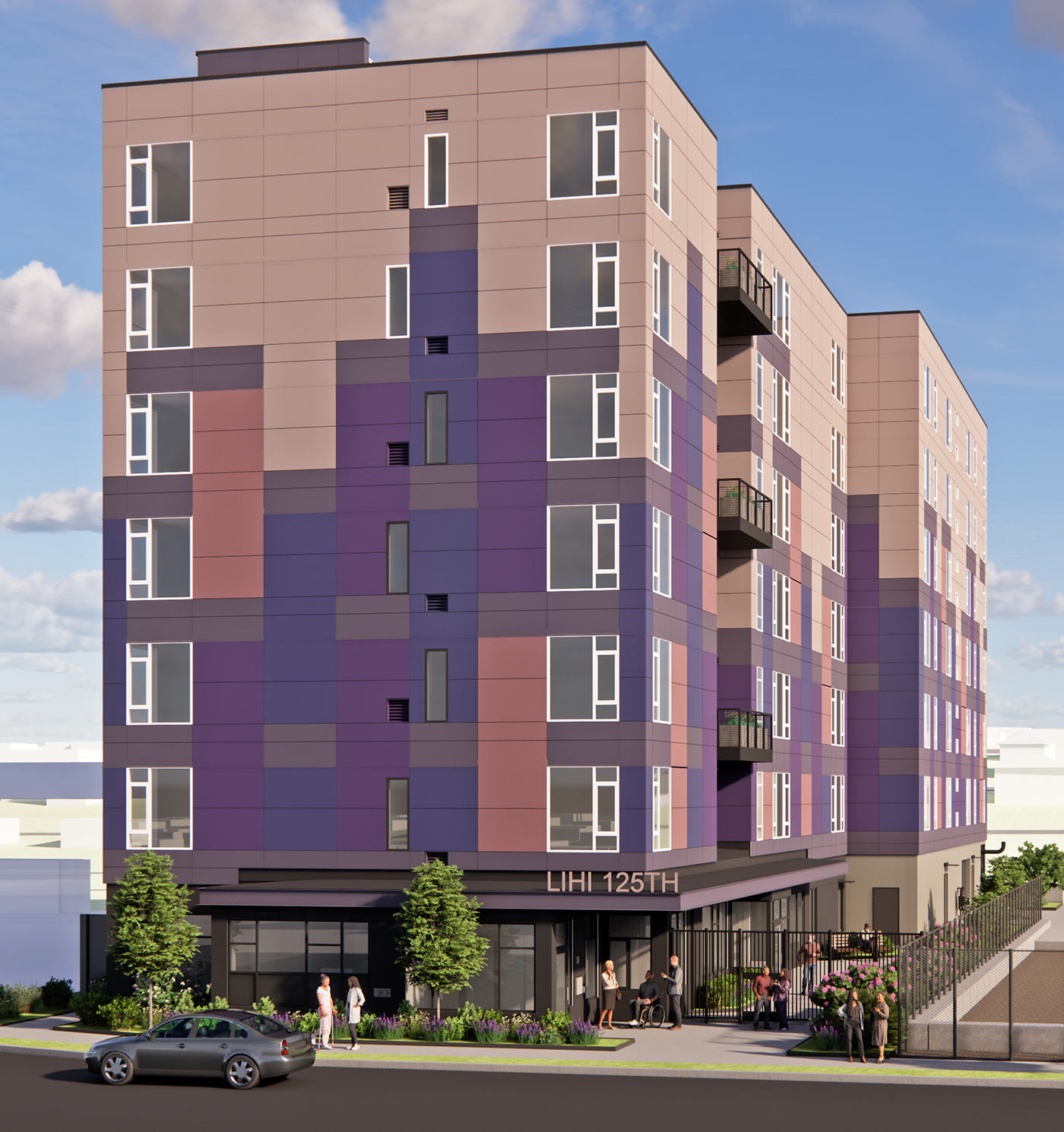
The success of Hobson Place laid the groundwork for a future energy-forward affordable housing project: 125th & Aurora Senior Housing, located at North 125th Street & Aurora Avenue North in North Seattle along the RapidRide E Line route. Designed for the Low Income Housing Institute (LIHI) and anticipated to break ground this summer, the project will provide 90 units of supportive housing for seniors.
125th & Aurora builds upon Hobson’s lessons, with design improvements and code changes helping reduce both cost and complexity. Since the 2018 Seattle Building Codes first required ERVs and incentivized electric domestic hot water systems, what was once cutting-edge at Hobson is now standard practice for multi-family housing construction in Seattle.
This evolution means that while Hobson Place saw a 3.8% increase in total costs for Phius-related improvements, 125th & Aurora is projected to come in at under 1% additional cost.
HYDRONIC HEATING AND COOLING
125th & Aurora is introducing a novel mechanical system to multifamily affordable housing: an air-source heat pump hydronic heating and cooling system. Designed by Ecotope, the system distributes thermal energy through floor-by-floor water loops, eliminating harmful refrigerants from the building interior.
This system promises long-term energy savings and a healthier indoor environment, while ensuring HVAC system longevity via the use of water-based distribution rather than refrigerant, setting the stage for further technical advancement in multi-family housing.
To control costs, the project will use a two-pipe system, meaning it can operate in either heating or cooling mode seasonally (but not both simultaneously). While less dynamic than a four-pipe system, this approach works well paired with a very high-performing building envelope. It also provides in-unit cooling, adding a new amenity for affordable housing as summers become hotter and wildfires more frequent.
FLIPPING THE PARADIGM
Both Hobson Place and 125th & Aurora demonstrate how affordable housing can be at the forefront of sustainability and building innovation. Traditionally, energy-efficient systems and high-performance design are seen as luxuries affordable only to market-rate developments.
While those projects have more leeway to weigh upfront costs against lifecycle savings, affordable housing is traditionally limited by complex funding streams and strict budget caps on upfront construction costs. By leveraging sustainability-focused funding sources and adopting a systems-based design philosophy, Hobson and 125th & Aurora achieve performance levels that exceed most market-rate housing.
As urban centers grapple with rising housing demand, climate change, and social inequities, projects like Hobson Place and 125th & Aurora are models for how affordable housing can lead in the development of a more sustainable and equitable future. By embracing energy efficiency, reducing reliance on harmful refrigerants, and prioritizing occupant health and comfort, these developments demonstrate a bold path forward — one where everyone, regardless of income, can live in a building that respects both the environment and its residents.
Melissa Wechsler is a principal at Runberg Architecture Group and a part-time lecturer at the University of Washington’s Department of Architecture teaching mixed-use, multifamily design in the graduate level housing studio.
Other Stories:


