|
Subscribe / Renew |
 |
Contact Us |
| ► Subscribe to our Free Weekly Newsletter | |

Construction Bids
| home | Welcome, sign in or click here to subscribe. | login |


 print print  email to a friend email to a friend  reprints add to mydjc reprints add to mydjc |  |
 |
June 10, 2025

Foster
|

Ptacek
|
As substantial public investments strive to better connect our region, transit-oriented development (TOD) provides a substantial contribution to meeting the Puget Sound region’s housing needs and sustainability goals with walkable development and livable density. From the initial Sound Transit 1 Line to ST-3, how have we learned from missed opportunities in the past to potential development as it is unfolding today and in the future?
Prior to the middle of the last century, transit-oriented development was the key driver of urban development, fostering new neighborhood centers further from the main city center. In fact, many of the most loved walkable neighborhoods in Seattle and Tacoma originated as streetcar suburbs, efficiently transporting people to and from downtown.
However, post-WWII suburban expansion and car-centric development led to the dismantling of streetcar systems and a shift toward low-density sprawl. By the late 60s, worsening traffic and environmental awareness prompted local leaders to reconsider the role of transit. Regional agencies such as the Puget Sound Regional Council (PSRC) began promoting policies that integrated land use with transportation planning, laying the groundwork for future TOD.
SOUND TRANSIT AND THE MODERN ERA OF TOD
After multiple failed attempts (see Jon Talton’s timely Seattle Times column, “Light rail is a target to critics, but the economic benefits are clear”), the modern era of transit began in earnest with the passing of the Sound Move plan in 1996 that eventually established the initial “Link” light rail system, “Sounder” commuter rail system, and “Regional Express” bus network.
Most significant for potential transit-oriented development was the opening of the 14-mile Central Link (now the 1 Line) in 2009, connecting Tukwila (and later SeaTac) to Downtown Seattle through the Rainier Valley. While the 1 Line established the foundation for future ST2 and ST3 expansions, political headwinds, geotechnical conditions and cost overruns resulted in a significant reduction to the original ambitions.
Twenty-five years ago, the Seattle Housing Authority began redeveloping Rainier Vista at the same time Seattle began station-area planning for Columbia City Station along the 1 Line. One of GGLO’s earliest TOD projects, this presented the perfect scenario to overlay urban design and planning policy with transportation— connecting mixed-income residents to employment without being car dependent.
The redevelopment replaced all 481 original World War II era low-income homes while also providing several hundred new units for families and seniors representing a broad income range. In total the plan for the 67-acre site provided 895 households in a walkable mixed-income community with new community parks and gardens, pedestrian scaled streetscapes, and community services all adjacent to the Link station.
The award-winning project is a great example of livable mixed-income development, however like the initial 1 Line, the project’s low density was a compromise and a missed opportunity for a prime TOD site. The city station planning did not increase allowable height and density to accommodate more than four-to-five-story development — and only in the areas within a block of the station. Though greater height and density was proposed, most of the site remained zoned for low-rise development.
At the time, one public comment asserted that the city was trying to “build skyscrapers in a wheat field” for considering seven-story mid-rise development along the light-rail line. Now passengers wonder why the buildings along MLK are so small.
One stop to the south, lessons learned are being applied at another Rainier Valley TOD site with the redevelopment of Bellwether’s Kingway Apartments. Located adjacent to the future Graham Street Infill station, Kingway proposes to redevelop an existing 7-acre low density site with up to 750 affordable housing units.
Several other early TOD projects advanced along the 1 Line with varying degrees of success in areas like Tukwila, Columbia City and Mount Baker, where new housing, retail, and mixed-use developments began to cluster around stations. Despite this, much of the land in the station walksheds is still predominantly low-density residential, surface parking, and auto-centric commercial uses.
The missed opportunities can be attributed to land use policies that limited development, a young transit agency that was not yet focused on supporting TOD, and market challenges of assembling numerous small parcels to create a viable development site. Anecdotally, Sound Transit staff noted in a past ULI Forum that the focus at the time was just to establish a transit system (in fairness, no small undertaking). While Sound Transit’s first TOD project, Senior City in Federal Way, opened in 2010, it was not until 2012 that Sound Transit adopted its initial transit-oriented development policy.
ST2 AND THE NORTH LINE
As light rail expanded north of downtown Seattle to Capitol Hill, The U District and Northgate, so did the opportunities for transit-oriented development. This included Sound Transit’s first station area Agency TOD project at Capitol Hill Station with 429 homes, including 177 that are affordable apartments. Continued transit investment and land-use policies stimulated numerous private investments from small infill developments to the reimaging of the former Northgate Mall (Northgate Station).
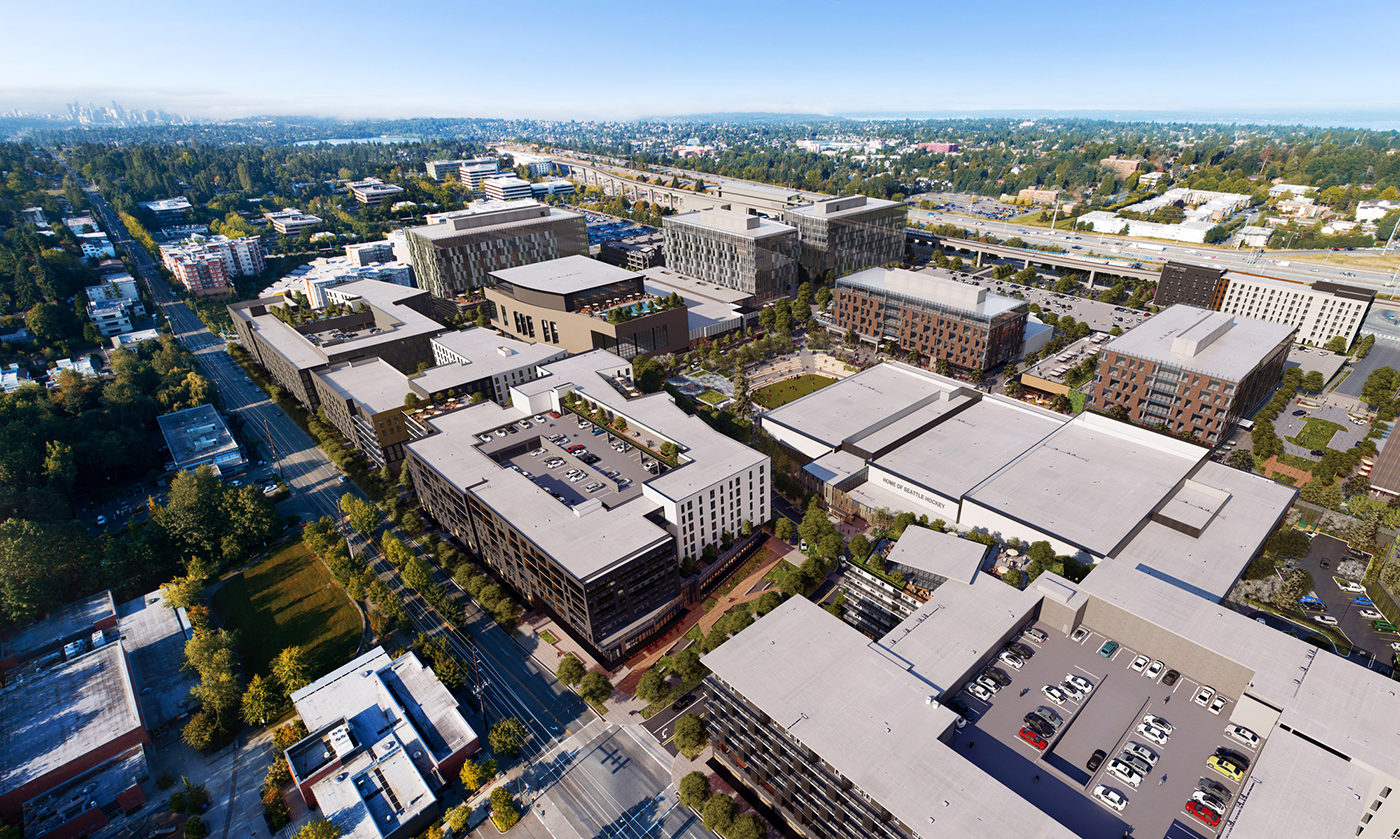
The initial vision for the redevelopment of Northgate Mall was as much a response to a changing retail market as it was a response to the impending arrival of mass transit. Fortunately, during the initial master planning phase, the ownership group and their team had the vision to rethink initial less-ambitious plans, which gave way to a more holistic rethinking of the entire neighborhood.
The approved masterplan includes up to 940 residential units, 350 hotel rooms, and nearly 2 million square feet of new commercial space, while the total amount of retail space was reduced by about half of its former size. The development is transforming former surface parking and auto-centric retail into a walkable mixed-use neighborhood anchored by the Kraken Community Iceplex and new central park.
North of Seattle, Shoreline and Lynnwood had the foresight to complete bold station area planning long before the first arrival of any trains. Shoreline completed station area subarea plans in 2016 which rezoned mostly single family residential to Mixed Use Residential (MUR) with a maximum height of 70 feet. A unique aspect of the Shoreline Station Subarea Plan is a phased zoning map that unlocks nearly 70 blocks of TOD density immediately and additional density in 2033.
While the Shoreline Stations just opened in August of 2024, they have already seen approximately 1,700 homes planned or built near the North Station and nearly 3,100 homes built or in the development pipeline near the South Station. This strategy addresses both the evolution of how the market may be more likely to respond to opportunity over a longer period of time, and a more gradual process of change in the scale of development.
Lynnwood’s 2005 Subarea Plan envisioned an urban transformation from suburban big box stores and strip retail into a vibrant city center that divides existing superblocks into smaller, pedestrian-oriented streets. In total there are nearly 3,000 housing units in the development pipeline for Lynwood City Center, including large projects such as Merlone Geier Partners' Northline Village and The District (Formerly Lynnwood Public Facilities District), which includes redeveloping existing strip centers and tripling the size of the Lynnwood Events Center space.
In addition to new development, Lynnwood is planning for pedestrian and bicycle infrastructure improvements and the creation of a new Townsquare Park. Housing Hope is also in the planning process for seven-story affordable housing and social services on the surplus ST property adjacent to the new station.
THE EASTSIDE AND EQUITABLE TOD POLICY
On the east side of Lake Washington, TOD is driving the construction of many of the new homes from downtown Bellevue to Redmond. The Sound Transit alignment through the Wilburton and Bel-Red neighborhoods departs the freeway in favor of right-of-way through former light industrial areas that present greater TOD opportunities, attractive parcels for development and an uninterrupted walkshed.
On the north side of the Spring District, state legislation and the Sound Transit Equitable Transit Oriented Development Policy is shepherding the construction of 234 affordable apartments being developed by Bridge Housing. The affordable housing is just the first two buildings of the larger Sound Transit Spring District OMFE Surplus site redevelopment that also includes market-rate housing, retail, office and open space.
The East Link Extension recently celebrated the opening of stations at Marymoor Park and Downtown Redmond. The Redmond expansion coincides with the 2024 adoption of Redmond’s updated Comprehensive Plan (Redmond 2050).
The plan focuses on growth in the three neighborhoods served by new light-rail stations, with opportunities for increased density, reduced parking requirements and higher affordability requirements. Height and density incentives allow for 12 stories in the City Center and Marymoor Village, while 30-story (!) towers could be possible in the core of Overlake Village — time, and the market will tell.
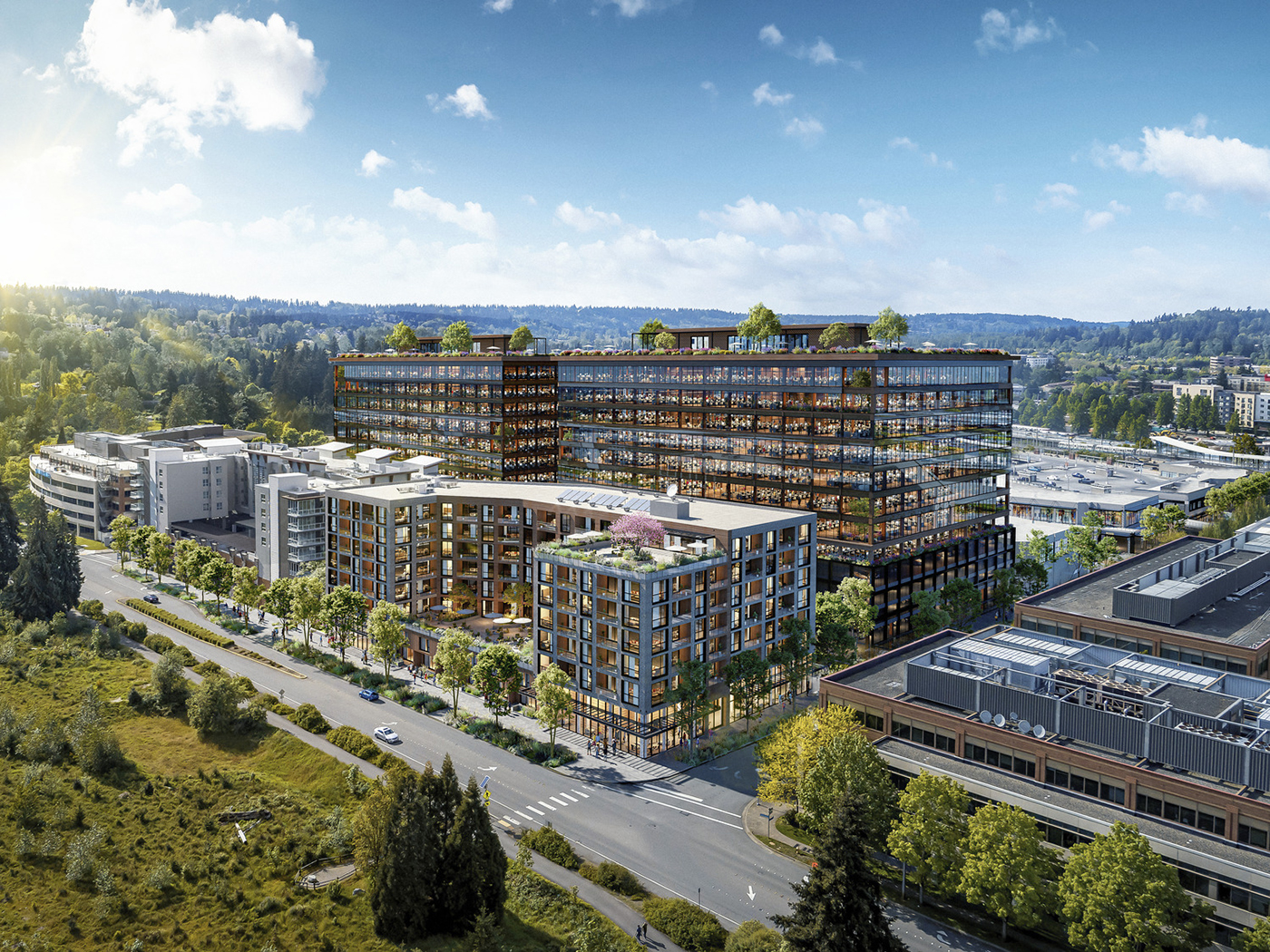
Under the new code, Hines is leading the expansion and redevelopment of the Redmond Town Center (RTC) site, as the development manager for Fairbourne Properties. The proposed Master Plan Development (MPD) will replace surface parking with a new transit-oriented, mixed-use community while enriching the existing main retail street.
The MPD proposes up to 1,040 dwelling units along with new retail and potential office development. A minimum of 20% of the dwelling units will be affordable at 60% Area Median Income (AMI).
WHERE ARE WE HEADED?
The Puget Sound region has made great strides in transit-oriented development over the past 25 years, from a transit afterthought to the central strategy to meet our housing and sustainability needs.
In Seattle, as public sentiment towards density and transit-oriented development has been shifting, the city has started removing roadblocks to development. North and Eastside communities have made bold policy changes to allow for greater height and density around transit. Sound Transit, PSRC, and the state Legislature have all taken an active role in planning not just for transit, but for the dense walkable TOD communities that are needed to support it.
The next challenge planners and policy makers face is whether recent policies align with market realities, and to strike the right balance between encouraging TOD while also meeting other community goals.
Will height and density incentives encourage a greater supply of housing, or will they discourage development? Although high-rise construction is now allowed in more areas from Overlake to Lynnwood, residential rents cannot support the high construction cost needed to create that development in most areas outside downtown Seattle and Bellevue. Communities need to seek lessons learned and best practices from other jurisdictions and the broader development community. We should be just as proud to repeat the successes of our Puget Sound neighbors as we are to emphasize qualities of what makes each neighborhood unique.
Looking ahead to the completion of ST2, the start of ST3, and the new Stride Bus Rapid Transit (BRT) Line, the future of TOD in the Puget Sound promises to be even more dynamic. Integrating collective lessons learned to overlay both land-use policy and transit planning, together with acknowledging an ever-evolving market reality are essential to shaping the next chapter of TOD in our region.
From the echoes of the streetcar era to the hum of the light rail, the Puget Sound’s journey with TOD demonstrates a continuous striving towards more livable, accessible and environmentally responsible urban environments. As we continue to invest in transit systems, we are building not just transportation networks, but the foundations for thriving communities for generations to come.
Jeff Foster is a Principal at GGLO. Mitch Ptacek is a Senior Associate and Project Manager at GGLO. Both are architects focused on mixed-use Master Planning.
Other Stories: