 |
Subscribe / Renew |
 |
Contact Us |
| ► Subscribe to our Free Weekly Newsletter | |

Construction Bids
| home | Welcome, sign in or click here to subscribe. | login |


 print print  email to a friend email to a friend  reprints add to mydjc reprints add to mydjc |  |
 |
May 4, 2026
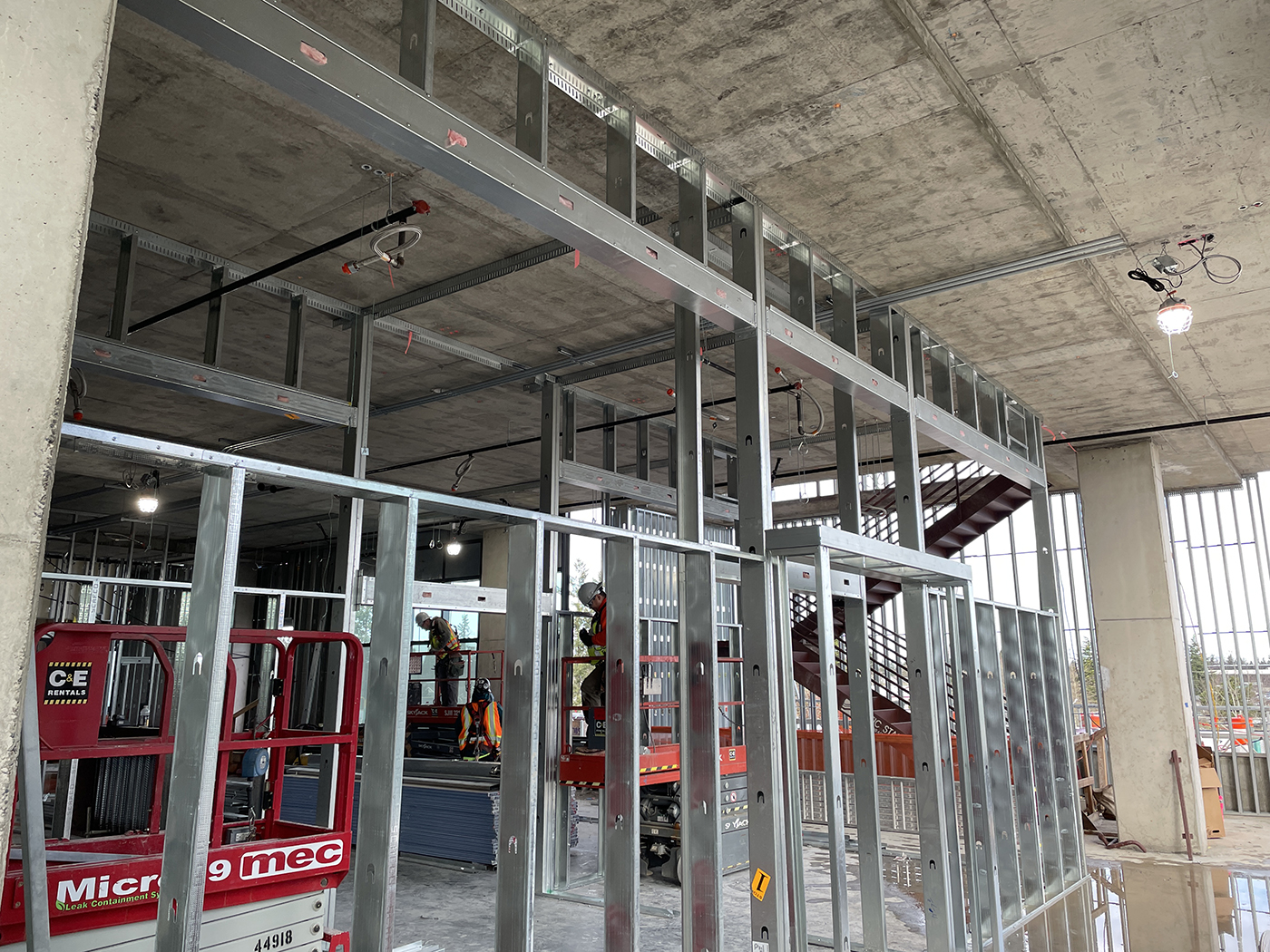
Clackamas County Circuit Courthouse
Location: 1000 Courthouse Road, Oregon City
Contractor: Cascade Acoustics
Architect: DLR Group, Portland, Oregon
Labor partners: Western States Carpenters; Operative Plasterers’ & Cement Masons’ International Association; Laborers International Union of North America
Clackamas County Circuit Courthouse is a new six-story, 250,000-square-foot judicial facility, housing 14 courtrooms with capacity for future expansion, judges’ chambers, secured circulation areas, holding cells, and offices for county, state, and city agencies. Designed to meet strict functional, security and acoustic requirements, the building serves as a critical civic institution for Clackamas County and was delivered to LEED Gold standards. Cascade Acoustics served as a design-assist subcontractor and performed extensive interior and exterior framing, drywall, ceiling, and acoustic scopes throughout the facility.
The project is notable for its delivery under a P3 Uniform Special Conditions subcontract, which required the design to continue evolving during construction. Cascade Acoustics collaborated closely with the architect, engineers, general contractor, and fellow trades over a ten-month preconstruction period to refine wall and ceiling systems to meet stringent STC, CAC, and NRC performance criteria while maintaining schedule and cost control.
One of the most significant challenges was ensuring acoustic privacy within courtrooms, where STC performance was paramount and errors were unacceptable. Multiple high-performance wall assemblies were required, and even minor deviations could compromise compliance. To mitigate risk, Cascade Acoustics implemented a robust QA/QC program that included full-time monitors, color-coded drawings, documented installation procedures, and photo-based tracking to verify compliance at every stage.
Courtroom ceilings introduced additional complexity, combining drywall and acoustical ceilings with compound radii to form elliptical geometries. Each courtroom was similar but uniquely configured, requiring precise coordination and custom-fabricated components. Through disciplined quality control, collaboration, and technical execution, the project team successfully delivered highly complex framing for the project that meets the demanding functional, acoustic, and security standards of a modern courthouse.
Other Stories:


