 |
Subscribe / Renew |
 |
Contact Us |
| ► Subscribe to our Free Weekly Newsletter | |

Construction Bids
| home | Welcome, sign in or click here to subscribe. | login |


 print print  email to a friend email to a friend  reprints add to mydjc reprints add to mydjc |  |
 |
May 4, 2026
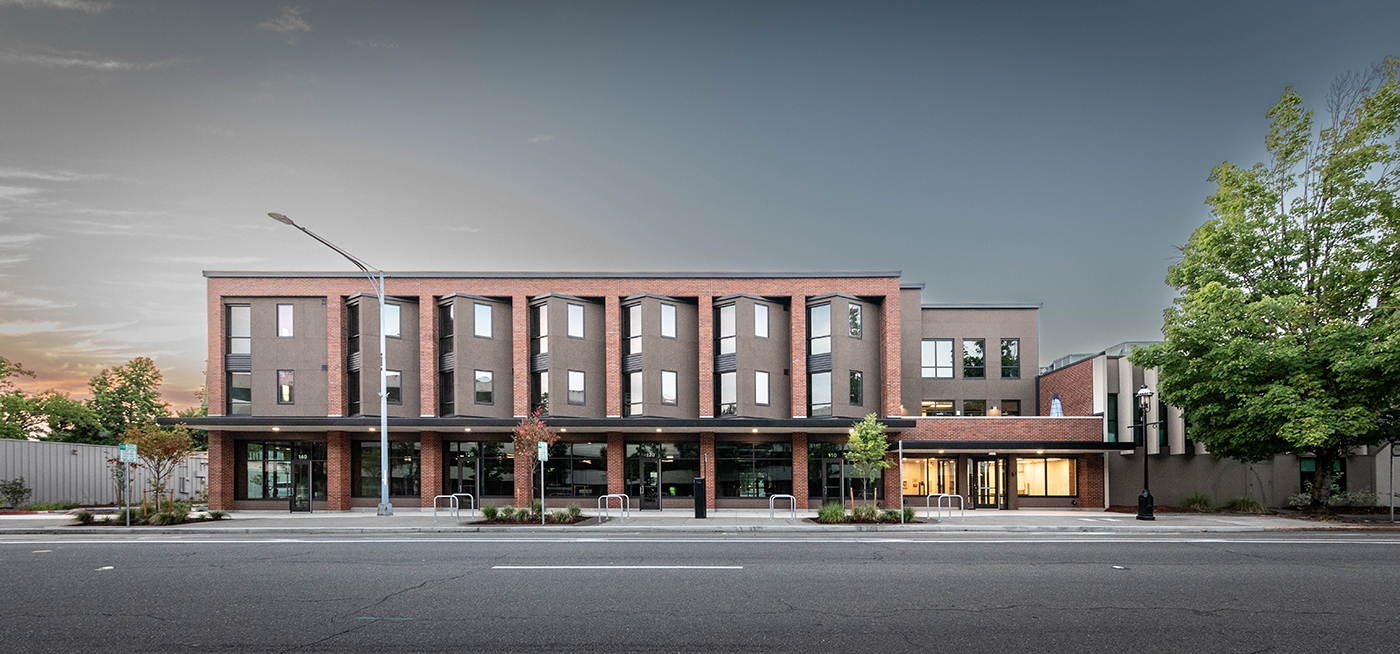
Hope Plaza
Location: 605 Center Street N.E., Salem
Contractor: The Harver Company
Architect: Anderson Shirley Architects
Labor partners: Western States Carpenters; Operative Plasterers’ & Cement Masons’ International Association
Hope Plaza is a mixed-use development in downtown Salem that transforms the former Greyhound bus station site into a supportive housing and employment hub for survivors of domestic violence, sexual assault, stalking and human trafficking. The project combines ground-floor retail spaces with safe housing above, creating opportunities for job training and long-term stability while contributing to the surrounding urban fabric.
The project is notable for both its social mission and its innovative exterior construction. Hope Plaza is the first large-scale project in the Pacific Northwest to utilize PermaBase CI, a composite cement board with integrated rigid insulation that provides continuous insulation (CI) while serving as a substrate for direct-applied stucco systems. The system was paired with a Dryvit exterior finish to address thermal performance, air and moisture control, and durability, particularly where steel stud framing would otherwise contribute to thermal bridging. The building’s exterior geometry, including a distinctive sawtooth façade, provided an opportunity to demonstrate the flexibility and performance of the system.
Complex angles, winter weather, and the presence of an open-air atrium at the center of the building provided construction challenges. Scaffold systems were carefully configured to accommodate the sawtooth geometry and fully shrink-wrapped to protect work areas from rain and ice. Temporary wood enclosures and supplemental heat were used to protect the atrium and maintain appropriate conditions for stucco installation.
The judges were impressed with the outstanding use of this system. The added benefit of Continuous Insulation creates great value for the client.
Through close coordination with NWCB technical staff, manufacturers, and third-party consultants, the project team successfully implemented new materials and detailing methods. The result is a high-performing, visually striking exterior that supports the project’s broader mission of safety, dignity and long-term community impact.
Other Stories:


