 |
Subscribe / Renew |
 |
Contact Us |
| ► Subscribe to our Free Weekly Newsletter | |

Construction Bids
| home | Welcome, sign in or click here to subscribe. | login |


 print print  email to a friend email to a friend  reprints add to mydjc reprints add to mydjc |  |

March 21, 2002
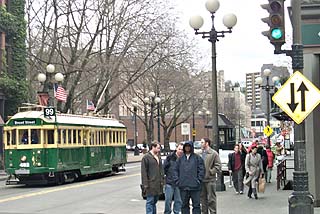
Photos by Denis Toomey Historical traffic lights are an important part of Pioneer Square's image. |
Perhaps you remember the local safety officer coming to your grade school each year with his demonstration kit and stern attitude. Like a drill sergeant toughening up a platoon of marines, he would drive home the meaning and importance of the red, green and yellow of the town's traffic signals. As a result, we all knew when to stop and when to walk and why.
But things aren't that simple with traffic signals anymore.
|
Seattle's traffic signals are going through several changes and it's not something you might notice just by looking. Most of us react to the signals in a robotic way, not always waiting patiently for our turn to proceed either by foot or vehicle.
Nobody really stops to think about those mechanical light boxes anyway, right? Well, If you are a transportation manager, a city finance manager, a historic preservationist or a city councilmember you do.
Power savers
Seattle is serious about its traffic lights. In fact, the city will end up spending $2 million in a current project to convert the city's traffic lights from energy wasting incandescent to energy efficient LEDs (light emitting diodes). Seattle is one of the first major U.S. cities to undertake such a project, which it began in 1998. The city has over 8,000 signals controlling 1,000 intersections.
It is estimated that more than 6 million kilowatt hours will be saved when the project is complete. New signals would use about one-tenth the power of existing lights. That's enough energy to power almost 700 homes.
According to Councilmember Heidi Wills, who sponsored a bill to swap the lights, City Light saved $775,000 in one year from the change in red lights only. And now the city has moved on to the green lights -- with nearly 5,000 left to change at last count.
Those yellow lights, however, will not join their high-tech neighbors in the changeover, because when the math is done, they are lit for much less time and so the change would not be cost effective.
Antiques
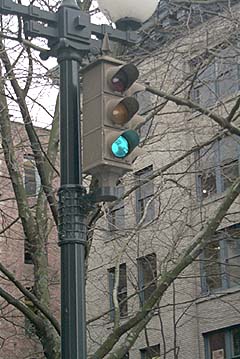
In Pioneer Square, the city is paying extra attention to retrofitting its historic traffic signals. The historic neighborhood has as many as 80 antique fixtures.
Not everyone notices the finer details, but to Barrett Williams who heads the National Streetscape Society in St. Louis, the city deserves a round of applause for keeping minor details authentic, such as its traffic lights. Williams says it is rare for a city to preserve such a detail and that many cities trashed their lights 40 to 50 years ago.
The job for retrofitting lights in Seattle is under supervision of Brian Kemper, traffic-signal operations manager for Seattle's Transportation Department. And much to William's joy, Kemper and his department actively seek antique fixtures and parts to keep Pioneer Square's lights authentic.
Several years ago, a fire destroyed a good part of the city's collection of antique lights and parts. Insurance money has been paying to replace some of those lost, when Kemper's department is lucky enough to find replacements.
Red-lighters beware
Modern traffic lights, or their retrofitted elders, aren't just about changing colors. Seattle is considering joining about 60 U.S. cities in installing traffic cameras to aid in enforcement of what traffic signals are supposed to make us do -- stop.
A plan is already well on its way to install red light camera photo enforcement systems at key Seattle intersections. The pilot project, funded by the city and under the control of Seattle Transportation, may be issuing citations by late summer. According to Mike Estey of Seattle Transportation, the city is currently selecting a vendor for the project and awaiting police review and input.
Despite controversy surrounding this type of surveillance, the city has set aside $200,000 to catch motorists -- and maybe pedestrians -- in the act of violating the laws traffic signals govern. A similar system in Lakewood installed last July caught 454 red-light violators at two intersections in one week's time.
No matter where one sits on the legal issue, there is cause for alarm because insurance industry statistics claim up to 800 deaths and 200,000 injuries each year are caused by people running red lights.
Managing the flow
Another project from the state Department of Transportation has 17 city intersections hosting traffic surveillance cameras. The cameras keep vigil over intersections on Aurora Avenue, Royal Brougham Way, Mercer Street and in Northgate. The cameras allow crews to study traffic patterns and keep watch during emergency situations. When the cameras are linked to the WSDOT Web site in the coming month, motorists will be able to plan the best commute or trip route through the city.
Funding for traffic surveillance cameras is in place for Lake City Way and 35th Avenue Southwest. Also, a camera could be installed on the West Seattle Bridge.
Also on board are computer controls that switch lights to aid police and rescue vehicles navigating heavy traffic areas. And now some of King County's buses are given preferential treatment at controlled intersections with similar systems. Transponders installed on a bus can communicate with smart traffic signals that give them the green when they approach. One intersection's test results showed as many as 43 percent fewer stops for equipped busses.
The bus system, called Transit Signal Priority, was first tested on Rainier Avenue and now 21 intersections on Aurora Avenue North have joined the system, with several more transportation corridors to follow. As many as 80 intersections will be changed by the initial funding for the project which was financed by a voter-approved proposition.
No matter if you are caught by a camera, or forced to stop out of turn for an approaching bus, and no matter what is causing the familiar colors to illuminate, there is at least one thing you can count on when you face that traffic signal: Green means go, red means stop and yellow forever signals change.
Previous columns:


