 |
Subscribe / Renew |
 |
Contact Us |
| ► Subscribe to our Free Weekly Newsletter | |

Construction Bids
| home | Welcome, sign in or click here to subscribe. | login |


 print print  email to a friend email to a friend  reprints add to mydjc reprints add to mydjc |  |
 |
May 29, 2025

Moggio
|

Helmer
|
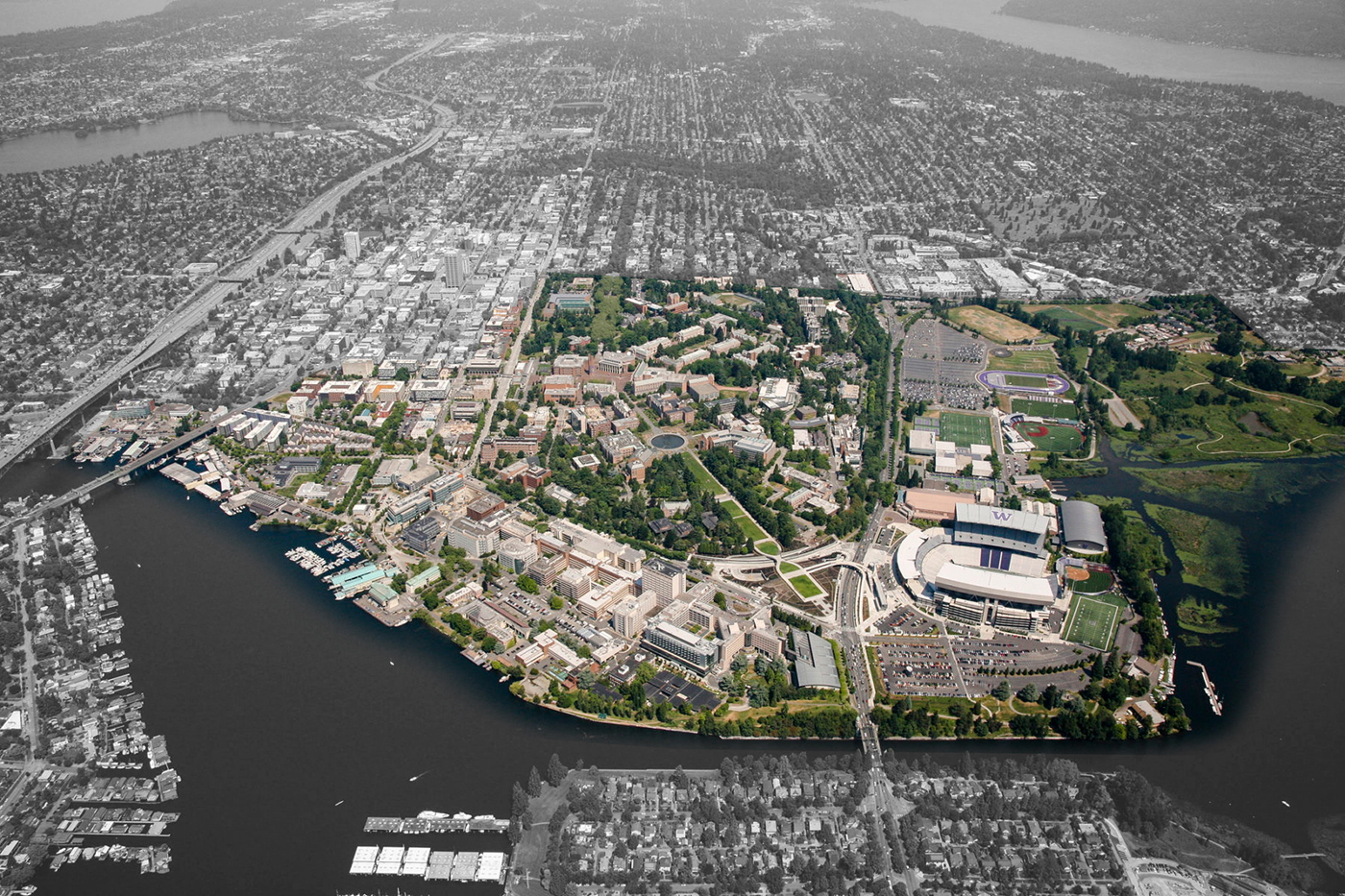
Every institution has its ticking clocks. At the University of Washington, one of the loudest is the growing backlog of deferred renewal needs across more than 200 buildings on its Seattle campus. These aging facilities increasingly threaten UW’s ability to support its core mission of education and research. In 2020, a comprehensive facility condition assessment confirmed the scope of the problem and the risk it poses.
UW is not alone. Across the country, higher education institutions are grappling with the challenge of maintaining aging infrastructure amid budget constraints and increasing expectations for performance, sustainability and resilience. But instead of reacting to problems as they arise, UW is reframing the issue with a proactive and data-informed Campus Renewal Program.
Working alongside the university, Miller Hull helped develop a strategic, long-range planning tool that maps a path forward — one that ties facilities decisions to academic priorities, financial realities and long-term campus goals. The approach offers a new model for capital planning in higher education: measurable, adaptable and mission-aligned.
FROM DATA TO DIRECTION
The Campus Renewal Program began with a large and unwieldy dataset: the results of UW’s facility condition assessment, which identified the lifecycle and renewal needs of thousands of assets and calculated the Facility Condition Needs Index (FCNI) for buildings across campus. While the index gave a baseline view of deferred maintenance, we found that the data could only take us so far and that we needed additional inputs to develop an actionable plan.
We layered in additional data: academic and research use, sustainability goals, building performance, cost data from recent capital projects and input from campus stakeholders. The result is an asset-based model that accounts not just for a building’s condition but for its value to the institution.
To make this information accessible and actionable, our team developed a custom visualization and decision-making tool in Tableau — a widely used data visualization platform. This tool aggregates multiple datasets and proposes a plan of action for each building — repair, renovation, or removal —while modeling different funding and timeline scenarios. Every decision can be adjusted to reflect institutional priorities, available capital, surge space and decarbonization goals.
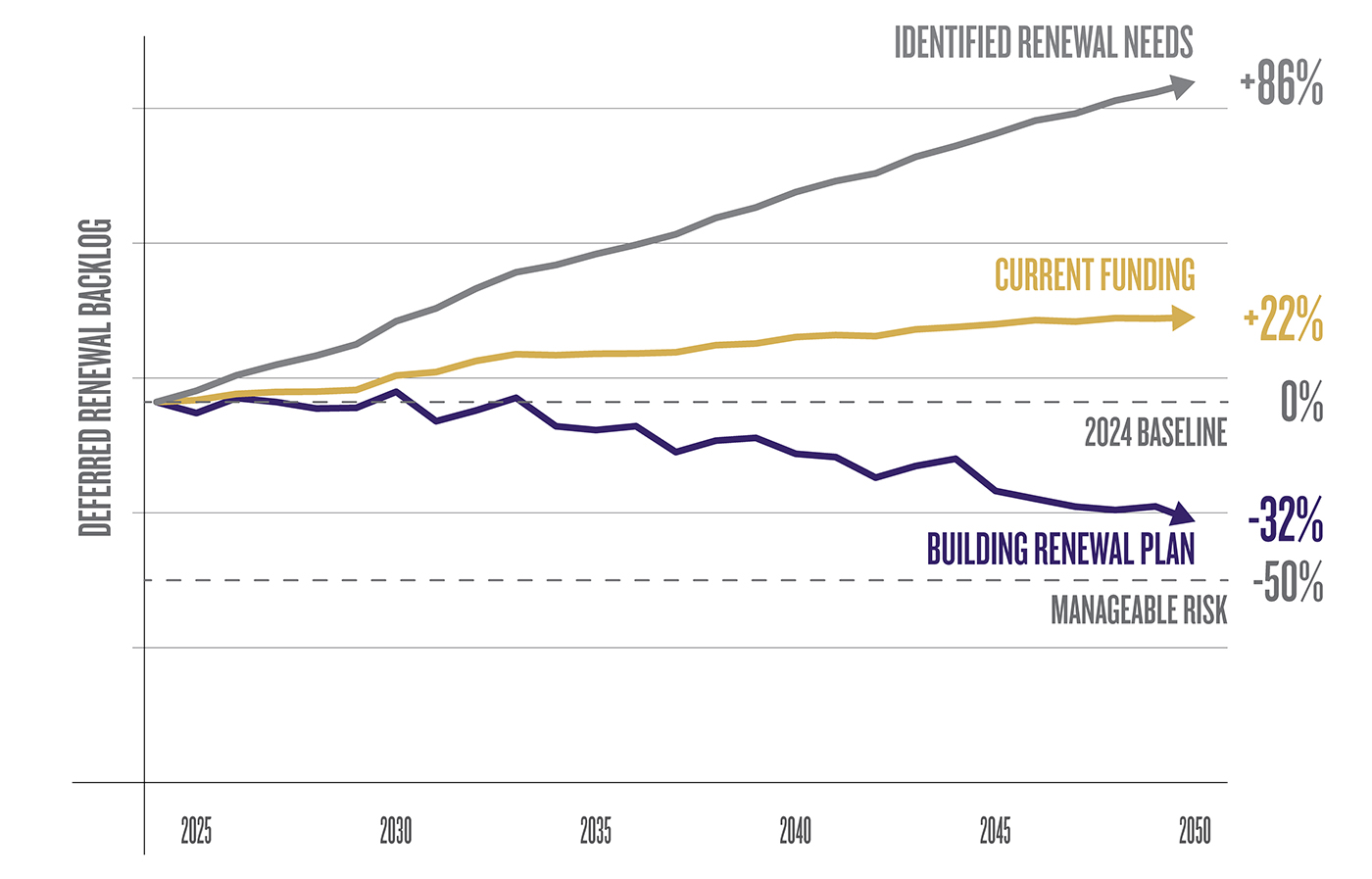
The tool outlines both 10-year and 25-year implementation strategies, with a longer-term goal: to significantly reduce UW’s deferred renewal risk by 2050. It’s a living plan — updated regularly, and responsive to change.
A collaborative process
Key to the program’s success was early and consistent engagement with stakeholders. Through a series of collaborative workshops, UW planners, facilities leaders and academic representatives worked together to identify priorities across the 25-year horizon. These sessions helped the team account for more than just data — they addressed the nuances of capital budgets, phasing constraints and shifting academic demands.
This stakeholder-driven process surfaced critical campus dynamics: where surge space would be needed to enable phased renovations, which projects had the most alignment with the university’s research goals and how to anticipate which funding sources might change over time.
THE BUILDING RENEWAL TOOL
The Tableau-based visualization tool was developed not just to inform the initial plan but to empower ongoing decision making. The deliverables include a user manual, allowing UW to update the tool internally as buildings age, new data becomes available, or institutional priorities shift.
This tool provides university leadership with the ability to:
• Visualize campus-wide data trends and hot spots
• Simulate and evaluate various funding and phasing strategies
• Align facilities investments with academic mission and sustainability targets
• Support multi-disciplinary decision-making with shared metrics.
The tool allows capital planning to become strategic, transparent and adaptive, rather than reactive.
PLANNING WITH PURPOSE
One of the most powerful outcomes of this effort has been a shift in institutional mindset. Instead of focusing exclusively on growth — new buildings, more square footage — the Campus Renewal Program encourages smarter planning with what already exists. The question is no longer “what do we build next?” but “how do we take better care of what we have?”
In an era of limited resources, this pivot is critical. It enables UW to prioritize projects that deliver the greatest long-term impact, not just the ones with immediate visibility or political appeal. It also gives university leadership a common language — and common data — to make the case for reinvestment in existing infrastructure.
LESSONS FOR OTHER INSTITUTIONS
The approach taken by UW and our team offers useful insights for other universities facing similar challenges. Among the most important lessons:
Start with the big picture. Deferred maintenance isn’t just a facilities problem; it’s a mission risk. Framing the issue in terms of long-term institutional goals helps elevate it as a strategic priority.
Don’t stop at the quantitative data. While quantitative assessments like FCNI are essential, they don’t capture the full value or potential of a building. Qualitative input — academic mission, stakeholder knowledge, program value — is equally critical.
Engage early. Bringing in voices from across the institution — from facilities and operations to academic leaders and sustainability teams — ensures the plan is grounded in shared priorities.
Take an asset-based approach that results in the best outcome for each facility, regardless of current use and program. Academic needs change over time, and a poor building today could become a great building for someone else in the future.
Visual tools matter. Interactive dashboards not only help planners make decisions but also help them communicate those decisions clearly across departments.
Be flexible. The model should be designed to evolve. Institutions change, funding shifts and facilities age in unexpected ways. A usable tool is one that adapts.
LOOKING AHEAD
As universities continue to face tightening budgets and rising expectations, smart planning will be more important than ever. The University of Washington’s Campus Renewal Program represents a shift away from reactionary capital planning and toward something more intentional: a system that helps the university care for what it has, align facilities with mission and plan confidently for the future.
We believe this approach can serve as a roadmap not just for UW but for other institutions seeking to transform deferred maintenance from a liability into a long-term opportunity.
Elizabeth Moggio is a principal at the Miller Hull Partnership. Michael Helmer is a project architect at the Miller Hull Partnership.
Other Stories:


