 |
Subscribe / Renew |
 |
Contact Us |
| ► Subscribe to our Free Weekly Newsletter | |

Construction Bids
| home | Welcome, sign in or click here to subscribe. | login |


 print print  email to a friend email to a friend  reprints add to mydjc reprints add to mydjc |  |
 |
August 28, 2025

Baleiko
|

Albores
|
The new Redmond Library in Central Oregon is more than a replacement for an aging civic asset. Designed by The Miller Hull Partnership with local partner Steele Associates for Deschutes Public Library (DPL), the two-story, 40,000-square-foot facility represents a new model for 21st-century libraries: deeply rooted in place while systemically coordinated across a growing regional network.
One of six libraries modernized, reconstructed, or newly built under a countywide bond measure, Redmond’s library offers a compelling case study in how civic buildings can simultaneously reflect the unique values of a local community and leverage system-wide efficiencies. It asks, and answers, the question: how do you design for one place while designing for many?
A CIVIC HUB SHAPED BY LOCAL VOICES
Redmond is one of the fastest-growing cities in the state, with a changing population that includes families, outdoor recreationists, Spanish-speaking communities, LGBTQ+ youth and many others. DPL engaged in an extensive public outreach effort before design even began, conducting targeted conversations with community groups to understand what people needed from their library, and how those needs could evolve in the future.
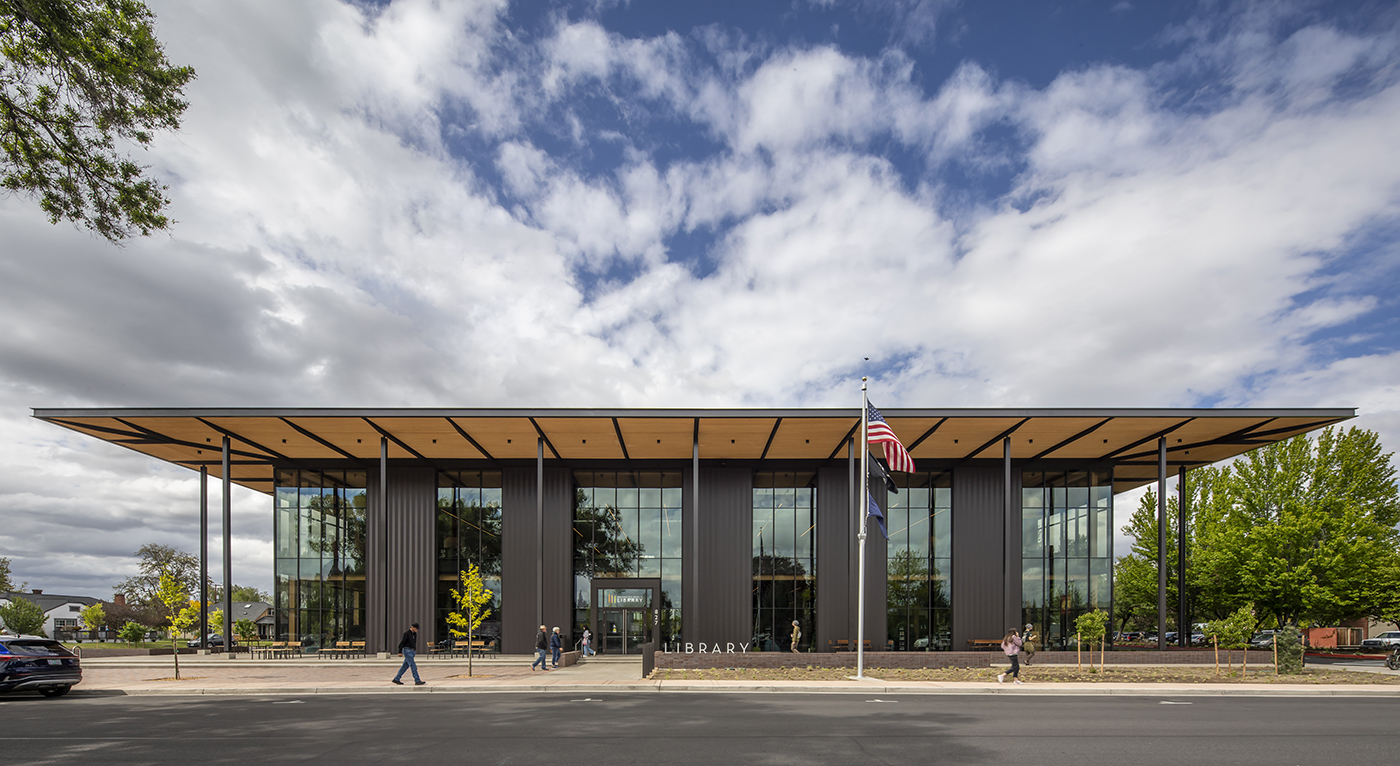
The result is a building defined by flexibility, inclusivity and a strong civic identity. The design includes a vibrant children’s discovery space, a dedicated teen lounge, a creative maker space, reservable meeting rooms and co-working rooms.
These decisions weren’t arbitrary, but were directly informed by the community. Spanish-speaking families, for instance, often use the library as a multigenerational group, so the Spanish-language collection was intentionally located adjacent to the children’s area to keep families connected. Additional features support everyday ease and accessibility. A drive-through book drop and staff service window allows patrons to pick up holds and return materials without leaving their vehicles, a convenience especially appreciated by families and older adults, or during Central Oregon’s colder months.
Outside, the library introduces a broad civic plaza and a deep, covered porch that serves as an extension of the library’s programmatic heart. Positioned adjacent to both the children’s and maker spaces, the porch allows activities to spill outdoors in warmer months. Whether it’s a storytime, craft fair, or casual gathering, the porch functions as a community living room, a threshold between civic infrastructure and everyday life.
A MODERN TAKE ON CONTEXT
The building’s design carefully balances a forward-looking approach with respect for Redmond’s historic downtown. A dark red Iron Stone brick volume to the north references neighboring civic buildings, including City Hall, and ties the new library into its urban context.
Installed in a crisp stacked bond pattern with areas of textured relief around windows, the brick adds depth and shadow while giving the facade a clean, modern character.
To the south, a glass- and metal-clad volume brings daylight deep into the open library spaces. These two volumes are unified beneath a wide, overhanging roof that offers shade and allows for an extensive photovoltaic array, sized to meet 100% of the building’s energy needs, making it a net-zero energy designed building.
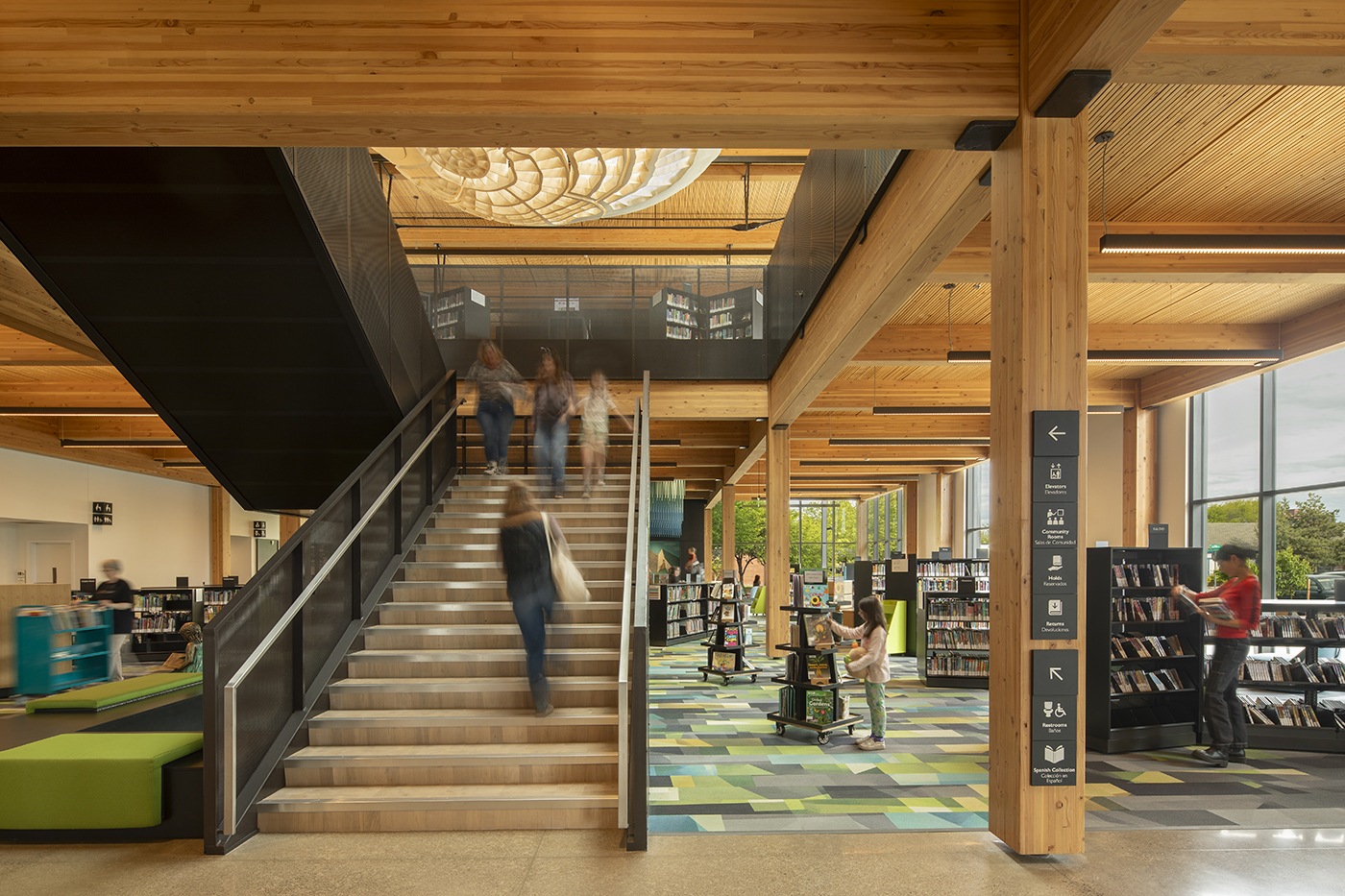
Inside, exposed acoustic dowel-laminated timber (DLT) ceilings and wood columns bring natural warmth and refined acoustics to the space. Libraries require significant acoustic mitigation, which can obscure exposed timber. By selecting acoustic DLT, the design team preserved the mass timber aesthetic while meeting the library’s specific sound performance needs.
A SYSTEM-WIDE STRATEGY
While the new Redmond Library is tailored to its local context, it is also part of a broader, county-wide initiative to modernize Deschutes Public Library’s entire network. Miller Hull, in partnership with Steele Associates, has led the design of six library projects across Deschutes County — including renovations, a replacement, and one entirely new library—under a once-in-a-generation bond measure.
Managing multiple concurrent projects across the system allowed the design team to implement a consistent approach to building controls and specifications. This shared protocol allows maintenance staff to work efficiently across branches and manage systems from a centralized platform.
At Redmond, this system-level thinking is most visible in the automated materials handling system used to sort and process returned items. While such equipment is often hidden from public view, here it is intentionally exposed near the book return, offering visitors a peek into how the library operates. It’s both a functional element and an engaging design moment, bringing transparency and curiosity into the patron experience. Staff areas were also designed with consistency in mind, creating shared protocols and layouts that ease transitions for employees who may rotate between branches. This standardized approach improves flexibility and reduces training time, helping the system function more like a connected network than a collection of disparate buildings.
DESIGNED TO GROW WITH ITS COMMUNITY
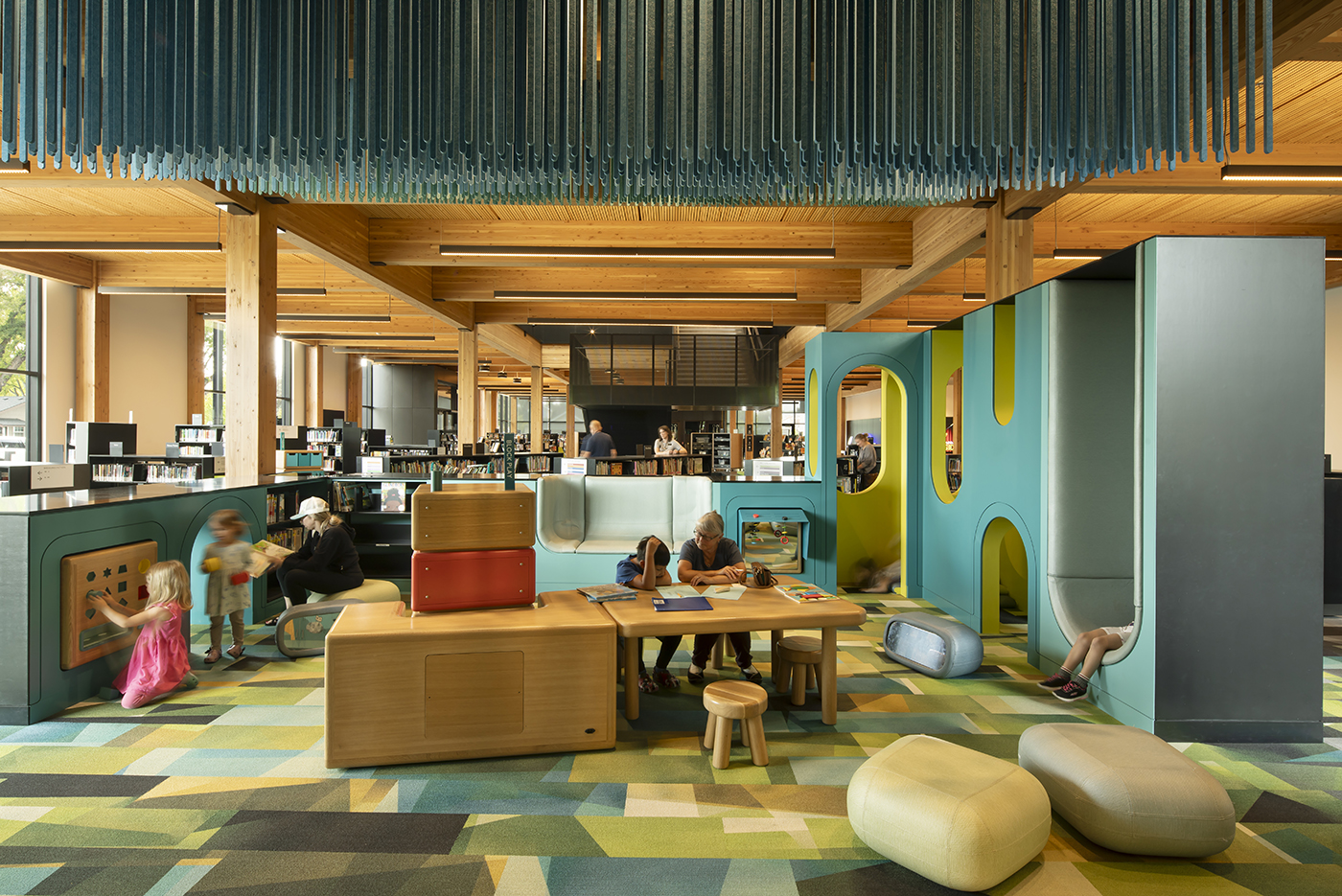
The Redmond Library reflects a broader transformation in how libraries serve their communities. Gone are the days of single-purpose rooms and fixed shelving. Today’s library must be able to host a robotics workshop one day and a civic planning meeting the next. Miller Hull responded to this need by designing large, unobstructed interior volumes with mobile shelving and reconfigurable furniture.
The maker space supports a wide range of programs—from sewing and craft projects to 3D printing—while the adjacent creative labs offer quieter, tech-ready environments suitable for podcasting or focused study.
Public art also plays a central role in shaping the visitor experience. Suspended above the central stair is a site-specific sculpture by Pacific Northwest artist John Grade.
Inspired by the cellular structure of local sagebrush and the obsidian flows of the nearby Newberry Caldera, the piece links Redmond’s natural landscape and complements the flow of the library’s interior. Positioned above the main staircase leading to the adult collection, the sculpture provides a thoughtful focal point for visitors as they move through the space.
A BLUEPRINT FOR THE FUTURE
The Redmond Library goes beyond replacing a building; it redefines civic space for a growing community and balances local character with system-wide efficiency, combining tailored experiences with standardized infrastructure.
As communities invest in public facilities, Redmond serves as a practical example of how libraries can function, the diverse communities they serve, and how they adapt over time.
Ruth Baleiko is a partner at The Miller Hull Partnership. Mathew Albores is a principal at The Miller Hull Partnership.
Other Stories:


