|
Subscribe / Renew |
 |
Contact Us |
| ► Subscribe to our Free Weekly Newsletter | |

Construction Bids
| home | Welcome, sign in or click here to subscribe. | login |


 print print  email to a friend email to a friend  reprints add to mydjc reprints add to mydjc |  |
 |
August 28, 2025

Clark
|

Decker
|

Twohig
|
In Spokane County, a once environmentally burdened industrial site now features a consolidated county operations center offering a model for civic transformation. The county’s first progressive design-build project, its success demonstrates a ‘proof of concept’ for efficient use of public resources.
For decades, county operations were scattered across several locations with outdated facilities. This included a site cluttered with obsolete structures, inefficient layouts, and the presence of asbestos from a previous industrial enterprise. But abandoning the site wasn’t an option, and the county pursued a sustainable redevelopment option.
Now, a new purpose-built, environmentally responsible, and future-ready operations center on 2.8 acres of remediated land provides a clean, efficient and well-coordinated county asset. Through the Progressive Design-Build (PDB) approach, a new campus of buildings was delivered two months ahead of schedule and $250,000 under budget — representing outstanding success in delivery and setting a benchmark for strategic, collaborative public works projects.
Before the transformation, Spokane County’s essential departments — such as the Bridge Crew, Signal Shop, Construction Inspection and the Materials Lab — worked out of deteriorating buildings that had outlived their mechanical and structural lifespans. Daily operations were hampered by gaps in communication and logistical inefficiencies, with improvements limited by poor environmental conditions. Recognizing the limitations, the county partnered with Garco Construction and Integrus Architecture through a Progressive Design-Build (PDB) model. This approach enabled the team to work closely from day one to align goals, solve problems collaboratively, and prioritize continuity of service throughout project execution to creation of something remarkable and built to last.
PHASED SOLUTIONS AND SMART DESIGN
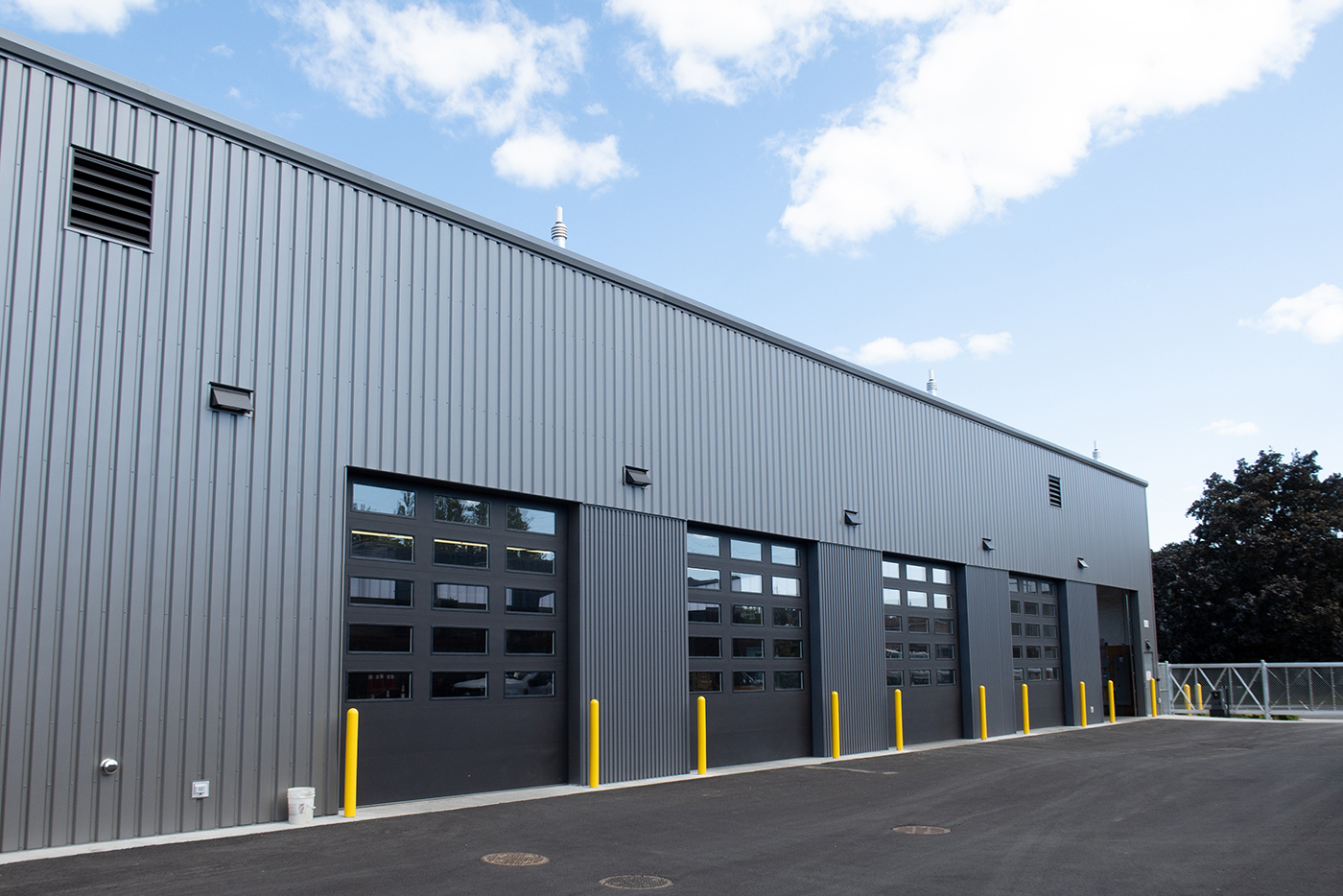
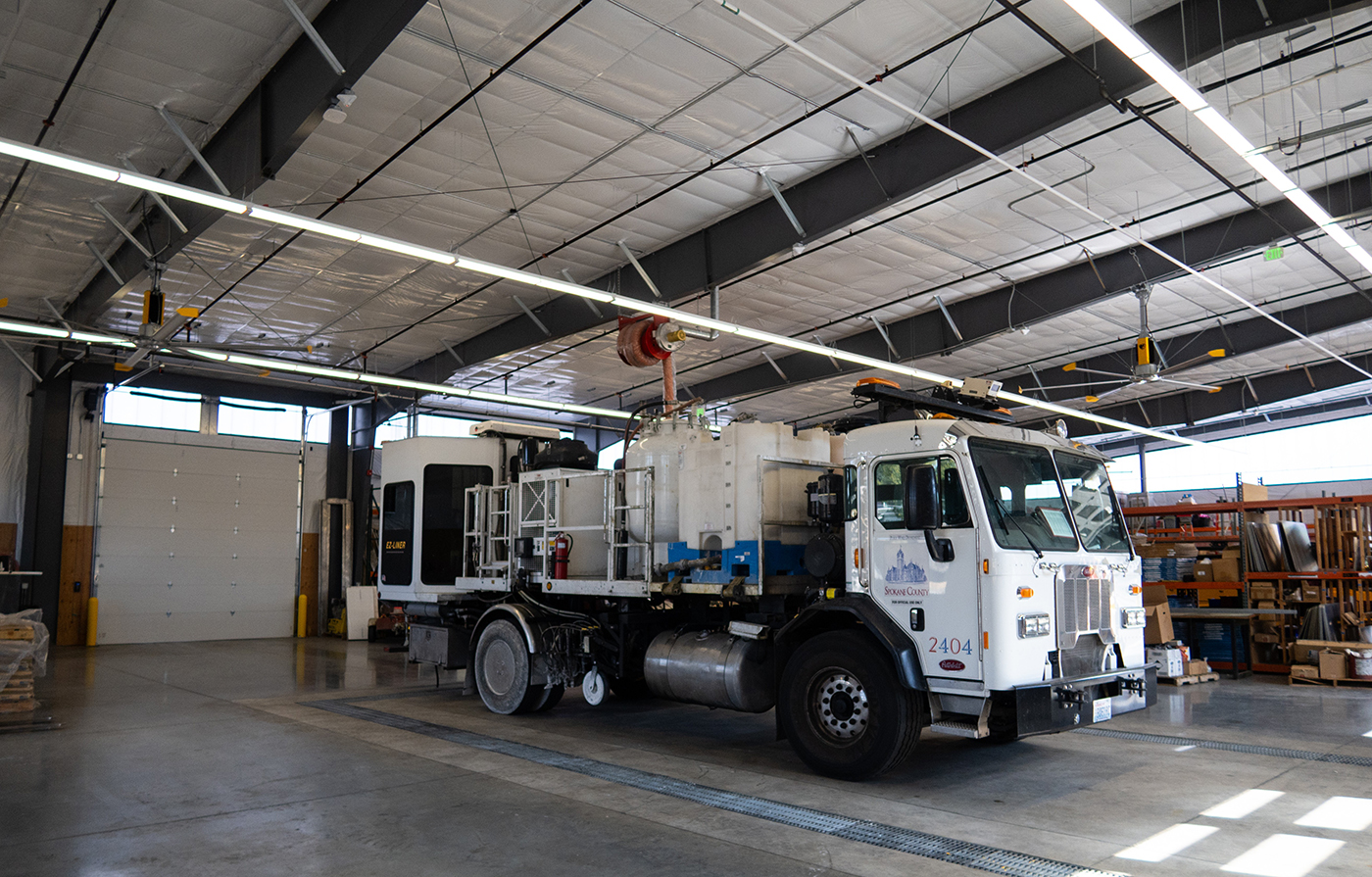
Following initial discussions and research, the collaborative design-build team developed three conceptual directions for consideration: the baseline “do nothing” reuse scenario, a monolithic structure, and the ultimately selected hybrid solution thoughtfully combining new construction in context of existing structures. It placed a new 16,000-square-foot shop and office building on the site along with an 11,500-square-foot pre-engineered storage facility. These structures combined previously dispersed departments into a centralized, flexible campus designed for operations, training, logistics, and equipment storage.
Phased demolition and infrastructure installations allowed construction to proceed while county services remained active elsewhere on the site. Buildings were only decommissioned once their replacements were ready. The county never stopped working — even as its workplace evolved around it.
ENVIRONMENTAL REMEDIATION WITHOUT DISRUPTION
The Spokane County Operations Center isn’t just about consolidation and modernization — it represents a successful example of environmental reclamation. It also provides additional security and operational enhancements for both the Ops and Fleet complexes. Once home to an early 20th-century asbestos manufacturing plant, the land and buildings held environmental risks that weren’t visible — but that could not be ignored.
While the site had remained in active use by county departments for years, construction risked disturbing those materials unless handled with precision. Rather than opting for costly and disruptive full-scale soil removal, the county and its design-build team chose to contain the hazard while reclaiming the land with a remediation strategy focused on encapsulation. Through a carefully phased approach, known areas of concern were addressed directly, while the broader site was shaped to shield and stabilize what lay beneath.
Buildings flagged with asbestos-containing materials (ACMs) were selectively abated and demolished under strict environmental protocols. In zones with contaminated soils, the team adjusted grading to avoid deep cuts and ensured utility work remained shallow enough to avoid disturbing contaminated layers. Surfaces were then sealed under new asphalt, concrete, or fill soil in landscaped areas. The contaminated soils remain safely buried and inert— no longer a threat or a barrier to progress.
A detailed level of coordination helped the team avoid surprises and maintain a tight timeline. The team ensured that safety, sequencing, and regulatory compliance remained central throughout — meeting the standards of Washington’s Department of Ecology while keeping the project on track. This precision engineering turned a once-dangerous industrial parcel into a safe and usable civic resource.
OPERATIONAL SYNERGY BY DESIGN
Relocating critical departments in close proximity with adjacencies, refined through design workshops and site logistics studies, dramatically improved operational coordination.
An added advantage came from what didn’t move: Spokane County’s fleet maintenance facility remained across the street. For the first time, departments that collaborated frequently were working in physical proximity, facilitating seamless daily interactions between field crews, dispatch, and equipment managers.
“Every element of the site layout was reviewed through the lens of operations,” said Kyle Twohig, Senior Director of Public Works, Spokane County Operations. “While change for staff is always disruptive and challenging, ultimate buy-in and satisfaction with the completed project came from being engaged in the process and driving decisions up from the crews to the project management team.”
This intentional planning — supported by Building Information Modeling (BIM) and continuous design workshops — allowed for effective adjacencies, functional workflow zoning, and space that can evolve as department needs change. Building finishes and materials were chosen not just for durability, but for long-term adaptability.
MEASURABLE RESULTS, TANGIBLE BENEFITS
The Spokane County Operations Center project achieved several impressive outcomes:
• Delivery: Completed two months ahead of schedule
• Budget:Finished project $250,000 under the original cost with all owner betterments taken
• Continuity: No interruption to county services during construction
• Environmental: Contaminated soils contained and rendered inert
• Functionality: Previously scattered teams now consolidated into a single, efficient hub
These results came from rigorous planning, collaboration and a commitment to public value at every step.
LESSONS IN CIVIC INNOVATION
The Spokane County Operations Center project offers several key takeaways for future public infrastructure initiatives:
• Design-build results grow with experience
This wasn’t the county’s first vertical D/B project — but it was one of the most complex. It showcased the evolving sophistication of Spokane County’s capital project strategy and a willingness to fully engage as design partners for real-time problem-solving, improving both outcomes and relationships.
• Phased construction protects continuity
Smart sequencing of demolition, utility cutovers, and new construction allowed staff to remain on-site throughout the project, avoiding expensive relocation costs and ensuring continuity of critical operations and services.
• Design supports more than space
From acoustics to adjacencies, and from daylighting to durable finishes, the team designed for workflow, workforce comfort and long-term adaptability. “Soft walls” and generalized zones make future reconfiguration simple and cost-effective.
• Hazmat doesn’t mean halt
Even with a complex environmental history, a tailored remediation plan made full redevelopment not only possible, but responsible and resilient. With the right strategy, even contaminated sites can be safely reused and transformed into community assets.
A BLUEPRINT FOR PUBLIC PROJECTS
The Spokane County Operations Center represents civic reinvestment, strategic coordination, and that progressive project delivery facilitates significant transformation when design and construction teams work together as collaborators from the start. The county has now used this model for numerous projects.
More than a replacement facility, it’s a symbol that with collaborative planning, smart design, and a willingness to engage with complexity, even the most daunting legacy public infrastructure sites can be reclaimed to provide communities with safer, more efficient futures through successful public investment and environmental renewal.
Steven Clark is an associate principal and design manager focused on civic projects at Integrus Architecture in Spokane. Rob Decker is vice president of Commercial projects at Garco Construction. Kyle Twohig is senior director of Spokane County’s Public Works Department.
Other Stories: