 |
Subscribe / Renew |
 |
Contact Us |
| ► Subscribe to our Free Weekly Newsletter | |

Construction Bids
| home | Welcome, sign in or click here to subscribe. | login |


 print print  email to a friend email to a friend  reprints add to mydjc reprints add to mydjc |  |
 |
August 28, 2025

Blazek
|
Nestled in the heart of Skagit Valley, the city of Mount Vernon is home to just over 36,000 people. Known more for its tulip fields and agricultural roots than high-performance design, this small city recently delivered a civic building that sets a new local benchmark for sustainability and performance: the Mount Vernon Library Commons (MVLC).
This all-electric facility combines a public library, community center, structured parking and the largest public electric vehicle (EV) charging station in the United States, all while pursuing Passive House certification, a rigorous standard for energy efficiency. Remarkably, the project was completed through a public bidding process and funded by about 20 sources, all without increasing local property taxes.
For architects, engineers, and public-sector leaders, Mount Vernon offers a powerful lesson: size, budget and location don’t have to limit what’s possible in civic architecture.
A MULTI-PURPOSE CIVIC BUILDING
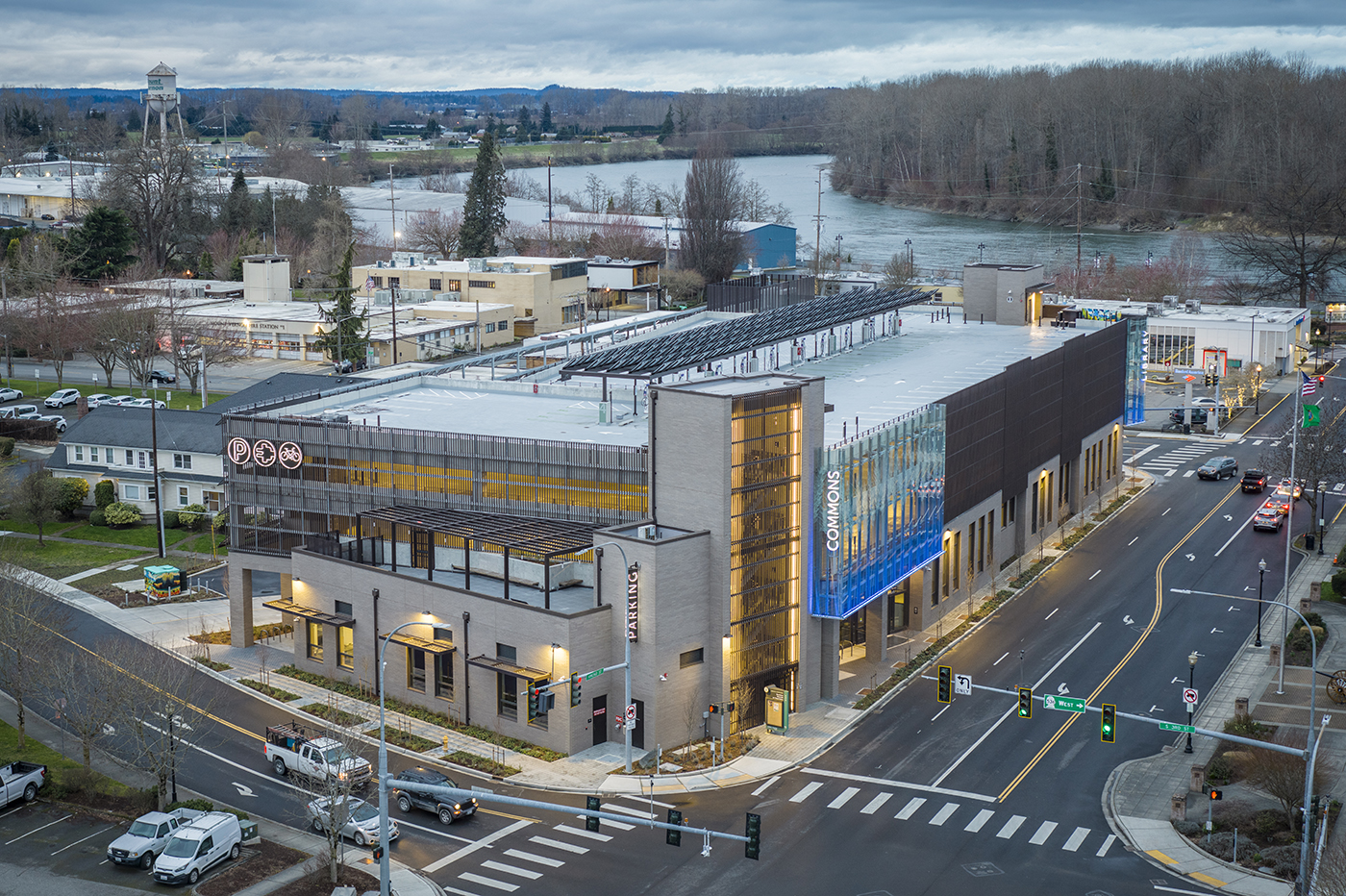
MVLC is more than a library. The building includes a community center, flexible event spaces, youth services and a commercial kitchen that supports local food entrepreneurs. Above, three levels of parking provide 268 stalls and 76 EV charging stations, with infrastructure ready for 200, making it the largest public EV charging facility in the nation.
Its location near Skagit Station, a regional transit hub, ties the project into a larger effort to encourage clean, multimodal transportation.
CHALLENGES AND SURPRISES OF PASSIVE HOUSE
Passive House certification requires meticulous attention to detail. The standard focuses on slashing energy demand through airtight construction, thick insulation, high-performance windows and efficient mechanical systems. While gaining traction in the private sector, it remains rare in public projects, especially those built through traditional low-bid processes.
Achieving Passive House on a publicly bid civic building meant working with construction crews unfamiliar with the standard. There was a learning curve, but with well-prepared contract documents, clear communication, and consistent site coordination, the team met the challenge. Once the crews understood the importance of eliminating thermal bridges, fully sealing penetrations, and following the insulation strategy, they became fully engaged and committed to getting it right.
The result is an extremely energy-efficient envelope that not only reduces energy costs year after year but also creates comfortable spaces throughout, even right next to windows. It also delivers clean, filtered air and exceptional acoustic performance that quiets the nearby street and train noise.
The results speak for themselves: the building’s energy use intensity (EUI) is about 12 — far below Washington state’s code maximum of 47 — and it passed blower door testing at four times better than code.
CUTTING CARBON FROM THE GROUND UP
The building’s size and program meant concrete was the best structural material, but concrete’s production is a major source of carbon emissions worldwide. The team made it a priority to reduce this impact.
Working closely with suppliers, the project team developed concrete mixes that replaced a portion of the cement content with lower-carbon alternatives such as fly ash, slag, and limestone, and by increasing the cure time. Concrete made up 55% of the building’s volume, and the team set an ambitious goal to reduce its Global Warming Potential (GWP) by 30—35%.
In the end, the project achieved a 41% reduction in GWP for the concrete work compared to typical construction. Just as importantly, the process helped raise awareness among trades and suppliers about the critical role materials play in reducing carbon emissions.
FUNDING WITHOUT RAISING TAXES
Financing a project of this scale and sustainability standard can be a hurdle for small cities, but Mount Vernon found a way. The $61 million project was funded through approximately 20 sources, including a $12.5 million grant from the Bipartisan Infrastructure Law, and a Transportation Infrastructure Finance and Innovation Act (TIFIA) loan, the first transit-oriented development in the country to receive such a loan.
Importantly, the city achieved all this without raising local property taxes, easing concerns about community affordability while making a long-term investment in resilience and equity.
WHAT THIS MEANS FOR OTHER PUBLIC PROJECTS
Mount Vernon shows that rural and smaller communities can lead on sustainability. The key was education, coordination and a willingness to push boundaries, even when that means more upfront effort.
By targeting Passive House certification through public bidding, the project demonstrated that these high-performance standards can be integrated into the traditional public procurement process. This creates a roadmap for other public agencies that want to build better buildings without relying on private developers or design-build approaches.
The project also highlights the importance of long-term thinking. While upfront costs increased by only about 3%, the resulting operational savings, improved comfort, and resilience to climate impacts make the investment worthwhile over the building’s lifetime.
A SPACE FOR COMMUNITY AND CLIMATE
Today, Mount Vernon Library Commons is already a vital community hub. It offers spaces where people can learn, gather, and access services in a healthy and inviting environment. The commercial kitchen hosts community classes and supports local entrepreneurs, while the parking garage and EV infrastructure encourage sustainable transportation.
The building’s Passive House features also increase resilience during extreme weather and wildfire smoke events, ensuring the facility remains a safe haven when the community needs it most.
Julie Blazek is a Partner at HKP whose design work has received numerous awards from AIA Northwest Washington and national recognition from the National Association of Home Builders.
Other Stories:


