 |
Subscribe / Renew |
 |
Contact Us |
| ► Subscribe to our Free Weekly Newsletter | |

Construction Bids
| home | Welcome, sign in or click here to subscribe. | login |


 print print  email to a friend email to a friend  reprints add to mydjc reprints add to mydjc |  |
 |
September 25, 2025

Legé
|
As we pack backpacks and lunches, students and parents around the Pacific Northwest are looking ahead to another exciting school year. As structural design partners, our thoughts turn to the types of schools in which our children learn. Will they be the traditional buildings of our youth, or better environments for learning and student health?
The materials we use to build our schools matter for our students. We can create beautiful, open spaces that use biophilic design to improve physical and mental well-being by leaning into the materials common to the Pacific Northwest. Mass timber, long overlooked by public schools, is finally becoming a material of choice for districts looking to create exceptional learning environments for students, faculty and their communities.
Wood buildings have multiple benefits, delivering healthier buildings for students and the environment. Students and faculty benefit from the biophilic features of wood buildings through better indoor air quality and environments that promote lower stress, resulting in better learning outcomes and higher staff satisfaction.
A highly sustainable material, mass timber delivers up to a 30% reduction in embodied carbon over steel. Improved forestry, including thinning for wildfire protection, doubles the sustainability benefits.
MODERN MASS TIMBER
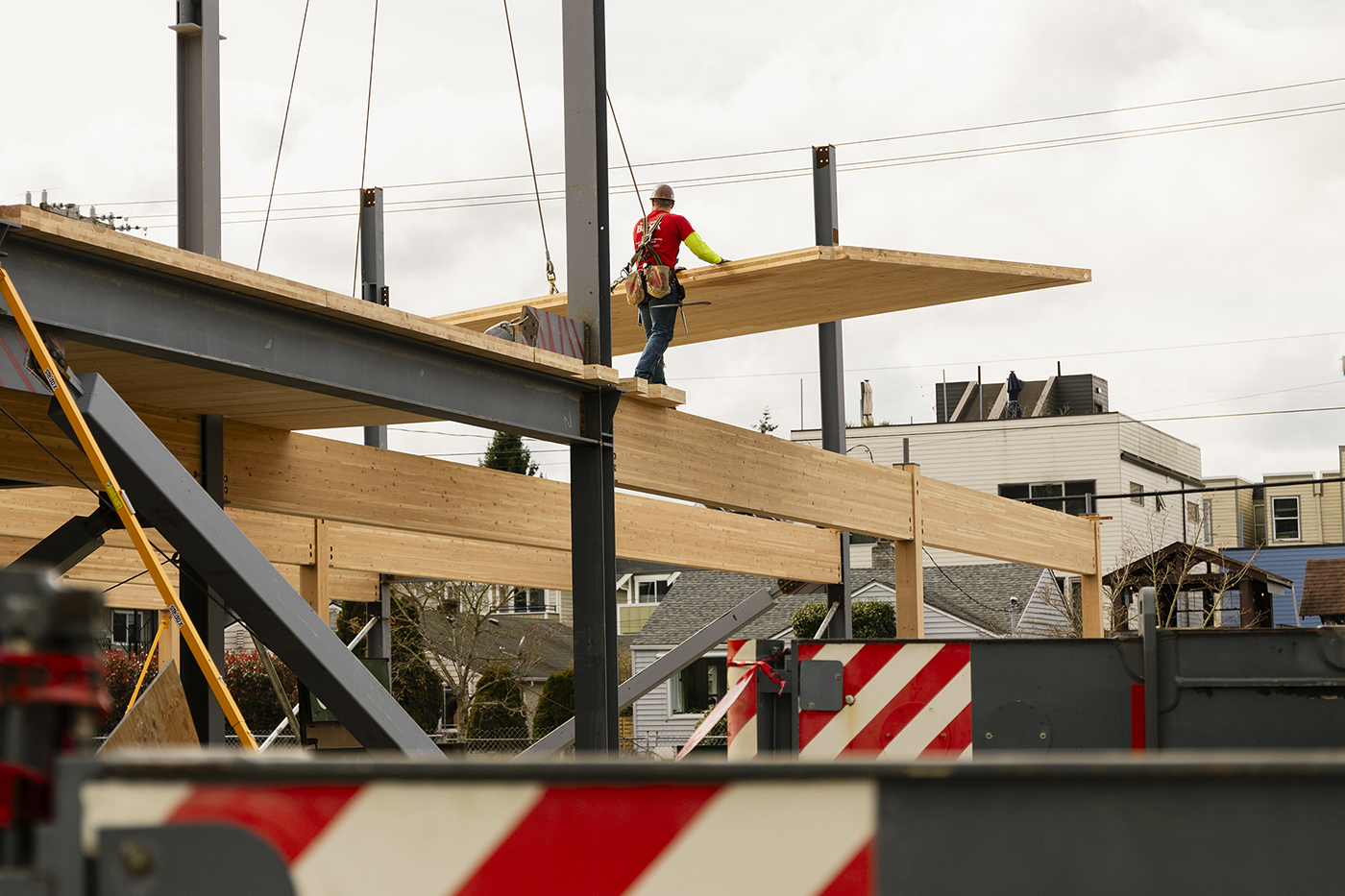
While large timbers were used in local schools at the start of the 20th century, modern mass timber is a new approach using large, engineered panels created from smaller glued timber pieces. The new material includes permutations such as Cross Laminated Timber (CLT), Dowel Laminated Timber (DLT), and glued and laminated beams and columns (Glulam).
Experienced teams have already developed and proved solutions to technical problems when building with mass timber, such as the building envelope, fire safety and seismic resistance. However, real and perceived challenges unique to school construction keep many schools using traditional construction materials.
These challenges are centered around three core issues: insurance, maintenance and construction costs. Fortunately, project advocacy by design professionals can help districts deliver mass timber schools that overcome these challenges and realize new benefits.
INSURANCE
Builder’s Risk insurance is a specialized type of insurance that protects buildings and materials during construction. Unfortunately, because the use of mass timber is so new, insurance providers don’t yet know how to price it and typically put a massive premium on the risk.
However, by starting to work with insurance brokers early in design, structural engineers at PCS have helped school districts navigate complicated paperwork and talk to brokers about our experience with mass timber schools, greatly reducing Builder’s Risk insurance costs.
At Seattle Public Schools’ 83,000 square-foot Alki Elementary, our team provided the insurance brokers with examples of successful schools, walking them through the real risk profile for the use of CLT and Glulam. The resulting policy cost was substantially lower than the initial quotes.
Joseph Mayo, associate principal at Mahlum, noted that “building experience in mass timber is critical. At Alki, demonstrating mass timber expertise was essential for attaining lower insurance rates and keeping mass timber on the table.”
MAINTENANCE
Some district facilities staff shy away from mass timber due to worries of vandalism and damage to exposed surfaces. However, having completed many schools with exposed timber, the PCS team has seen that students actually treat the wood structures with respect, more so than traditional drywall.
Some districts have taken a smaller-scale approach to incorporate timber construction. For example, Edmonds School District elected to use CLT panels and Glulam for their new 50,000 square-foot elementary school, and traditional steel for the remainder of the project at the College Place campus. The district wanted to reap the benefits of a mass timber learning environment but opted to take a lower-risk approach to see how the school would perform over time with younger students.
Similarly, North Thurston School district used DLT panels in their new student commons at River Ridge High School to take advantage of exposed structural wood with acoustic properties in the school’s premier space.
COMPARING COSTS
When structure alone is examined through a traditional cost per square foot lens, timber appears more expensive than steel, but when we look more closely at the real, holistic costs of both materials, timber becomes much more cost-competitive. Mass timber buildings are lighter, reducing foundation costs and the size of lateral bracing. They can also be constructed 25% faster on average than structural steel, with prefabricated assemblies driving construction efficiency and safety.
At Highline School District’s new Evergreen High School, PCS performed a holistic comparison of structural steel and mass timber. We factored the ability to deliver a highly efficient structural system, reduced finish costs and construction efficiencies to see the real cost differential. Looking at the final costs of construction versus only the first cost of material, CLT panels and glulam were clearly the more cost-effective choice for the three-story 90,000 square-foot building.
Kristian Kicinski, principal architect at Bassetti Architects, reflected on the project: “We saw a real schedule benefit by using CLT. Erection of the mass timber took about seven weeks, compared to 10—12 weeks that steel erection would have taken. That’s not including the time for metal deck and concrete deck pours; you can walk on the CLT decks right away. It was a boon to the construction team.”
“As our general contractors get more familiar with mass timber, we expect they will get more confident about including the schedule advantages into their pricing, and that will keep mass timber competitive with the cost of steel,” Kicinski said.
MORE EFFICIENT BUILDINGS
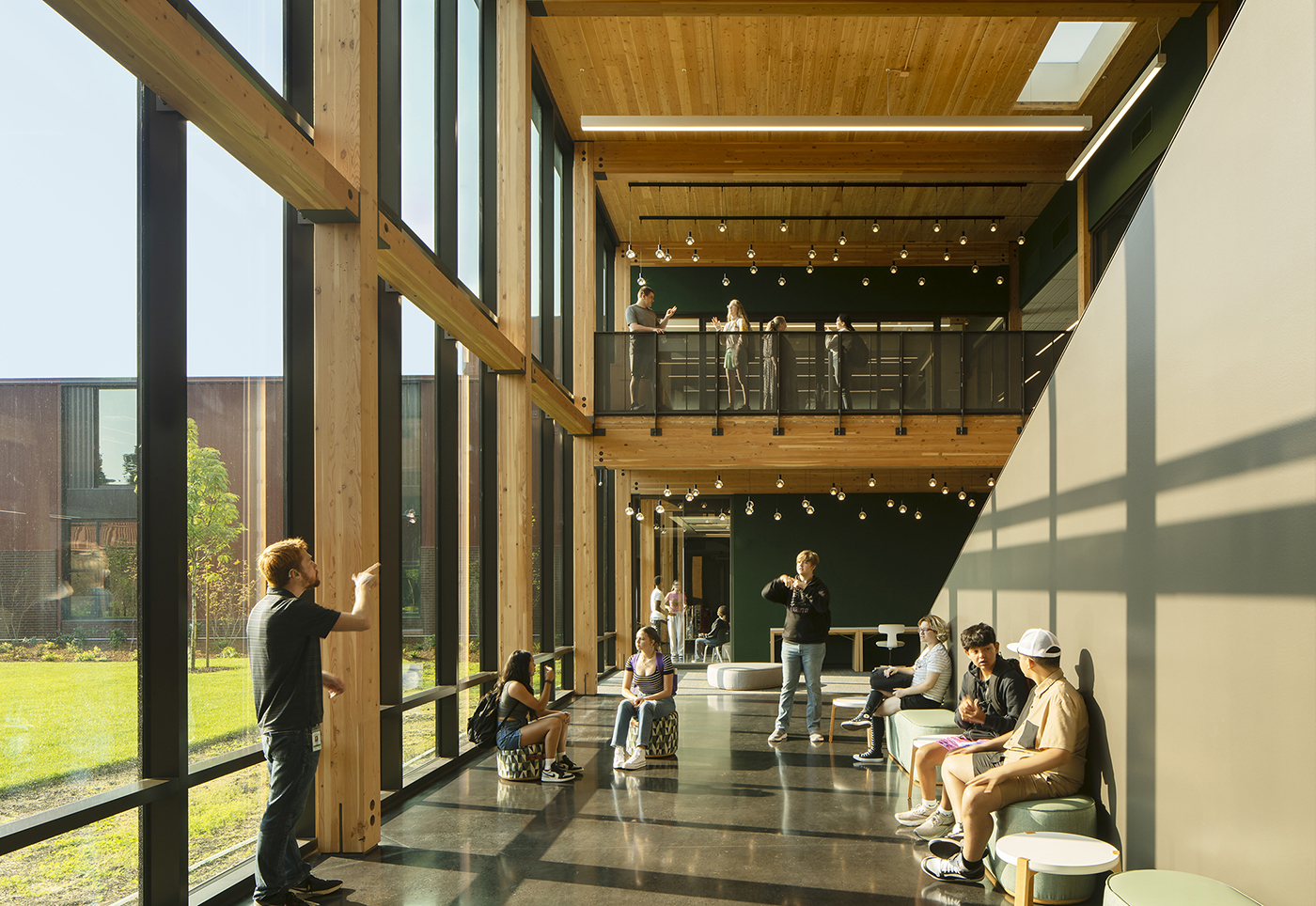
PCS worked with our design partners to develop structural layouts that work with a breadth of programming options, reducing the complexity of the structural system and significantly reducing costs. Achieving the cost advantages requires early collaboration between structural designer and architect to adapt the program to fit the simpler structural system.
As Matt Everett, senior project manager with Cornerstone General Contractors said, “The team matters—choosing an experienced team and engaging in early planning delivers the greatest impact in reducing project costs, preventing downstream maintenance issues and streamlining the builders risk procurement process.”
At the 50,500 square-foot, two-story Washington School for the Deaf Divine Academic Building in Vancouver, Wash., PCS collaborated with design-build team Skanska and Mithun to deliver a rigid, simple grid system of CLT panels and glulam which reduced overall costs for a beautiful, open learning environment.
JoAnn Wilcox, project designer with Mithun explains: “WSD is designed with a focus on functionality and flexibility that optimizes the use of wood fiber for cost performance. The design enhances the efficiency of mechanical system routing and reduces the building’s overall height while maintaining high ceilings, improving daylight penetration and ensuring even illumination of the wood surfaces. This system enhances both Deaf education and occupant wellbeing — reducing stress and increasing engagement in a home-like learning environment.”
Schools are a public resource that impacts thousands of students, parents, educators and the broader community. Kicinski summarizes: “As staff and students began occupying [Evergreen High School], I was struck by how often they said they loved the wood structure. The wood structure appeals to them viscerally; it makes them feel good. That’s very powerful.”
These examples prove that school districts can deliver better learning environments within their limited construction budgets while attaining the natural benefits of our most plentiful local construction material.
Alex Legé is an industry expert in mass timber design and principal in PCS Structural Solutions’ Seattle office.
Other Stories:


