 |
Subscribe / Renew |
 |
Contact Us |
| ► Subscribe to our Free Weekly Newsletter | |

Construction Bids
| home | Welcome, sign in or click here to subscribe. | login |


 print  email to a friend  reprints add to mydjc |  |
 |
October 22, 2026

Hindmarsh Wilcox
|
We have long known that the learning environment itself can serve as a “third teacher,” creating opportunities for active learning, discovery and student choice. This approach is becoming even more important as artificial intelligence changes how people find and use information. Students still need knowledge, but they also need to question, create, imagine and think critically, to use information, test ideas and respond to a changing world.
Schools can build these skills by creating spaces for provocation: purposeful learning experiences that begin with a question, material or challenge and invite students to explore possible answers.
How can design provoke expanded, student-led learning?
Educators describe two related forms of discovery: invitations and provocations. An invitation encourages students to interact with materials without a specific outcome. A provocation adds a learning goal, guiding question or creative overlay, moving students from casual exploration toward deeper thinking.
Both approaches are valuable. This article focuses on how school design can support provocations in shared, flexible environments where students can explore an idea, return to it and develop it over time.
Time is essential to this process. Meaningful discovery rarely fits within a single class period. When students can revisit an experiment, model or question over days, weeks or months, they are afforded time to make novel connections and test innovative approaches that build understanding.
Case study: a new facility centered on creativity through provocation
The Evergreen School is an independent school in Shoreline serving highly capable students in preschool through eighth grade. Creativity shapes both its curriculum and its campus. Curiosity drives deep and meaningful learning, and Evergreen students thrive when their questions help guide the process.
So, when planning a campus expansion for its preschool through kindergarten programs, the school partnered with Mithun to create spaces that spark wonder and connect ideas across subjects through questions, hands-on making and experiences beyond the classroom.
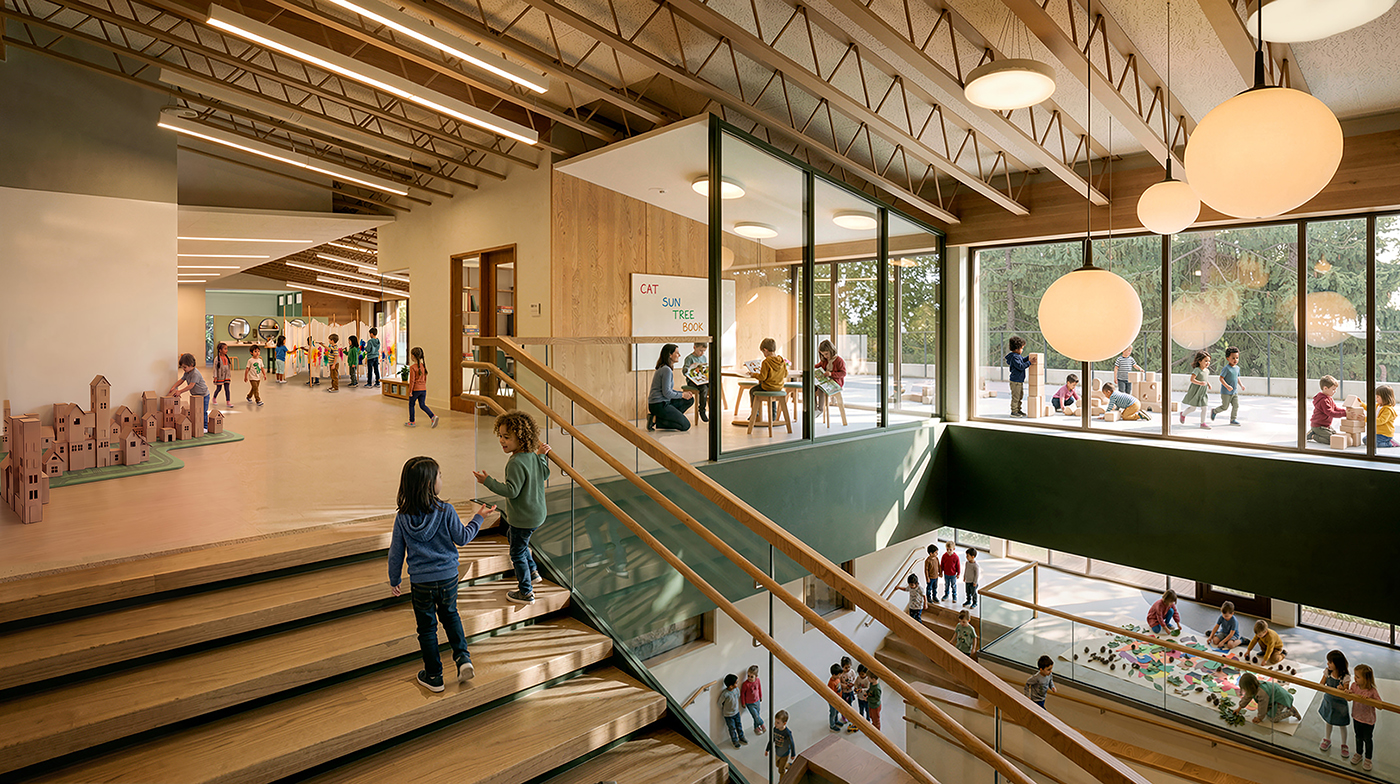
The school needed spaces that could support its provocation-based curriculum and respond to students’ rapid academic and social-emotional development between preschool and kindergarten, so Mithun began with a yearlong, teacher-led study of how learning happens at Evergreen.
A key finding was that young learners engage with their physical environment more than any other age level. And a project can lose its value if it must be packed away after an hour or each day. Children need places to leave work in progress, return to it and follow their curiosity at their own pace.
Students also engage with provocations differently as they mature. Preschool students may learn best in small groups rotating among activities, while kindergarten students can work in larger groups, sustain attention longer and pursue more complex investigations. Mithun’s design solution creates spaces for provocation that remain familiar from year to year but gradually transform to support growing agency.
Creating dedicated space for long-term exploration
Evergreen’s earliest learners needed places to experiment, tinker, play and solve authentic problems in big spaces specifically designed for little bodies. So, the design provides dedicated areas where creative work in progress is visible, and projects can remain in place.
This concept builds on Evergreen’s BIG Lab — short for Build, Imagine, Grow — an existing maker space for older students. For younger learners, it became a series of age-appropriate studios, or ateliers, inspired by the Reggio Emilia approach:
• Preschool students use several small, comfortable exploration areas with clear boundaries.
• Prekindergarten students share a larger communal space.
• Kindergarten students use three interconnected spaces that support learning across subjects.
These open-ended “creativity ateliers” invite children to experiment, persist and solve problems in spaces that can be connected or contracted to suit the activity. Sliding doors connect studios with classrooms, outdoor learning areas and one another, while features for art, science and construction support projects that cross traditional subject lines.
Classrooms and the ateliers form connected learning suites. Learning areas are organized by size, materials and function rather than by a fixed number of seats. And each suite, in turn, connects directly with outdoor learning and play space. This approach gives teachers more ways to organize students and activities, and allows projects to move among settings as they develop.
Leveraging multipurpose communal spaces for exploration
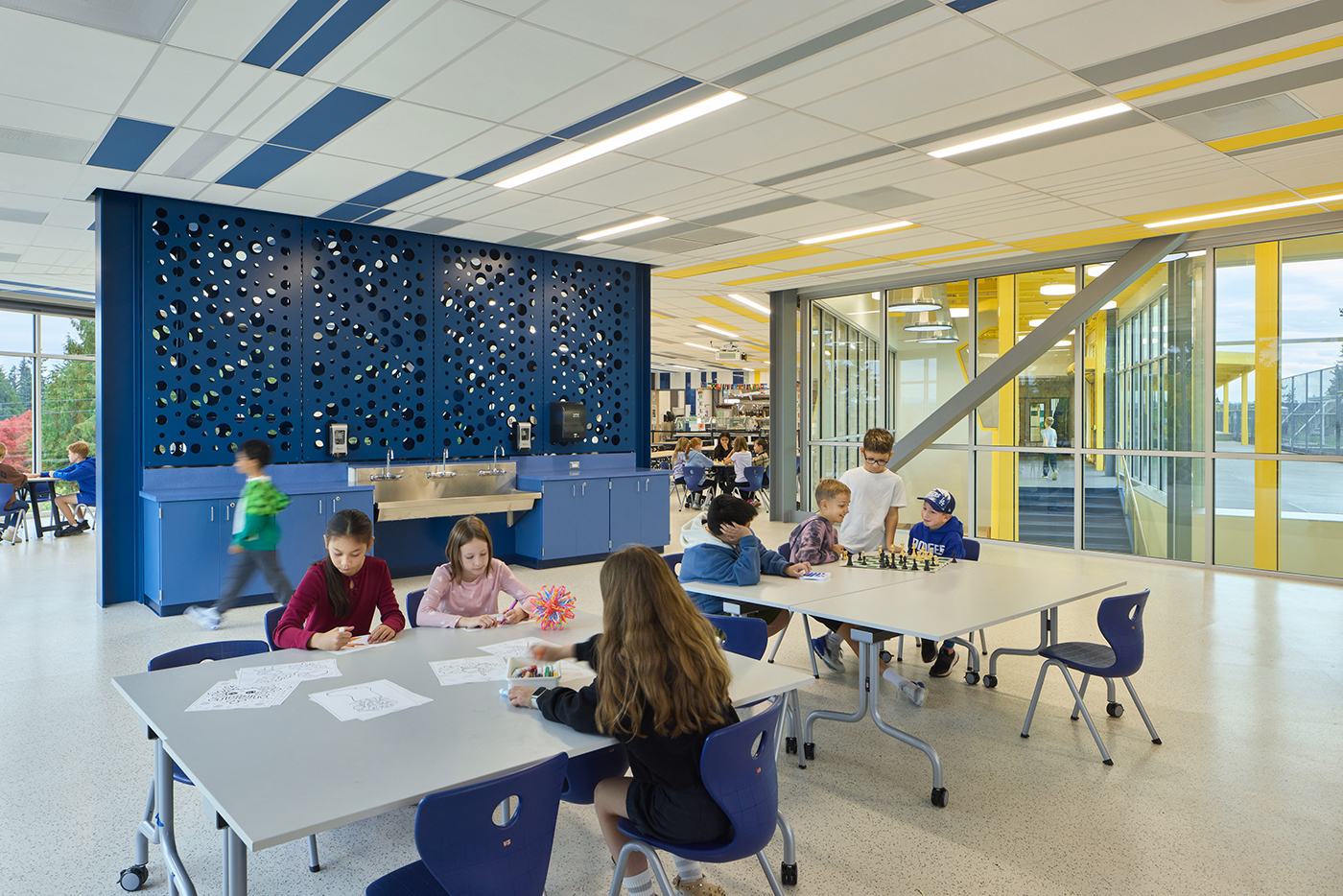
A school does not need a specialized curriculum on creativity to benefit from space for student exploration. With a recent classroom addition to increase student capacity at Maywood Hills Elementary School, the Northshore School District also needed to increase space for multipurpose activities and enrichment programs, without adding rooms dedicated to single use. Mithun’s design solution was to place an open learning studio with features for art, making, science and exploration adjacent to a new dining space, forming an expandable, flexible innovation hub.
The spaces work separately or together. The studio supports quiet dining at lunch and group learning activities throughout the day, while the dining space provides overflow space for projects as needed. Its location between the entry and playground places creativity-in-learning along a route students use regularly, increasing visibility and access. As a result, engagement with, and program diversity of, enrichment programs is increasing.
Maywood Hills shows how strategically designed, flexible, visible space for creativity can broaden participation within an existing program and limited footprint.
Design principles for spaces of provocation
Both Evergreen and Maywood Hills point to several adaptable strategies:
Support varied activities. Design spaces that can shift easily between individual work, small-group discovery, large-group collaboration and hands-on making, that supports teaching across subjects and collaboration among educators.
Put exploration along everyday paths. Locate project areas where students already travel and gather. Visible and accessible spaces invite participation and agency.
Connect subjects and materials. Place clean, messy, wet and dry work areas near one another so projects can easily combine art, science, technology, writing and building.
Make tools accessible. Provide student-height storage, work surfaces and materials so students can find, use and return resources independently.
Separate adult resources. Provide educators planning, preparation and storage nearby, so adult materials do not take over the learning environment.
Use technology purposefully. Accommodate digital media tools, 3D printers and audio equipment to support research, documentation and multi-media creation.
Let work remain in place. Value space for creativity early and track it in space planning; long-term access allows students to test ideas, learn from mistakes and improve their work.
Giving curiosity room to grow
A space for provocation is not defined by one room type, piece of furniture or technology. It is an environment that gives students time, choice, useful tools and permission to follow a question.
At Evergreen, connected ateliers support a learning model rooted in curiosity and long-term exploration. At Maywood Hills, flexible shared space expands access to mixed-media activities throughout the day. In both cases, design helps students take a more active role in learning.
When schools create visible, adaptable and respectful environments that support agency, safe risk, and discovery, space becomes more than a backdrop. It becomes an active part of the learning process and gives curiosity room to grow.
JoAnn Hindmarsh Wilcox is a partner at Mithun and education practice leader with national influence on PK-12 and higher education design.
Other Stories:


