 |
Subscribe / Renew |
 |
Contact Us |
| ► Subscribe to our Free Weekly Newsletter | |

Construction Bids
| home | Welcome, sign in or click here to subscribe. | login |


 print  email to a friend  reprints add to mydjc |  |
 |
October 22, 2026

Schafer
|

Campanella
|
The true value of a school building is measured by the learning experiences it inspires. At Tyee High School in SeaTac those experiences emerged when an innovative teacher worked with architects to transform the school’s sustainable design features into opportunities for hands-on, real-world science learning.
When Melissa Chance, a Career and Technical Education (CTE) teacher and leader of Tyee High School’s Environmental Leadership Program, was recruited to develop Highline Public Schools’s Environmental Leadership Pathway, she envisioned a program that would help students better understand the world around them and their role in shaping its future.
In the program, students earn science credit by exploring environmental issues affecting their own communities, investigating solutions and learning how individual actions can create meaningful change.
“We want them to see that their community is important to them, how to have the hard conversations and learn together,” Chance said.
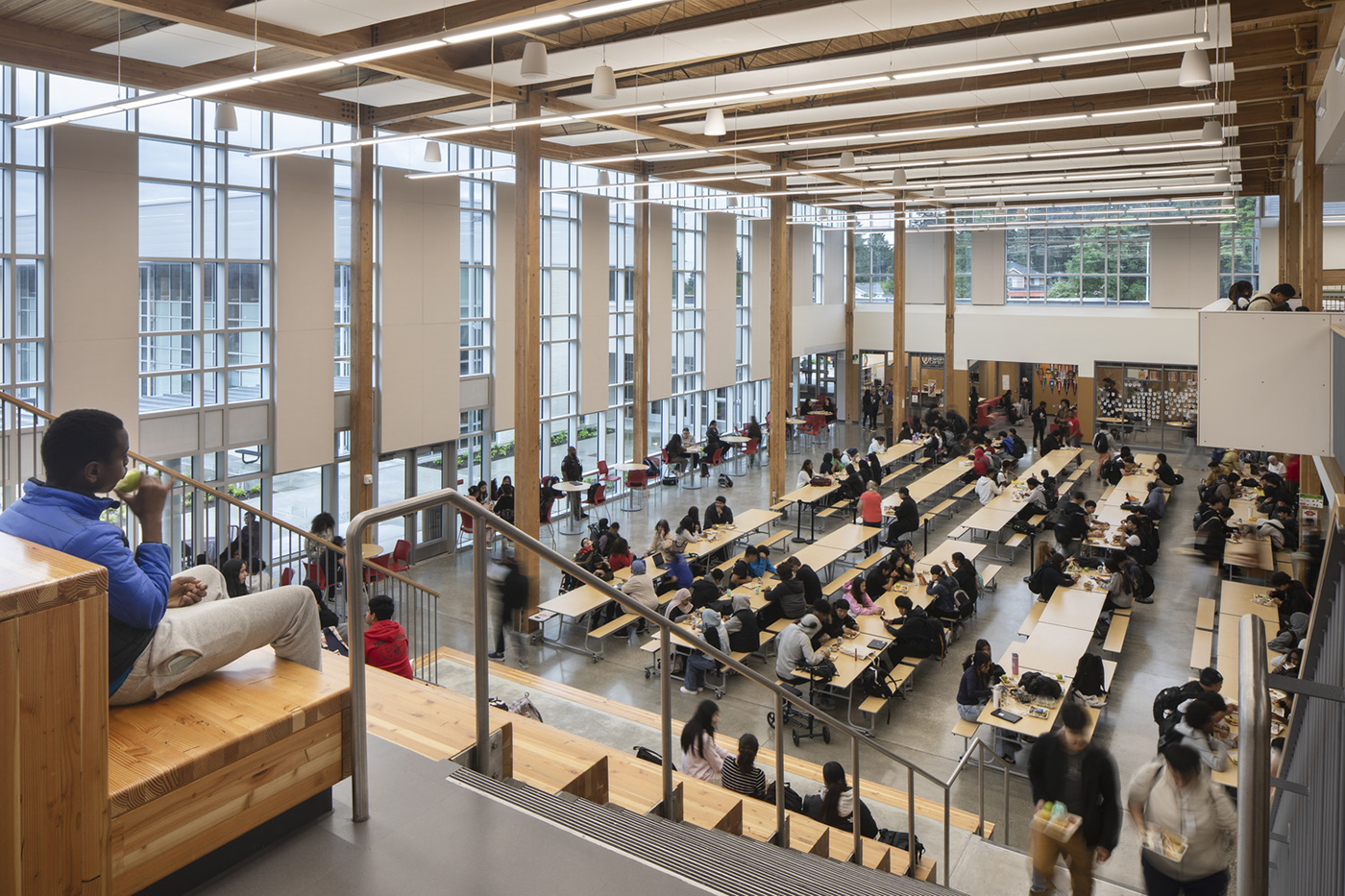
At the same time, Integrus Architecture was designing the new Tyee High School building. The team designed the building around principles of decarbonization, health and wellness, place and stewardship. Those principles informed everything from the school’s mass timber structure and daylight-filled learning environments to its native landscapes, rain gardens, solar panels and sustainable materials.
For Chance, the connection was immediate.
The vision for her program was never intended to be confined to a classroom. Instead, it centered on helping students engage directly with the environmental challenges and opportunities surrounding them. The new Tyee High School offered a powerful extension of that approach.
The same principles that guided the building’s design were the very concepts students were learning through the Environmental Leadership Program. Stewardship, resource conservation, healthy environments and sustainability were no longer abstract topics. They became visible and tangible through the architectural designers’ materials choices, systems and landscapes.
A BUILDING DESIGNED TO TEACH
For Chance and her students, the school’s sustainability features quickly became more than design elements. They became teaching tools.
Questions about climate and carbon came to life through Tyee’s mass timber structure and material reuse strategies. Lessons about water quality and ecosystem health connected directly to the campus rain gardens, bioswales and native landscapes. Concepts related to health and wellbeing became tangible through daylight-filled learning environments, views to nature and spaces intentionally designed to support comfort, belonging and student success.
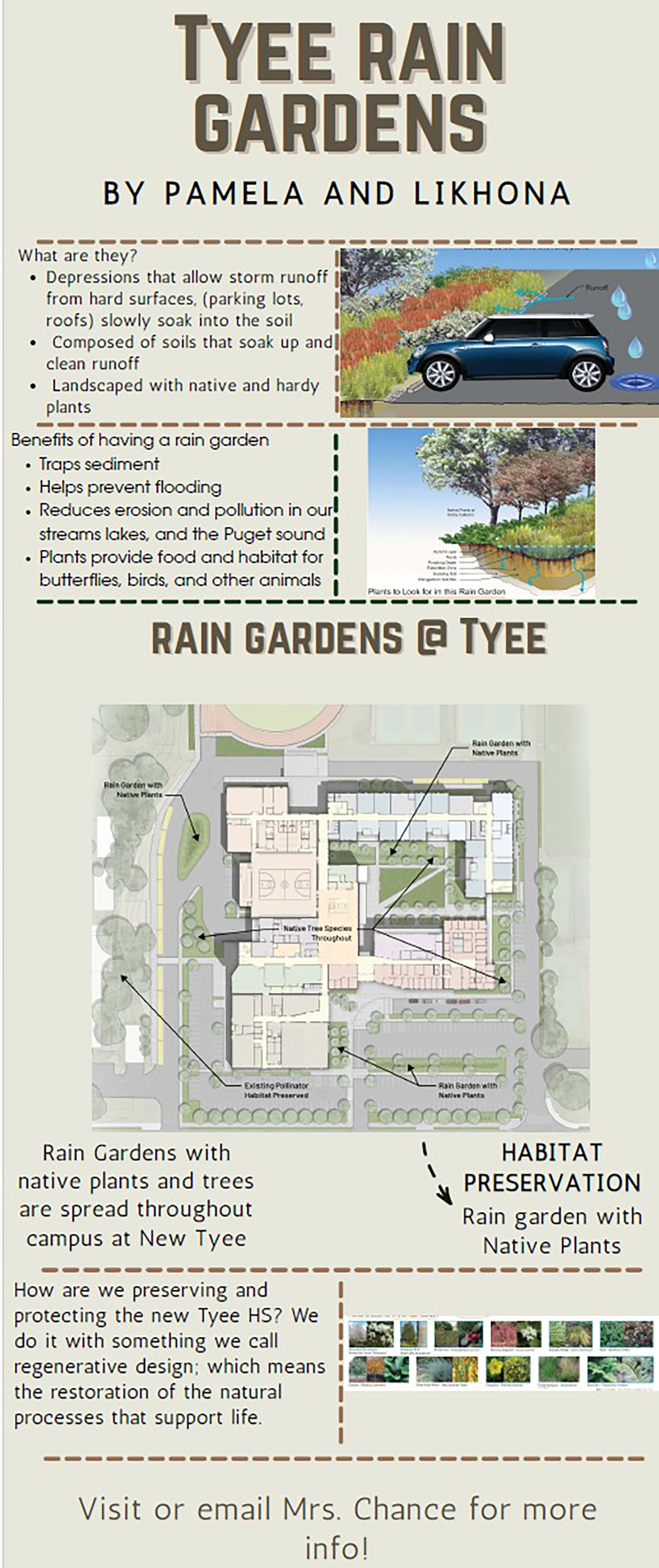
Recognizing the educational potential embedded within the building, Integrus Associate Principal Sam Schafer and architects Alexandra Forin and Will Crothers, members of the original Tyee design team, continued their involvement long after construction was complete. Inspired by the project and by Chance’s innovative approach to science education, they continued working alongside her to help students understand not only what sustainability features existed throughout the campus, but why those decisions mattered and how they influence environmental and human outcomes.
Students explored topics such as carbon sequestration, stormwater management, daylighting, renewable energy, native ecosystems and material reuse. They selected sustainability features throughout the campus to research and interpret, transforming their findings into district leadership presentations, educational posters and permanent informational plaques that will help future students understand the stories embedded throughout the school.
The partnership also gave students direct access to the professionals who helped shape their learning environment. Through conversations with architects, landscape architects, engineers, educators and community partners, they gained insight into how people from different disciplines collaborate to address real-world environmental challenges.
In the process, students became more than learners. They became interpreters, educators and stewards of their own school.
FROM DESIGN INTENT TO STUDENT AGENCY
The Environmental Leadership Program was never intended to be just another science class. Nor was Tyee High School designed simply to house students for six hours a day.
Instead, both were created to foster a deeper understanding of the connections between people, place and the environment.
The result is a feedback loop that extends far beyond construction. Design inspires curiosity. Curiosity leads to learning. Learning fosters stewardship. And stewardship, in turn, helps students recognize that they have the power to shape the future of the places they care about.
That transformation is what excites Chance most. Some students enter the program simply needing science credit or looking for a more engaging way to connect with science. Others arrive with little interest in sustainability or environmental issues. Yet through hands-on learning, community partnerships and meaningful connections to their surroundings, many students have developed a deeper interest in science and a greater appreciation for the role they can play in their communities.
Reflecting on those changes, Chance said, “I have won some kids over.”
Together, the program and the building demonstrate what is possible when educators and designers work together toward the same goal, helping young people understand their relationship to the world around them and empowering them to influence it.
In that way, Tyee’s most important sustainability feature may not be its rain gardens, mass timber structure or daylight-filled classrooms. It may be the students themselves, who are learning that stewardship is not something a building does. It is something people choose to practice every day.
Sam Schafer is an associate principal specializing in education architecture and Tina Campanella is director of business development and marketing at Integrus Architecture.
Other Stories:


