 |
Subscribe / Renew |
 |
Contact Us |
| ► Subscribe to our Free Weekly Newsletter | |

Construction Bids
| home | Welcome, sign in or click here to subscribe. | login |


 print print  email to a friend email to a friend  reprints add to mydjc reprints add to mydjc |  |
 |
November 20, 2025

Aalfs
|
After 17 years of vacancy and extensive damage from fire, earthquakes and weather, the 1892 Metropole Building has been given new life. Working with our client, the Satterberg Foundation, our design team, and the contractor team, we have transformed this historic Pioneer Square landmark into a center for nonprofit organizations advancing equity and community resilience. Through a blend of preservation, high-performance design, and social purpose, the project shows how restoring the past can help build a more sustainable and just future.
A COMMUNITY-FIRST APPROACH
The building’s mixed-use program was shaped by extensive engagement with nonprofit leaders, community advocates, and local residents. Through focus groups, interviews, and public meetings, we identified key needs, including affordable child care, office space for nonprofits, conference and event facilities, cultural and arts spaces, and a community kitchen. These priorities guided design decisions and ensured that the building would serve as a long-term resource for underserved communities at risk of displacement in downtown Seattle.
HISTORIC PRESERVATION MEETS TECHNICAL INNOVATION

Exterior restoration work repaired the building’s earthquake-damaged masonry structure, preserved the original Tenino sandstone and brick facades, and reconstructed missing architectural elements, including the cornice and prism glass skylights in the sidewalk that illuminate the basement. Two upper floors that collapsed during the 1949 earthquake were reconstructed as well.
Inside, we preserved exposed brick, stone, timber, and steel while minimizing new finishes to reduce embodied carbon and maintain material integrity. Historic cast iron columns and heavy timber framing were restored and reused wherever possible. New additions—a fire-rated glass-enclosed stairwell, rooftop terraces, and rehabilitated sidewalk areaways—support code compliance and enhance the experience of building tenants and users.
The building’s structure required a careful blend of preservation and technical upgrades. A hybrid approach to the seismic retrofit combines new steel moment frames and concrete shear walls with strengthened and repaired 135-year-old masonry walls. The team used 3D scanning and BIM to document existing conditions, guiding the restoration and reconstruction process to maintain historic character while meeting contemporary safety standards.
SUSTAINABILITY LEADERSHIP THROUGH COMMUNITY IMPACT
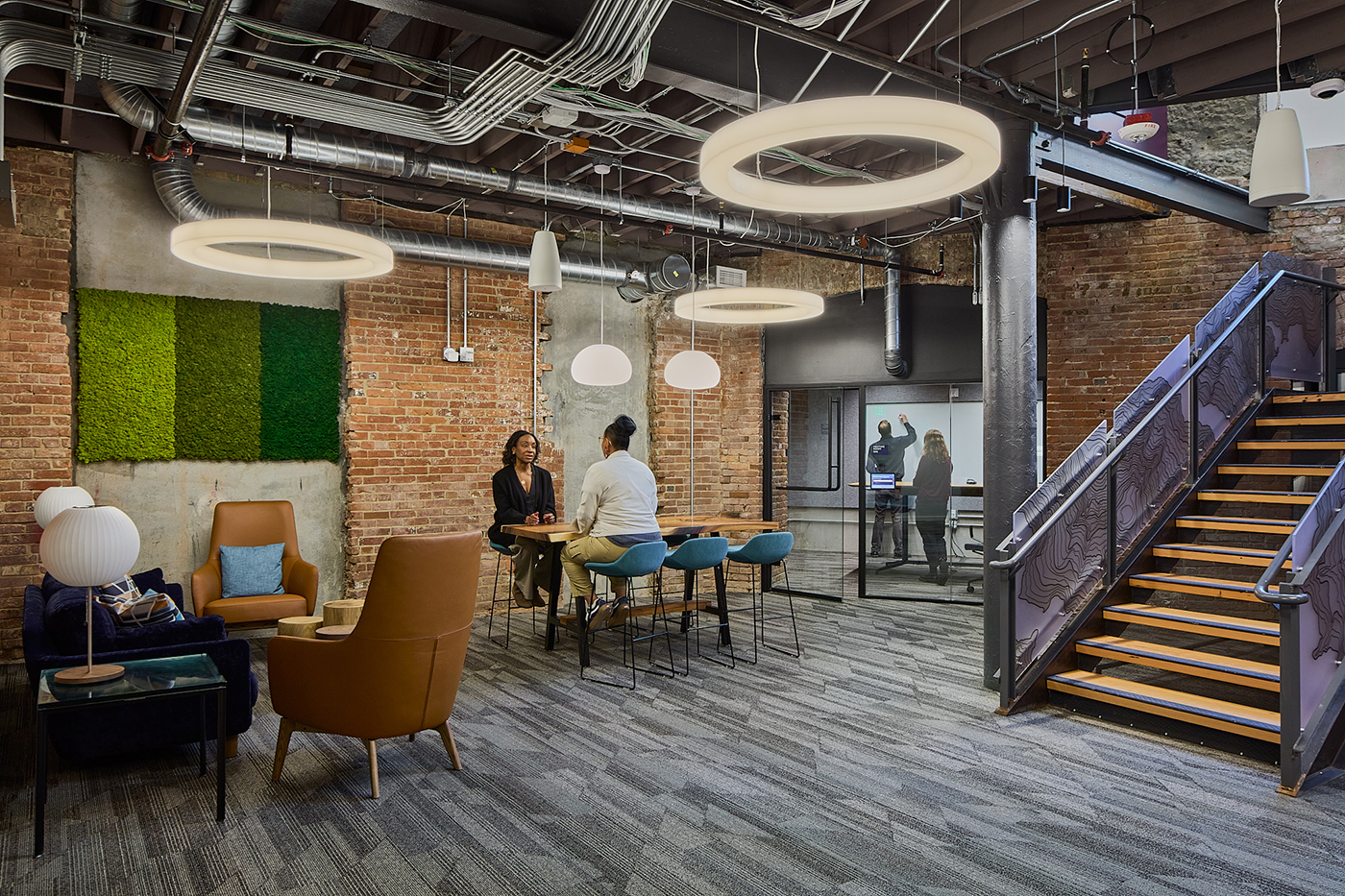
The Metropole Building’s environmental and energy performance is exceptional. With LEED Platinum certification and an Energy Use Intensity (EUI) of just 18, the building ranks among Seattle’s lowest-energy-use buildings across all sectors. An innovative HVAC system combines air-to-water heat pumps, hydronic radiant heating, and passive chilled beam cooling, with a dedicated, very high efficiency outside air heat recovery system.
Natural ventilation is managed with green light / red light displays in each space, which guide occupants to operate windows in coordination with the HVAC system, supporting comfort and energy efficiency. A new triple-glazed wood curtainwall system at the street level and triple-glazed double-hung wood windows at the upper levels help make a tight thermal envelope. Overall, the building offers a 65% reduction in energy use compared to the baseline.
On-site photovoltaic arrays with battery storage supply over 10% of the building’s energy needs, and fossil fuel use and Red List materials were eliminated. Water-saving strategies reduce potable water use by over 40%, while reflective and vegetated roof surfaces help mitigate urban heat island effects. Minimal use of added new finishes, reuse of existing historic materials, and careful material selection further reduce carbon impact while promoting occupant health. Alternative transportation is supported with bike storage, showers, and access to public transit.
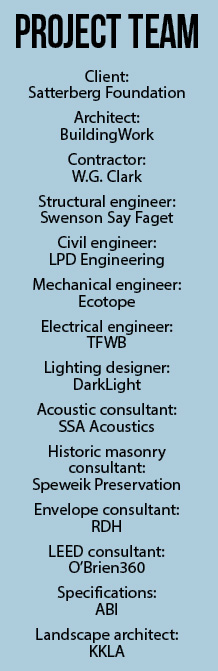
Through these strategies, sustainability extends beyond energy performance. By supporting nonprofit organizations focused on equity, social justice, and cultural preservation, the building strengthens community resilience and ensures that environmental improvements benefit people as well as the planet.
BALANCING PRESERVATION, MODERN CODES AND COMMUNITY NEEDS
Navigating historic preservation requirements, accessibility, seismic upgrades, and sustainability goals proved to be a complex set of challenges. Throughout six years of design, permitting, and construction, we continually balanced these priorities with the needs of the community. The project demonstrates that historic adaptive reuse can achieve cutting-edge environmental performance while reinforcing cultural identity and social equity.
A CIVIC ANCHOR FOR EQUITY AND INCLUSION
Today, the Metropole Building is a hub for nonprofit tenants and public-facing amenities, including a child care center, community kitchen, conference and event spaces, and arts venues. A permanent art collection, curated with input from local artists and community advocates, celebrates cultural heritage and reinforces inclusivity.
By restoring a long-vacant historic building and embedding it with equity-centered programming, the project shows that adaptive reuse can advance climate action, social equity, and urban resilience simultaneously. The Metropole sets a precedent for how historic structures can be transformed into low-energy, community-centered facilities without losing their essential character.
LOOKING AHEAD
The Metropole Building Project exemplifies the potential for historic buildings to serve as engines for social, environmental, and cultural impact. Its combination of innovative engineering, sustainable design, and community-first programming positions it as a model for adaptive reuse in urban historic districts, illustrating how preservation and sustainability can create meaningful social, environmental, and cultural benefits.
Matt Aalfs is the founder of BuildingWork, where he leads the design of civic, community, adaptive reuse and historic preservation projects that advance environmental, cultural and social impact.
Other Stories:


