 |
Subscribe / Renew |
 |
Contact Us |
| ► Subscribe to our Free Weekly Newsletter | |

Construction Bids
| home | Welcome, sign in or click here to subscribe. | login |


 print print  email to a friend email to a friend  reprints add to mydjc reprints add to mydjc |  |
 |
November 20, 2025

Takemoto
|

Perarnau
|
Populus Seattle, a 120-room boutique hotel set within a 1907 pipe fitting warehouse, demonstrates how adaptive reuse propels historic districts forward while preserving character and cultural relevance. Located in Seattle’s Pioneer Square, the project responds to the constraints and opportunities of working in one of the city’s oldest and most historically protected neighborhoods.
Through a collaboration between The Miller Hull Partnership and Coughlin Porter Lundeen (CPL), we transformed a heavy timber warehouse into a hospitality destination that connects past to present through thoughtful structural adaptation, code strategy, and design clarity in a sustainable manner through re-use rather than new construction.
REVITALIZING PIONEER SQUARE THROUGH ADAPTIVE REUSE

Historic buildings are essential to the future of sustainable cities, but too often they sit underutilized because they are expensive and complex to renovate. Aging structural systems, outdated layouts, restrictive zoning, and layered code requirements can create barriers to reuse. Populus Seattle offers a counterpoint. The building retains its distinctive industrial character while supporting new activations that strengthen the urban fabric of Pioneer Square. The project’s design strategy preserves the original brick and timber construction while introducing contemporary building systems and seismic upgrades that extend the building’s functional life for decades to come.
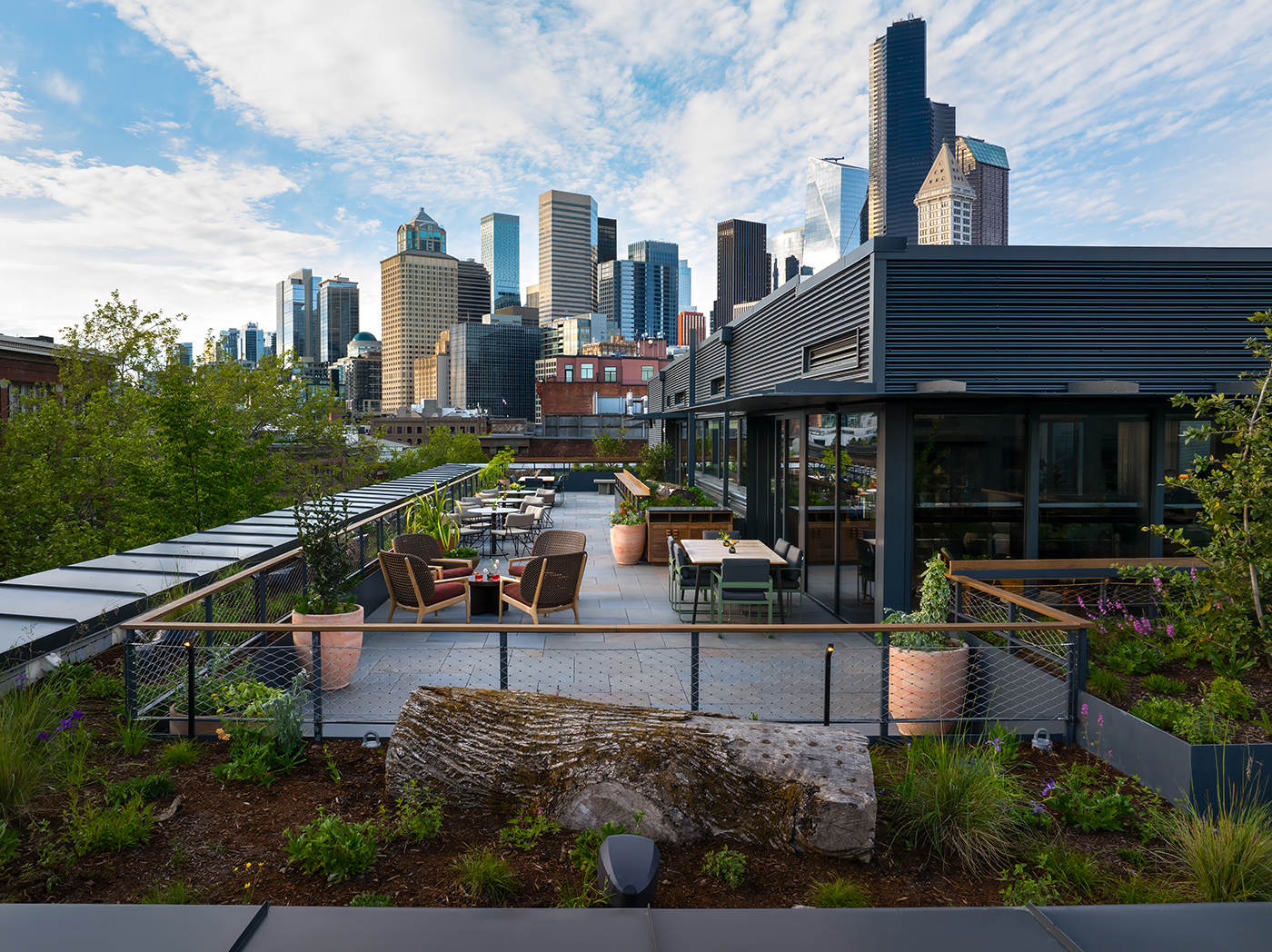
In order to connect the historic structure with the future of Pioneer Square, our team reoriented the existing structure around a new central organizing element: the Skygarden, which brings daylight and fresh air deep into the interior. Relocating the existing building core allowed us to open up the main entrance to reveal a clear visual and physical path from the street, through the building, and out onto the dining enclosure that extends into the RailSpur Alley. This visual connection also proceeds up to the rooftop, through a network of greenery, all centered around the Skygarden.
NAVIGATING STRUCTURAL CONSTRAINTS
The hotel, originally called the Westland Building, featured deep floor plates that restricted natural light and limited interior programming potential. In order to support office use, the former building owner cut a narrow lightwell into the structure in 1979 and inserted an elevator in the center. For Populus Seattle, the team expanded this intervention into the Skygarden, a larger atrium that now serves as both a lightwell and a social heart for the hotel, centered on the lobby and amenity spaces. It provides natural illumination to interior-facing guestrooms and reduces reliance on artificial lighting in the lobby.
Expanding the light well required precise structural planning. We reclaimed timber joists removed during the renovation and reintroduced them in different structural locations to support the new skylight at the base of the light well. This reduced the need for new structural materials and restored the historic structural rhythm of joists that were lost in the 1979 interventions.
At the same time, relocating the original elevator core not only improved circulation through the building but also reinforced seismic stability. This strategic move meets lateral force-resisting requirements without resorting to visually intrusive bracing strategies that would have compromised the historic architecture and the user experience. Concrete shear walls along the north and east alley-side walls were inserted discretely to further reinforce the overall structure while reducing the impacts to the primary south and west facades. By strengthening rather than replacing the heavy timber frame and the historic masonry, we upheld both preservation goals and carbon reduction strategies inherent to adaptive reuse.
PRESERVATION AND PERFORMANCE
Historic reuse projects require respect for original materials, but preservation alone is not enough—buildings must also perform at modern standards of safety, efficiency and comfort. Our work on Populus Seattle was reviewed through the National Park Service Historic Preservation Tax Incentives Program, which mandates that modifications remain reversible wherever possible. This criterion informed much of the detailing and engineering decision-making.
Adaptive reuse is also inherently sustainable through material conservation and reduced carbon impact. By retaining much of the original structure, we avoided the emissions associated with demolition and new construction. Structural reinforcements were added only where required for seismic resilience.
We preserved large spans of original Douglas fir timber framing, exposed structural decking, and brick masonry walls. Mechanical and electrical upgrades were integrated with minimal disturbance to historic materials. Where new systems were introduced, such as guestroom mechanical distribution, we carefully threaded infrastructure around the existing structure to avoid unnecessary demolition.
The Skygarden is one example where design performance and preservation intersect. Its framing references the rhythm of the original warehouse bays, while its scale and placement dramatically improve interior environmental quality. We were able to remove every other joist in this location to allow for greater daylight into the space. We also preserved the existing steel from the previous light well to retain the heritage of the building, even if it was no longer needed structurally. These interventions enhance the guest experience while reinforcing the building’s industrial character.
In some instances, where new openings were required between floors, existing timber needed to be cut or removed. Our team salvaged the timbers not just for new structural uses, but also for other design elements throughout the hotel. Reclaimed joists and columns were milled down to be reused as shelving in the library and purlins for the entry canopy. Reclaimed columns were repurposed as furniture elements. Reused materials minimize waste, resulting in a hospitality environment with both environmental integrity and long-term operational efficiency.
CODE INNOVATION UNLOCKS NEW POSSIBILITIES

Adaptive reuse projects in historic districts require a proactive code strategy. Early collaboration with the city of Seattle was critical to unlocking new use opportunities and achieving compliance without compromising design intent. Updates to Seattle’s mass timber code allowed us to expand vertically to add rooftop assembly spaces that would not have been feasible under older regulations.
CPL and Miller Hull worked closely with the city to convert the building type classification from Type IV-HT to Type IV-C, a significant distinction that requires a 2-hour fire resistance rating on all the primary structure, but then allows assembly spaces like bars and restaurants at higher stories for buildings made out of wood. However, applying these new code allowances to a 1907 structure required careful hybridization between existing heavy timber and new steel framing, as they were formulated for new mass timber projects, not historic heavy timber buildings.
Knowing that the building was originally designed to support heavy warehouse loads, CPL calculated how the size of the existing Douglas fir timbers could meet a 2-hour fire rating with the lower loads for a hotel. This allowed the project to proceed under the Type IV-C designation, which allowed for unlimited exposure of the timber members, including the car decking, which also provides the required 2-hour floor rating. A requirement to protect steel connections meant wrapping existing joist hangers with either spray-applied fireproofing in concealed locations or utilizing a drywall wrap in exposed conditions for a cleaner finished look.
Zoning constraints also required creative navigation. Rooftop dining and beverage service had historically been prohibited in Pioneer Square. Working with city officials, we leveraged recent rooftop occupancy amendments to secure approvals for a rooftop bar and hospitality suite—adding a unique hospitality experience and public activation point for the neighborhood.
This collaboration between CPL and Miller Hull demonstrates the importance of code advocacy in adaptive reuse. When applied thoughtfully, building codes can expand design possibilities rather than limit them.
INTEGRATING INFRASTRUCTURE AND PUBLIC SPACE
Populus Seattle is embedded in a dense historic urban block with layered infrastructure. One of the most complex engineering challenges involved the alley-fronting dining enclosure, located directly above an active Seattle City Light transformer vault. The original Westland Building had four loading bays facing onto the rail spur that were used for transferring goods into the warehouse. These bays were blocked up and filled with CMU blocks when the tracks were decommissioned, and an electrical transformer vault was installed within the private passageway. These openings have been restored to connect the restaurant to a new dining enclosure located atop the operational transformer vault.
The team worked closely with SCL and other authorities to coordinate a structural system that allowed for future transformer replacement without impacting the rest of the structure. The structural detailing allows for a single bay of the enclosure to be unbolted in the future, and allows the surrounding structure to remain.
At the neighborhood scale, the project reconnects Pioneer Square’s historic RailSpur corridor, a former rail line that once linked industrial loading docks. Through thoughtful architectural and structural moves like the dining enclosure atop a transformer vault, the building now opens onto this corridor through a sequence of interior and exterior spaces, including the skygarden, alley restaurant, and rooftop destinations. These moves introduce pedestrian connections through the site and contribute to the reactivation of long-neglected urban passageways.
A MODEL FOR FUTURE ADAPTIVE REUSE
Populus Seattle is both a building and a case study. It demonstrates how early design collaboration between architects and engineers can unlock possibilities hidden within historic structures. It proves that advocating within the building code framework can expand what is possible in preservation districts. And it shows that sustainability, economic viability and historic character can work together.
As urban cores evolve, the most sustainable building will continue to be the one that already exists. Projects like Populus Seattle show how we can reimagine historic structures for contemporary relevance and community value.
Tets Takemoto is an associate at The Miller Hull Partnership. Ana Perarnau is a structural project manager at Coughlin Porter Lundeen.
Other Stories:


