 |
Subscribe / Renew |
 |
Contact Us |
| ► Subscribe to our Free Weekly Newsletter | |

Construction Bids
| home | Welcome, sign in or click here to subscribe. | login |


 print print  email to a friend email to a friend  reprints add to mydjc reprints add to mydjc |  |
 |
July 31, 2025

Kleiner
|

Clinch
|
Climate mandates and shifting market forces are no longer future threats — we’ve now reached the tipping point. As cities roll out stringent performance standards like Seattle’s Building Emissions Performance Standards (BEPS) and Climate Action Plans (CAPs) take effect, organizations with aging infrastructure face hard decisions under short timelines.
These challenges can no longer be treated as siloed issues — climate compliance, deferred maintenance and capital planning demand integrated solutions rather than isolated one-off fixes. To succeed, institutions need strategic guidance from integrated teams that bring architecture, engineering, cost estimating, and construction insights together to support owners with life-cycle value decisions. These decisions help meet external policy regulations as well as internal climate commitments.
Healthcare and life science campuses are especially vulnerable to infrastructure risk, regulatory shifts and pressure to reduce carbon emissions. Their buildings often rely on outdated systems and typically consume three to five times the energy of a conventional office building.
A shift toward systems thinking, campus-scale decarbonization and collaborative delivery methods (like design-build) is allowing forward-looking institutions to proactively plan for — not just react to — uncertainty.
Drawing from real-world Perkins&Will project examples, this article explores how integrated teams help clients meet and exceed climate requirements, control long-term costs and transform risk into opportunity.
CAMPUS-SCALE DECARBONIZATION
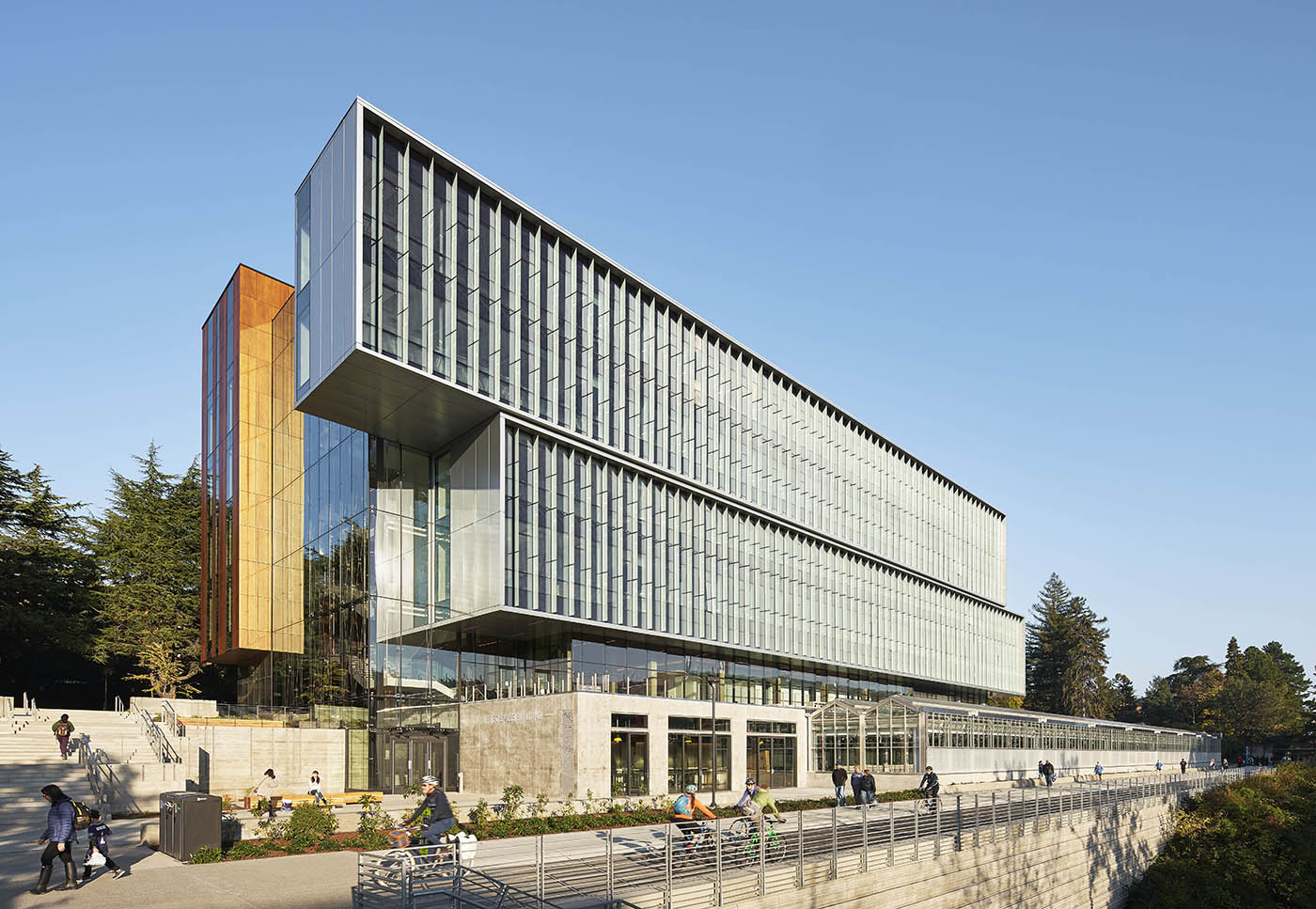
Regardless of a project’s scope, project teams should always evaluate decisions based on the campus-scale impact. An individual building design can set the course for future campus development. For example, the University of Washington’s Life Sciences Building was the first building on campus to meet the 2030 Challenge, cutting energy use by more than 80%. It showed what’s possible, helping pave the way for future campus projects.
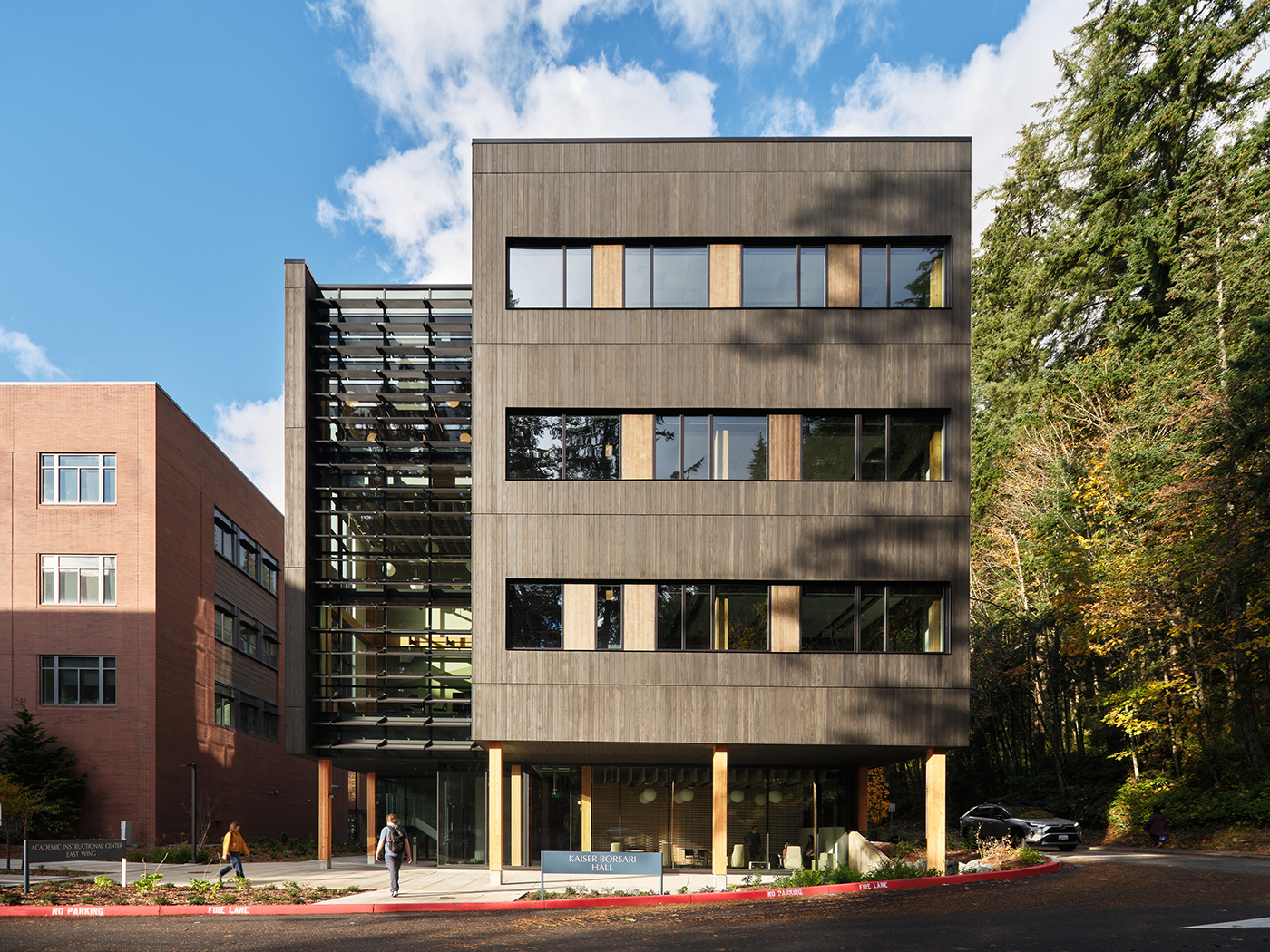
Another example of scaling up impact from an individual building is Kaiser Borsari Hall at Western Washington University (WWU). This Zero Energy, Zero Carbon project was built with mass timber and disconnected from the central steam plant to avoid using combustion for heating and cooling.
Following the completion of this building, WWU is advocating for all future buildings on campus to consider Zero Energy and Zero Carbon certifications using mass timber. As the university plans to transition its central plant to geothermal energy, it’s scaling up decarbonization efforts from one project to the entire campus.
BUILDING EMISSIONS PERFORMANCE STANDARDS
The Building Emissions Performance Standards (BEPS) is a policy that mandates existing buildings to meet greenhouse gas (GHG) reductions with targets that become more stringent over time. While this policy for non-residential and multifamily buildings larger than 20,000 square feet is specific to Seattle, other cities such as Washington D.C., Boston and New York City have implemented similar standards—signaling a nationwide shift toward regulatory climate accountability in the built environment.
The BEPS policy allows compliance at either the individual building or campus level. Our analyses on past projects have shown that the campus scale can be more cost effective when seen holistically.
By analyzing the percentage of total campus GHG emissions for each building, along with its anticipated costs for deferred maintenance, institutions can phase their renovations and new construction replacements through data-informed decision making — overlaying phased policy compliance with life-cycle costs at the campus scale.
CLIMATE COMMITMENT ACT
In 2021, Washington state passed the Climate Commitment Act (CCA) creating a Cap-and-Invest Program to fund projects that reduce GHG emissions, develop clean energy and improve air quality. In the 2023-2025 biennium, the state Legislature appropriated $3.2 billion with 16% dedicated to building decarbonization. Among the many recipients, universities are receiving $136 million of this funding for decarbonization projects, incentivizing institutions to capitalize on this regulatory response to our changing climate.
DEFERRED MAINTENANCE, ADAPTIVE TRANSFORMATION
There are non-regulatory requirements that are also catalysts for climate action. Many institutions have been experiencing a growing burden to address their increasing costs for deferred maintenance of aging systems.
For example, the University of Washington is evaluating aging mechanical, electrical, plumbing and structural systems for Bagley Hall, a 1935 chemistry building at the core of its Seattle campus. An integrated team approach to analyzing various alternatives for renovation scope provides institutions with a detailed analysis of existing and potential systems, construction phasing, and near-term and long-term cost estimates.
Another catalyst for change in our local market is adaptive transformation of existing buildings. By repurposing underutilized buildings — instead of demolishing and rebuilding them — owners reduce embodied carbon emissions tied to construction rather than just focusing on operational emissions from heating, cooling and power use after occupancy. As campuses electrify and power grids get cleaner, embodied emissions make up a bigger part of the carbon footprint. Adaptive transformation will continue to grow as a critical strategy for building owners to respond to our changing climate.
INTEGRATED DELIVERY AND SYSTEMS THINKING
Deeply integrated teams with expertise in low-carbon design, life-cycle cost analysis, and holistic systems thinking are critical to successfully navigating these new climate-driven opportunities. Conventional project delivery methods and siloed team dynamics will intensify as a limiting factor as climate regulations grow. Integrated delivery and systems thinking have shown their value over the past decade and will become essential over the next decade to adequately respond to our growing climate challenges.
Climate change isn’t a singular challenge — it’s a systems challenge. Institutions that embrace integrated, future-ready partnerships are better positioned to meet their climate goals, protect capital investments and strengthen community trust. By moving beyond traditional service models, the design and construction industry can deliver what clients actually need: certainty in an uncertain world.
Devin Kleiner is a principal and director of Regenerative Design at Perkins&Will. Andrew Clinch is a managing principal at Perkins&Will.
Other Stories:


