|
Subscribe / Renew |
 |
Contact Us |
| ► Subscribe to our Free Weekly Newsletter | |

Construction Bids
| home | Welcome, sign in or click here to subscribe. | login |


 print print  email to a friend email to a friend  reprints add to mydjc reprints add to mydjc |  |
 |
March 27, 2025

Tiedemann
|

Tario
|
Snohomish County’s Jim Creek, a tributary to the South Fork Stillaguamish River, has long been a refuge for endangered Chinook salmon. However, years of habitat degradation, simplified stream structure and warming waters threatened the viability of this critical waterway. In response, a collaboration between Surface Water Management (SWM), a division of the county’s Department of Conservation and Natural Resources (DCNR), environmental engineers and forward-thinking landowners culminated in an ambitious restoration effort — one that embraced risk and innovative hydrological design while putting landowners at the heart of the process.
SCIENCE FIRST, CONSTRAINTS SECOND
The Jim Creek Restoration Project benefited from a fortunate advantage at the outset: willing landowners who were open to collaboration. This led to a fundamental shift in approach: the ability to prioritize ecological science over logistical constraints, ensuring that restoration efforts addressed the creek’s most pressing needs.
Early regional studies identified Jim Creek’s limitations — lack of deep pools, insufficient wood for cover and rapidly dissipating cold-water inputs from Vos Creek. These factors contributed to declining salmon populations, warranting a large-scale intervention to restore hydraulic diversity and improve habitat resilience.
A PARTNERSHIP BUILT ON TRUST
The project team first identified the most effective restoration areas and then engaged landowners in targeted outreach. A defining success of this effort was the partnership with the Anderegg family, who own both banks of Jim Creek where it meets Vos Creek. Their flexibility and enthusiasm helped shape a high-impact restoration design focused on rebuilding natural stream complexity.
SWM and the design team engaged the Andereggs from the outset — explaining the science, setting realistic expectations and welcoming their input. This early and ongoing involvement proved crucial. While many landowners hesitate at the prospect of heavy construction on their property, the Andereggs embraced the vision, actively participating in the design process. They even kept the team informed about key site changes, documenting the creek’s transformation with video updates — especially during critical flood events.
GOING BIG: THE ROLE OF ENGINEERED LOG JAMS
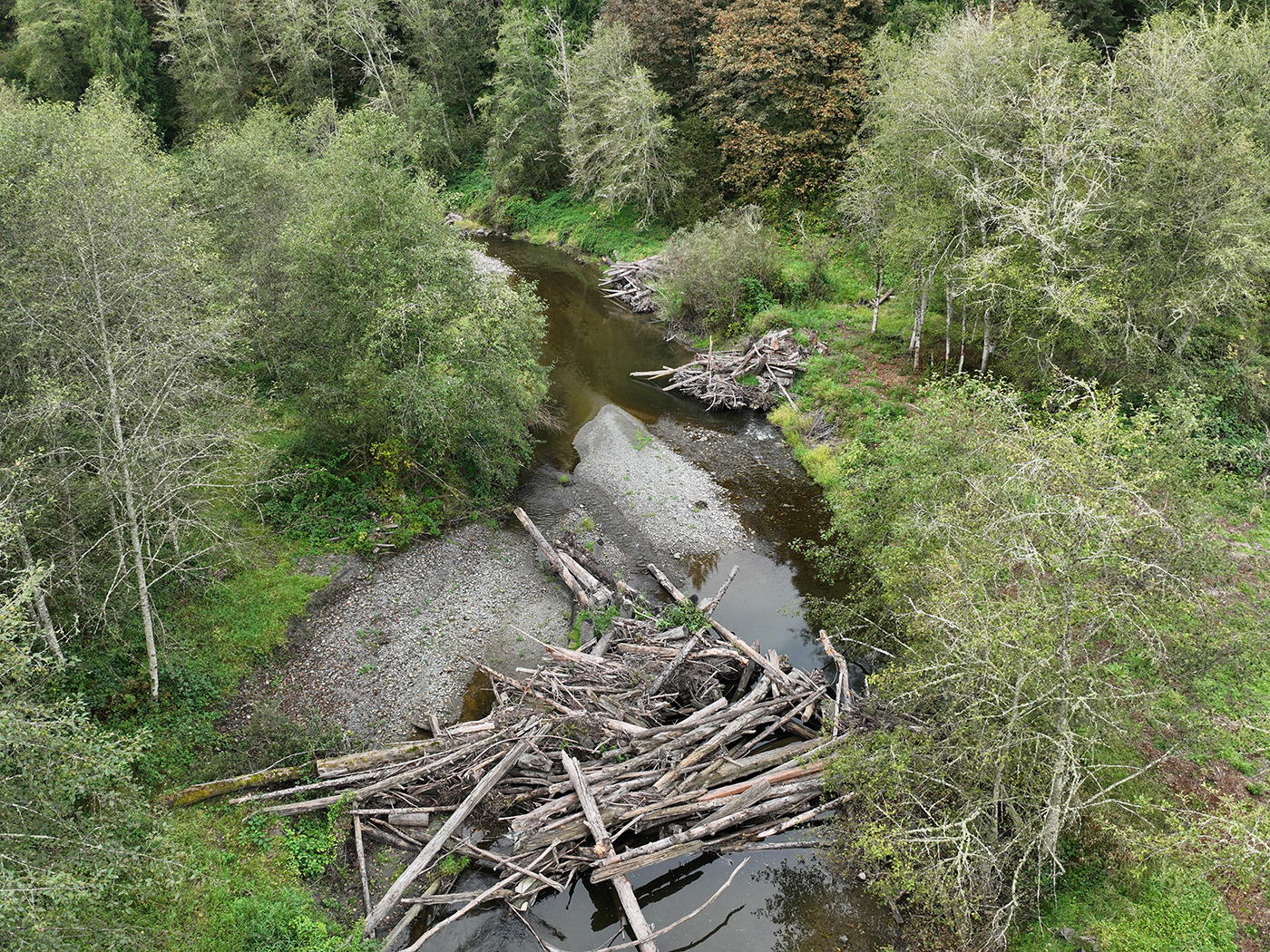
The project team adopted an ambitious design philosophy, opting for Engineered Log Jams (ELJs) — large, strategically placed log structures that promote streambed diversity, create deep pools and provide cover for salmon. The scale of the installations was striking; at least one-third of the channel was intentionally obscured by ELJs, ensuring substantial hydrological influence.
The team used advanced techniques to anchor and interlock structures, allowing the river to interact dynamically with the wood rather than washing it away. By mimicking natural log jams found in pristine river systems, these structures enhance fish habitat while stabilizing streambanks and improving flood resilience.
THE REAL-WORLD TEST: A RECORD FLOOD
In December 2023, just months after the project’s completion, Jim Creek experienced a record-breaking flood event. High water levels, powerful currents and extreme sediment transport created a significant natural test for the project’s design. Rather than focusing solely on structural integrity, the team assessed how the restoration elements functioned as intended — mimicking natural processes, promoting habitat formation, interacting with flow dynamics and supporting the overall ecological goals of the project.
For the Andereggs, witnessing their property adapt to such an extreme event was a powerful validation of their trust in the project. Their videos of the flooding provided valuable insight into how the restoration influenced water movement and sediment deposition, reinforcing the importance of designing for natural processes rather than rigid structural outcomes.
LESSONS FOR FUTURE RESTORATION EFFORTS
Jim Creek’s restoration offers a roadmap for future projects facing similar challenges. Several key lessons emerged:
• Prioritize science over convenience — Selecting the most ecologically impactful locations first yields greater restoration success.
• Engage landowners as partners, not just stakeholders — Meaningful communication and collaboration can transform landowners into champions of a project.
• Embrace risk and think big — Small-scale interventions often fail to achieve meaningful ecological improvements. By designing for bold hydraulic changes, the Jim Creek project delivered lasting habitat benefits.
• Monitor and adapt — Ongoing observation, especially in the wake of extreme weather events, ensures restoration work meets its goals and informs future efforts.
A MODEL FOR PUGET SOUND CONSERVATION
As climate change intensifies flood events and further strains Pacific Northwest salmon habitats, Jim Creek serves as a powerful case study in restoration done right. It demonstrates that the correct mix of scientific rigor, collaborative landowner engagement and willingness to take bold risks can help revitalize degraded streams.
For business and environmental leaders in the Puget Sound region, the project underscores an essential truth: conservation and economic interests need not be at odds. By investing in smart, science-driven restoration efforts, communities can build both ecological resilience and stronger, more engaged partnerships between the public and private sectors.
The Jim Creek project was funded by grants from the State of Washington Salmon Recovery Funding Board through the Recreation and Conservation Office (RCO), the State of Washington Department of Ecology, and by Snohomish County Surface Water Management Utility fees.
Matt Tiedemann is a senior engineer with Natural Systems Design (NSD), the lead engineering firm on the Jim Creek Restoration Project. Lisa Tario is a river engineer at Snohomish County Department of Conservation & Natural Resources (DCNR) Surface Water Management Division.
Other Stories: