 |
Subscribe / Renew |
 |
Contact Us |
| ► Subscribe to our Free Weekly Newsletter | |

Construction Bids
| home | Welcome, sign in or click here to subscribe. | login |


 print print  email to a friend email to a friend  reprints add to mydjc reprints add to mydjc |  |
 |
March 27, 2025

Lacy
|
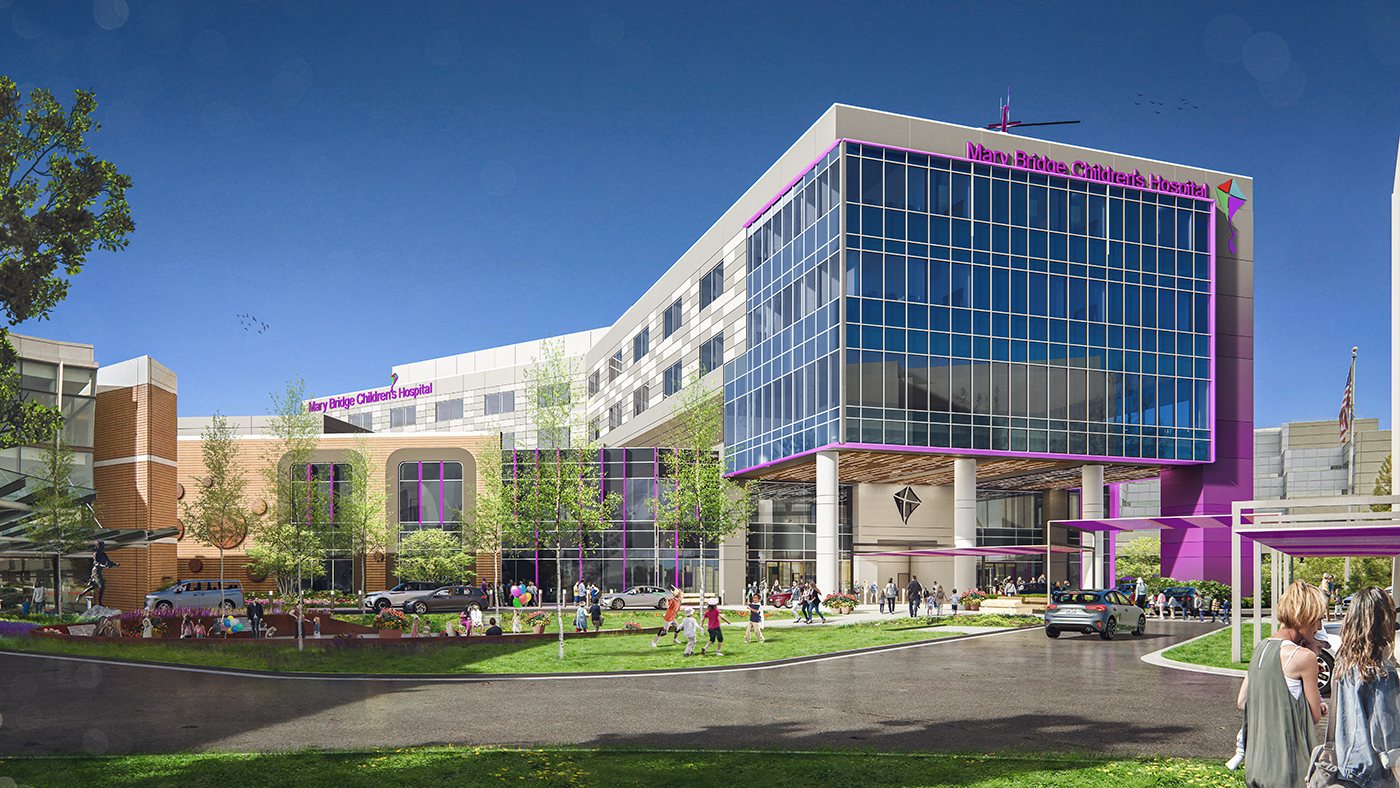
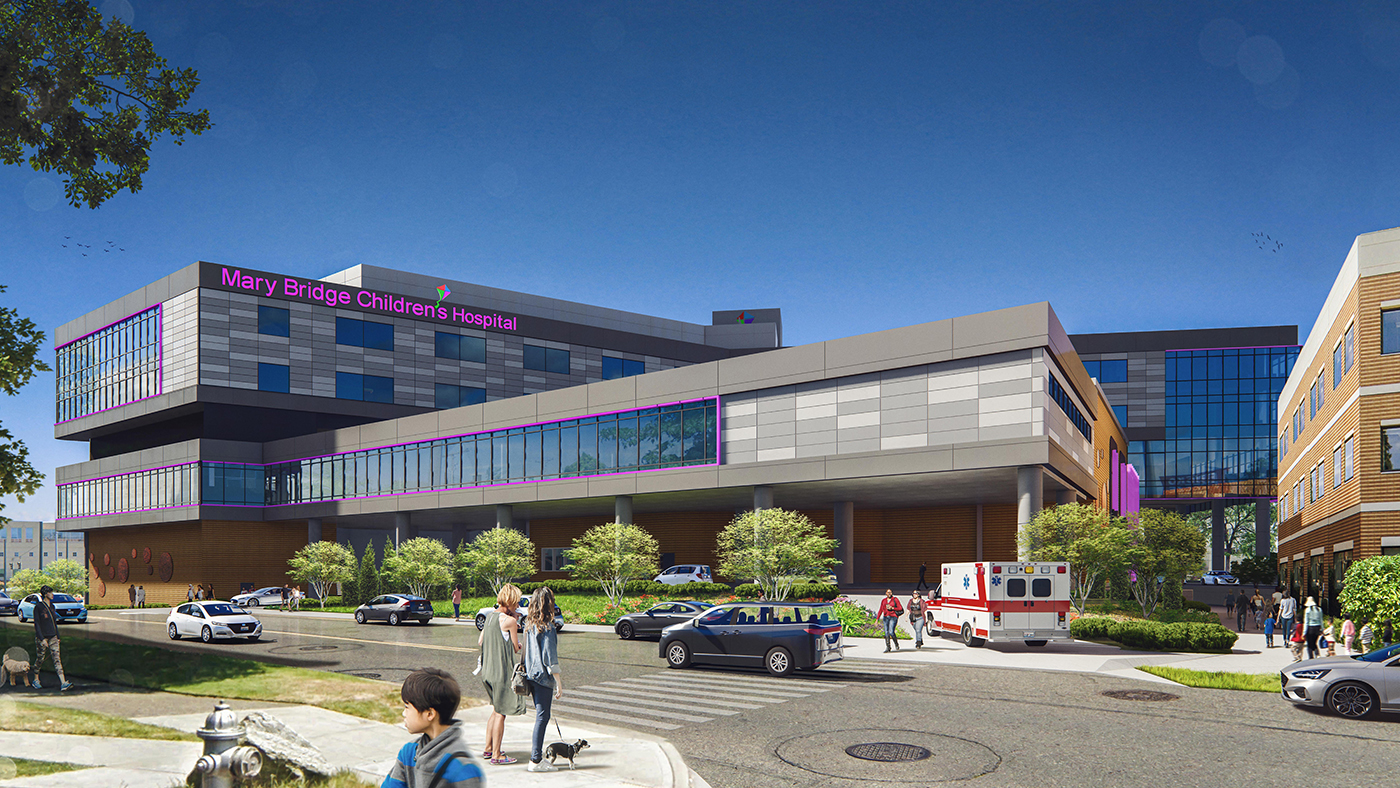
After more than 30 years of sharing space with MultiCare Tacoma General, Mary Bridge Children’s Hospital is preparing to open its own dedicated facility in early 2026 — one designed entirely with kids in mind.
Serving 100,000 pediatric patients annually, the new hospital and expanded outpatient center will offer a child-centered environment that prioritizes comfort, healing and play, even in the face of illness.
Hospital leaders believe this standalone space will transform care for generations to come, and getting there required a unique collaborative effort. Designers, builders, and stakeholders had to do more than work as a team — they had to see the project through the eyes of a child.
SPOTLIGHT ON CHILDREN
The needs of pediatric patients can differ markedly from the needs of their adult counterparts, so designing and engineering healthcare facilities for children requires a different approach, one that accounts for patient demographics and developmental needs, visit frequency and typical length of stay, research and technology, specialized equipment and more.
Consider how lighting might appear different to someone three feet tall than to someone six feet high. Lighting also plays a role in both physical safety and psychosocial wellbeing. Mary Bridge Children’s Hospital addresses this by incorporating dynamic color-changing lighting in play spaces and public areas as well as using tunable white lighting throughout the hospital. These tunable white lights can lead to better patient outcomes, especially in NICU and behavioral health rooms.
“The team’s lighting program for this hospital is designed to support wayfinding and wellbeing, but it’s also about creating a sense of wonder for the children,” said Lilian Fu, vice president and national lighting practice lead at WSP in the U.S.
CONNECTED CARE
Children’s hospitals also often involve multidisciplinary care teams and large support networks, such as classmates and sports teams, which can require larger and more flexible spaces. Further, new technologies in pediatric care, such as hybrid operating rooms and fetal MRI, can mean that children’s hospitals are more technologically advanced than general healthcare settings.
“These larger, technology-supported spaces necessitate additional planning for everything from electrical load to room size, shape and set-up,” says Douglas Lacy, senior vice president and engineering lead for WSP in the U.S. “By prioritizing a child’s unique needs, hospitals can create environments that support the physical and emotional wellbeing of young patients and their families, as well as the dedicated healthcare professionals who care for them.”
HEALTHY HOSPITAL, HEALTHY KIDS
Sustainability in a healthcare setting can cover a range of aspects, including reduced carbon emissions, high quality indoor environments, use of healthy materials and enhanced facility resilience — all of which contribute to the wellbeing of the people inside the buildings.
“The energy-saving measures for Mary Bridge were multidisciplinary in nature, starting with a high-performance central plant that utilizes energy recovery chillers and heat pumps,” said Zach Stevens, vice president, WSP in the U.S., who serves as the project’s sustainability lead. “Condensing gas boilers that provide backup and that only engage in peak low ambient conditions prioritize lower energy use while increasing the hospital’s resilience.”
Indoor environmental quality is another important factor to consider in children’s hospitals, since poor indoor air quality can negatively impact health, especially for the 120,000 youth in Washington with asthma. WSP’s team used an advanced computational fluid dynamics simulation to ensure that combustion exhaust from the boilers and generators would not enter the building.
Stevens says, “Reducing combustion is a major health benefit, not just for reducing the health impacts of climate change in the long run, but with respect to rates of respiratory illness, especially in children.”
The result of energy-saving LED lighting, design for future full electrification, and other measures was a 75% reduction in emissions, equivalent to 3.2 million vehicle miles, and a 48% energy reduction when compared to a median existing hospital.
IT TAKES A VILLAGE: INTEGRATED PROJECT DELIVERY
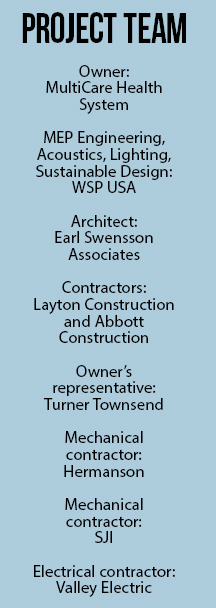
Achieving healthy, dedicated pediatric spaces like those at Mary Bridge Children’s requires a team effort. Having the designers, builders, trades, and craftworks engaged in a collaborative environment can deliver child- and family-friendly spaces that are cost-effective and comparatively fast to construct compared to traditional construction methods, while bringing cost assurance to health systems.
To deliver on that objective for the new Mary Bridge Children’s, the project’s many design partners collaborated under a single integrated project delivery contract, chosen because it enhances communication and buy-in of project outcomes while reducing both material and intangible waste.
“Most of the integrated delivery we do in healthcare is what I call behavioral integration, focusing on achieving the goals and conditions of satisfaction for the client,” says Lacy. “Owners are generally dissatisfied with how megaprojects are delivered — over budget and over schedule — and this contracting method can turn the tide on that dissatisfaction. On this project, we spent a fair amount of time getting behaviors right in the early stages, employing some lean strategies and figuring out how to approach problems.”
TARGETED VALUE THROUGHOUT
One of those approaches was target value delivery, which established MultiCare’s value priorities and set cost targets before the design stage. This method aligned the design and construction process to avoid cost-overruns and ensured that the hospital was built efficiently — all while maintaining children at the heart of value decisions.
“There are different ways to do risk mitigation on large projects. One way is to split it up into many pieces so no one piece can sink the ship. The other way is to pull everyone closer together so that you can rely on each other not to sink the ship. The latter is more like a real relationship, taking more work to build but being more beneficial in the end,” adds Lacy.
Finally, the group added major trade partners through a component team structure, which allowed the owner, designers, builders, and trades to analyze options to keep the project within its target value budget while ultimately serving children and families.
“We onboarded trade partners based on qualifications and capacity during schematic design and aimed for early procurement releases for major equipment. Prefabrication of components also played a significant role. We had bi-weekly target value delivery meetings to track costs and ensure we stayed within budget. This deep collaboration led to project success for both the client and the community.”
Douglas Lacy is a lead electrical engineer at WSP in the U.S., works with healthcare clients nationally, and is an active member of the Lean Construction Institute.
Other Stories:


