 |
Subscribe / Renew |
 |
Contact Us |
| ► Subscribe to our Free Weekly Newsletter | |

Construction Bids
| home | Welcome, sign in or click here to subscribe. | login |


 print print  email to a friend email to a friend  reprints add to mydjc reprints add to mydjc |  |
 |
March 27, 2025

Alozie
|

Moellentine
|
If you’ve been to Georgetown, you may have noticed the industrial buildings, or the charming strip of businesses along Airport Way South; but what you likely didn’t see were many homes or apartments. Georgetown, despite offering 29,000 jobs, is home to just under 1,500 residents.
Many people would like to live here but can’t because of the lack of housing stock and neighborhood services.
This is where the idea of The Bend began, and what it is in its simplest form: When completed, The Bend will offer 1,000 units of housing to Georgetown, making room for 2,500 people across nine blocks. Groundbreaking is expected this summer on the very first building.
At least 600 apartments will be affordable to households earning at or below 70% AMI, a number that may come down with added community investments in the project. With over 75,000 square feet of affordable living and workspace, it will bring necessities like cultural and community services, grocery stores, an early learning center, artisan workshops, and small businesses, making the neighborhood more vibrant and connected.
THE VISION
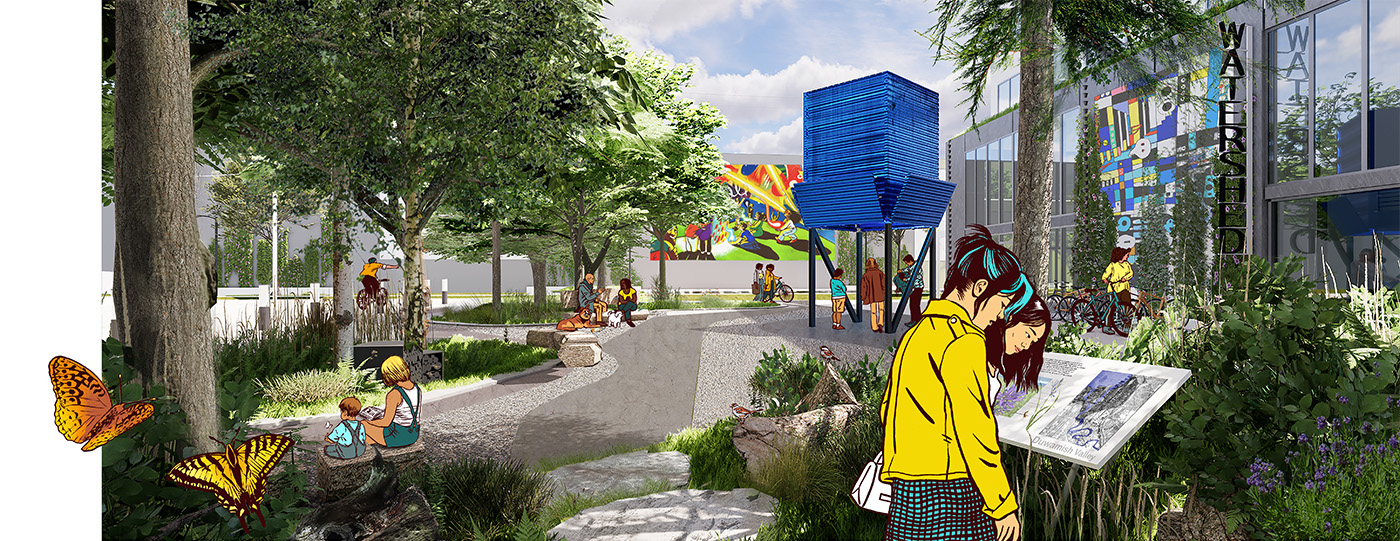
The vision for The Bend began with Equinox Studios, which has anchored art in the neighborhood since 2006. Equinox hosts artists and artisans in affordable studios, and attracts visitors to experience and participate in artmaking during open studios, monthly art walks, “Art Attacks” and other public events.
With over 150 practicing artists on one block, this community has built a unique environment that is hard to replicate. The Bend seeks to create more opportunities for artists by providing workspaces and essential amenities that support both their craft and day-to-day living. In 2019, Watershed was formed as a nonprofit 501(c)3 to develop affordable housing; in 2021, we united the development plan for The Bend with Equinox Studios.
The Bend is deeply atypical as a development — it is a nonprofit, led by artists, driven by the radical inclusion of art, making, and community in affordable housing and public space, and with a commitment list 100 strong — ranging from environmental, to social, to accessibility needs and beyond — to recast what a development can do to positively impact a neighborhood and a community.
This project is ambitious, infused with the gritty, creative spirit of Georgetown. We are actively working alongside those who have shaped this neighborhood into what it is today, carrying its history forward while forging something new.
IMPACT, STARTING WITH CONSTRUCTION
The impact The Bend seeks to make starts with the construction process. Our team has adopted an Equity in Construction (EIC) policy to ensure meaningful subcontracting, material supplier and employment opportunities were accessible to Duwamish Valley and MWBE businesses and residents. Objectives of this policy include working diligently with the general contractor to engage Duwamish Valley Community organizations for the purpose of sharing information on when and how to bid on Bend projects, contracting 25% of the project’s total construction costs to Duwamish Valley and MWBE businesses and material suppliers, and requiring project subcontractors with a projected manpower forecast of six or more workers to make an effort to hire at least one qualified Duwamish Valley resident.
These guidelines help us ensure that the local community has the opportunity to become a part of this project, and benefit from the economic impacts of a development of this size.
MAKING ROOM FOR PUBLIC SPACE
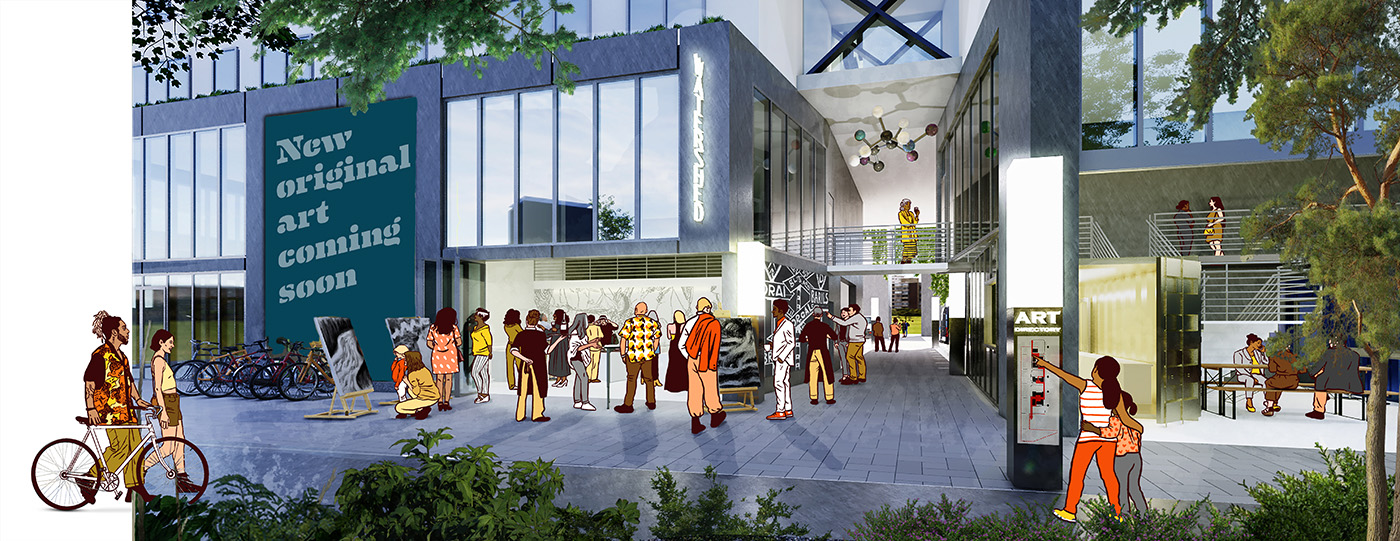
Outside of “downtown” Georgetown, the neighborhood isn’t very walkable today. The commercial west side of Georgetown has a unique character shaped by its industrial and manufacturing roots. It’s a gritty and textured neighborhood that can sometimes feel unapproachable, but there are oases amidst the chaos. The Bend hopes to encapsulate these materials and bring them into the building designs.
The Bend, located between Fidalgo and Dawson, anchored by 4th, addresses this by designing not impervious, square blocks of housing, but carving into the blocks to create room for green space, public art, and ground plane interaction along a meandering path that is not only safe, but pleasant.
Signal Architecture + Research has led the development of the “Cookbook of the Street,” an urban planning guide structured around the metaphor of a cookbook, identifying key “ingredients” of the street design, the “tools” needed to prepare them, and examples of what successful “recipes” can look like. Just as in cooking, some ingredients are options, while others are non-negotiable. This framework is meant to guide the creation of meaningful public spaces that reflect much of its existing character yet leave room for improvisation.
The Bend is building in the only place in Georgetown where dense midrise apartments can be built. The commercial zoning in these 9 acres allows a wide variety of activities at ground level with housing above. Commercial developers have so far overlooked the area and, without a bold plan, higher-cost housing will inevitably overrun this island of opportunity. Duwamish Valley residents have a history of activism and finding creative solutions to community challenges.
100 COMMITMENTS
The Bend is the latest example of resistance and adaptation for and by the people. Our work over the next decade to forge The Bend is guided by five Imperatives and 100 Commitments to our community.
The Bend’s five imperatives, organizing the 100 commitments, are:
• Art as Convener (for example, commission or acquire at least 60% of artworks from women and BIPOC creators)
• Environmental stewardship (for example, install at least 1 watt of solar panels per gross square foot of building area )
• Diverse and inclusive (for example, include members of Watershed’s communities in decision-making: artists, residents and workspace tenants, local community organizations, and representatives of diverse ethnic and cultural groups, in particular those which have been or are vulnerable of being displaced from the Duwamish Valley)
• Affordability (for example, set rents so at least 80% of apartments are rented at prices affordable to households earning at or below 60% of AMI; aim to fill 100% of workspaces with artists and artisans, nonprofits, and neighborhood-serving small business, and lay the groundwork for converting at least 100 units to resident ownerships within 20 years with affordability restrictions)
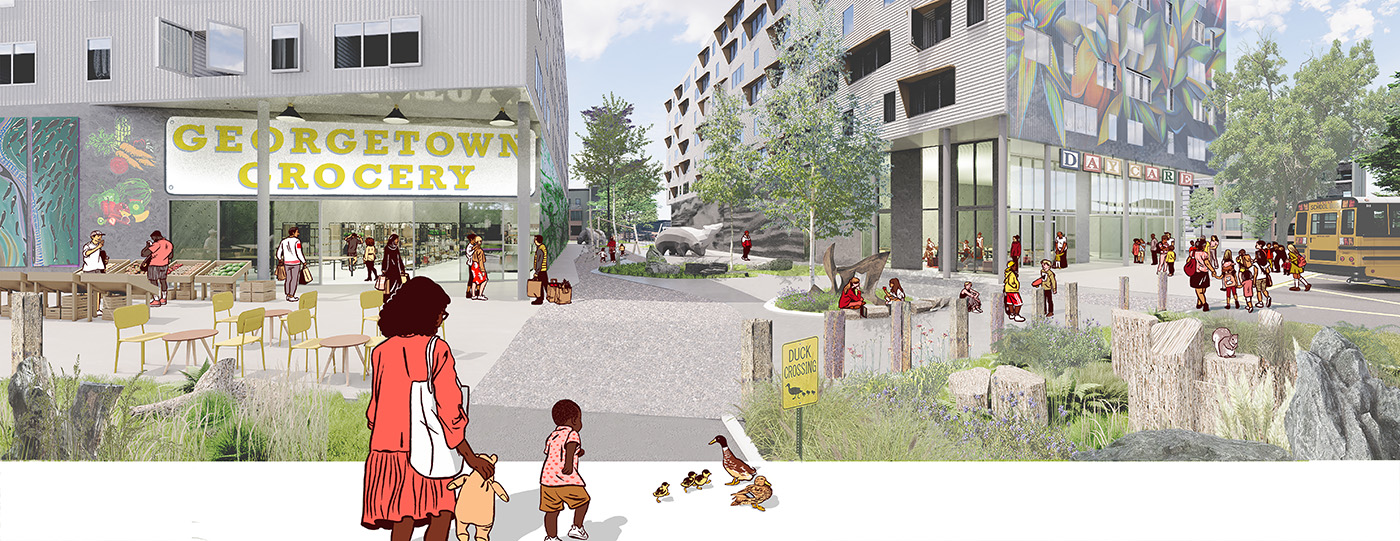
• Livability (for example, provide at least 10 square feet of amenity space per apartment for recreation, exercise, gathering, and/or maker spaces, and programming in each building; provide space for an early childhood education facility and house a food vendor/grocery in one of the workspaces)
See all 100 commitments here: https://watershedcommunity.org/our-100-commitments/
Creating a district that is projected to double the current population of Georgetown comes with the responsibility to be responsive to the needs of the neighborhood today. The industrial and residential are cherished, and in tension with one another: freight traffic versus safe, walkable streets; manufacturing jobs versus the pollution these industries create; families versus airport noise.
Striking a balance between these competing needs is crucial as The Bend evolves to accommodate and integrate new tenants into a place that is loved, and home to a vibrant community today.
Eric Alozie is a project consultant with Watershed, working on The Bend. Lorine Moellentine is an architectural designer at Signal Architecture + Research, working on The Bend.
Other Stories:


