|
Subscribe / Renew |
 |
Contact Us |
| ► Subscribe to our Free Weekly Newsletter | |

Construction Bids
| home | Welcome, sign in or click here to subscribe. | login |


 print print  email to a friend email to a friend  reprints add to mydjc reprints add to mydjc |  |
 |
October 31, 2024

Bonotto
|

Greene
|

Jones
|
The physical removal of the Alaskan Way Viaduct in 2019 made many Seattleites’ long-held dream of a connected cityscape suddenly seem possible — but for Magnusson Klemencic Associates (MKA), one of the engineering firms tasked with making it a reality, the transformation of Seattle’s waterfront has been decades in the making.
“Our engineers have been working on Seattle waterfront projects for more than 20 years,” said MKA Senior Principal and Civil Engineering Practice leader Matt Jones. “With the opening of the Seattle Aquarium’s Ocean Pavilion in August followed by the Overlook Walk this month, the public can finally enjoy a direct, fully accessible connection between Pike Place Market and the waters of Elliott Bay. We feel honored to be part of the wonderful teams that made this dream a reality.”
MKA, a century-old, Seattle-based structural and civil engineering firm, has helped shepherd numerous visionary projects to completion in Seattle, starting with the Olympic Sculpture Park, which opened in 2007. In addition to its marine views and jaw-dropping art displays, the park connects Western Avenue to the water via an ADA-compliant series of switchbacks designed to tackle the site’s steep grade and the crossing of Elliott Avenue and the railroad.
“The elevation change between the waterfront and the park entrance is more than 40 feet,” said MKA Principal Rita Greene. “That’s like climbing the stairs of a four-story building. People are looking for a more gradual route.”
During her 36-year career with MKA, Greene has been a civil engineer on many of the firm’s waterfront redevelopment projects—the Elliott Bay Central Seawall, Harbor Steps, Ocean Pavilion, Pike Place Market’s MarketFront entrance, Pike Place Market Garage, and, most recently, the Overlook Walk—in addition to being the civil engineering project manager for Olympic Sculpture Park.
“From a design standpoint, one of the biggest challenges for the team was how to create a direct route long enough to make the slope accessible for everyone,” Greene said.
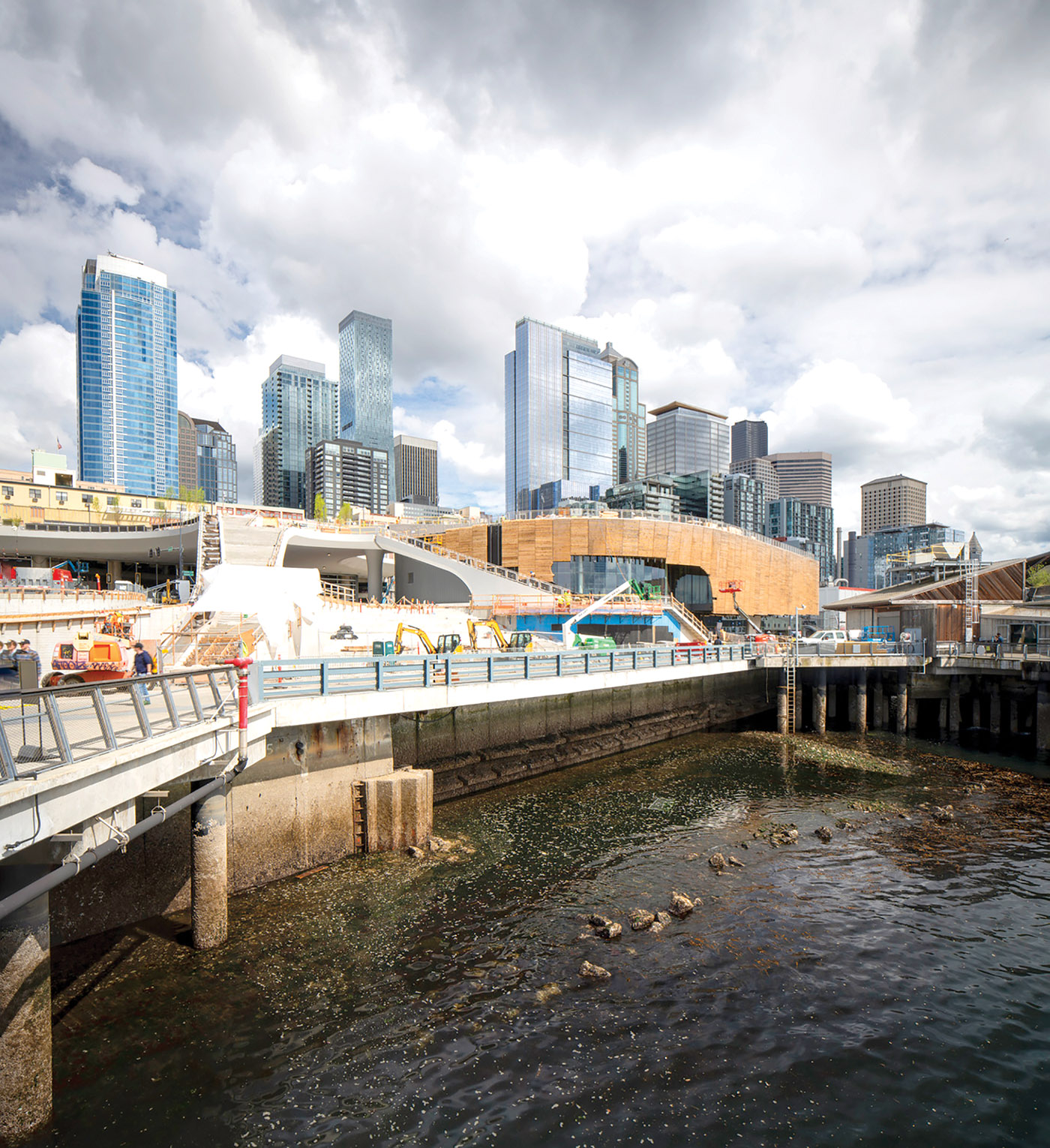
MKA’s innovative design of the Olympic Sculpture Park resulted in the American Council of Engineering Companies’ highest national honor, the Grand Conceptor Award. Ten years later, another Seattle waterfront project opened in 2017, Elliott Bay Central Seawall. MKA designed a light-penetrating surface into the new cantilevered sidewalk to bring natural light into the water below to encourage juvenile salmon migration. Additional site improvements included a new habitat beach and temporary and permanent pedestrian amenities behind the wall.
“The Seawall was the start of what we now understand to be the reimagined waterfront, as the previous seawall had reached the end of its useful life after protecting the city for more than 70 years,” Jones continued. “The new Seawall was designed to protect the city for the next century as it was brought up to current seismic standards, accounts for projected sea level rise, and provides marine habitat.”
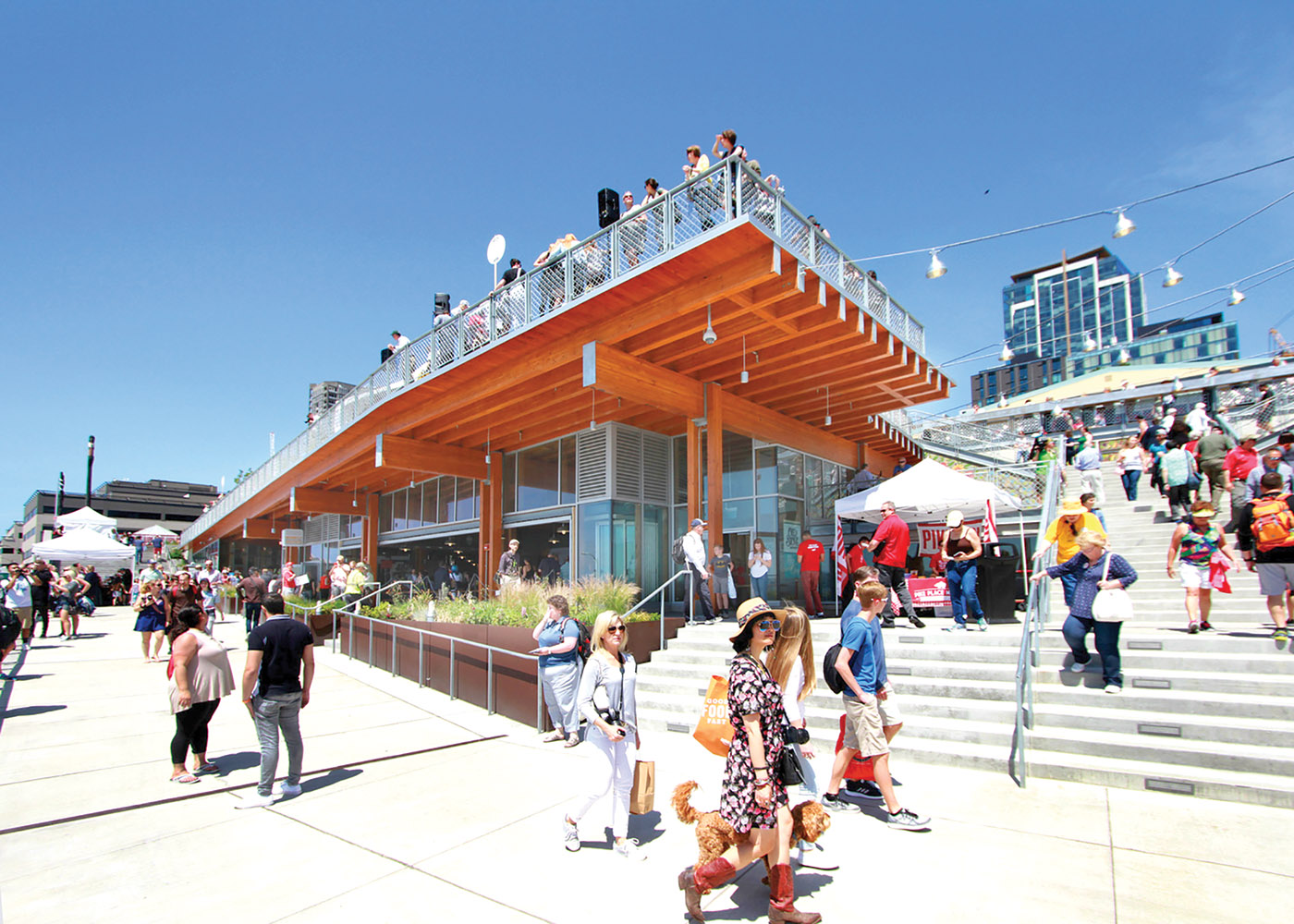
Concurrent with the Seawall’s design and construction, the landscape architectural firm Field Operations shared its sweeping vision for the waterfront. The firm’s vision soon gave way to an official Master Plan detailing a new pedestrian-centric, north-south promenade with strategic connections to downtown that reconnect the urban core with the waterfront. Field Operations envisioned the most prominent of these connections as an elevated path to Pike Place Market. After designing Pike Place’s new MarketFront Entrance, MKA’s structural and civil engineering teams were thrilled to complete the downtown-to-waterfront connection through two additional projects: the Overlook Walk and the Ocean Pavilion.
A WALK 20 YEARS IN THE MAKING
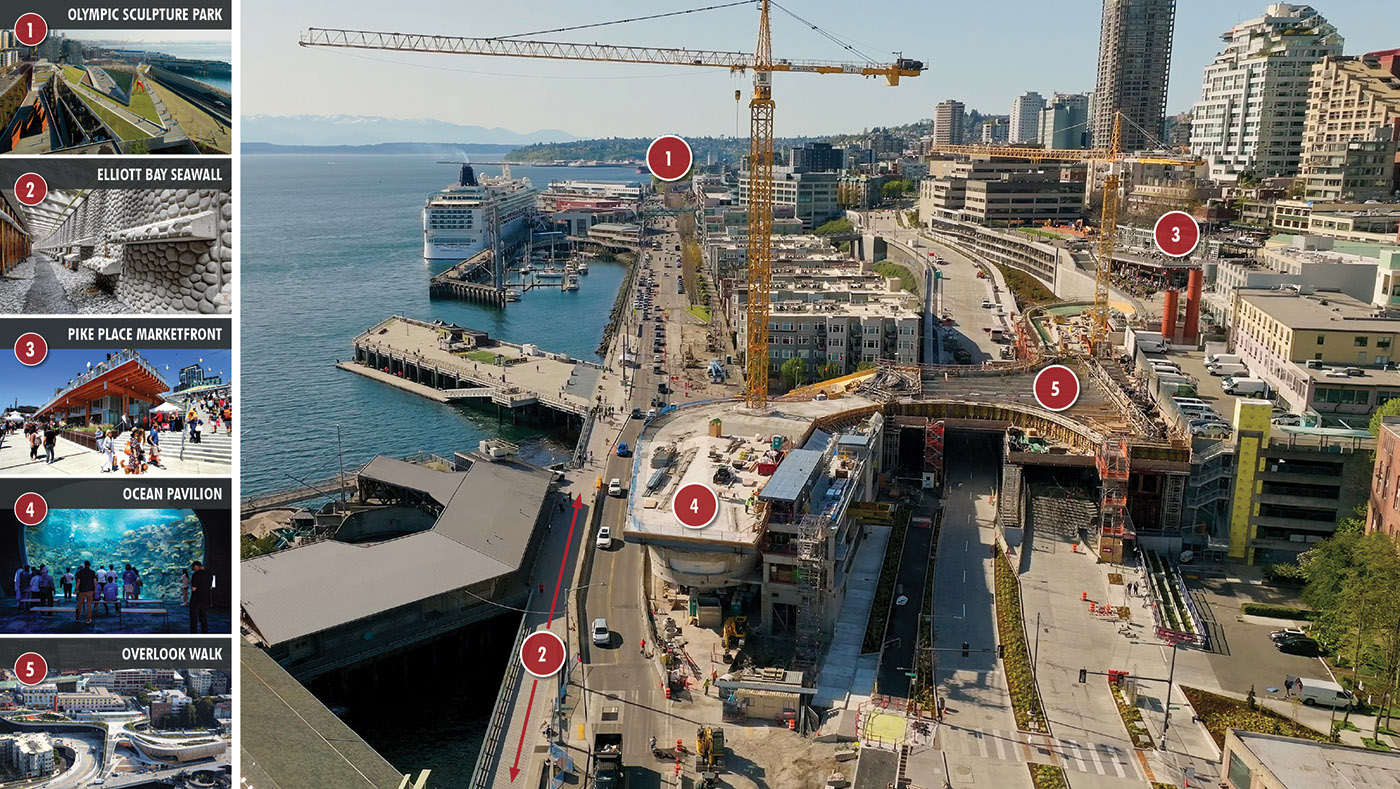
The story of Seattle’s new Overlook Walk, an elevated, pedestrian public walkway structurally connected to the new Aquarium Ocean Pavilion, began in 2001 and has taken more than 20 years to come to fruition. MKA is the Structural and Civil Engineer of Record (EOR) on the Ocean Pavilion and one of the EORs on the Overlook Walk. With the Overlook Walk predating the Ocean Pavilion, MKA worked with the design teams to seamlessly integrate the Pavilion into the projects already underway.
“Originally, the Overlook Walk, promenade, and sidewalks were designed as if the Ocean Pavilion wasn’t there,” Greene said. “It’s hard to imagine looking at it now. We were able to advise on the Alaskan Way efforts and construction drawings to help make sense of what needed to be done to insert the Ocean Pavilion into an existing design.”
Working on separate yet comingled projects is always complicated. The Overlook Walk sits over back-of-house space for the Ocean Pavilion. To incorporate the Overlook Walk’s bridge column locations and storm drain piping into the design of the Ocean Pavilion, MKA designed openings large enough to prevent the columns that penetrate the pavilion from touching the slab in a major earthquake. The high roof of the Aquarium is connected to the Overlook Walk by a seismic joint measuring approximately one foot across, allowing the two buildings to move independently and not impose force on each other during an earthquake. Another seismic joint separates the Overlook Walk from the Market. MKA worked with Jacobs, EOR for the Overlook Walk Bridges, and LMN Architects, the Architect of Record for the Ocean Pavilion, to detail the joint.
“With different lateral systems at the two structures, team collaboration and communication were critical to prevent building interaction during a seismic event,” said MKA Associate Hannah Bonotto, the Pavilion’s structural engineering project manager.
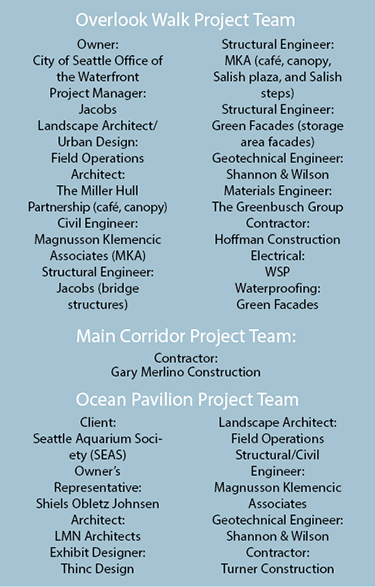
MKA’s structural engineers also designed the café, service building, Salish Plaza and Salish steps.
“People might not realize it, but they are standing not only on the roof of the Ocean Pavilion but also overtop the main habitat and the various creatures swimming below,” Bonotto explained.
The Ocean Pavilion’s eastern retaining walls also support the main corridor project and are designed to accommodate the American Society of Civil Engineers’ required design loads, as well as the American Association of State Highway and Transportation Officials loads. MKA’s civil team worked to assist the bridge engineers with finish grades for the bridge sidewalks and plazas, designed the grading and drainage improvements of the Overlook Walk’s Salish Plaza and steps, and integrated the Ocean Pavilion into the Alaskan Way promenade and sidewalk design that had already been completed.
“The final product looks beautifully cohesive, but these projects were designed separately,” Greene concluded. “It’s a testament to the skills of all our team members that we could work together and have all the various projects come together in such a unified way.”
Hannah Bonotto is an associate at MKA and structural engineering project manager for the Ocean Pavilion and Overlook Walk. Rita Greene is a principal at MKA and civil engineering project manager for the Olympic Sculpture Park, Ocean Pavilion, and Overlook Walk. Matt Jones is a senior principal and civil engineering practice leader at MKA.
Other Stories: