|
Subscribe / Renew |
 |
Contact Us |
| ► Subscribe to our Free Weekly Newsletter | |

Construction Bids
| home | Welcome, sign in or click here to subscribe. | login |


 print print  email to a friend email to a friend  reprints add to mydjc reprints add to mydjc |  |
 |
October 31, 2024

tenBrink
|

Barash
|
Thousands of Seattleites showed up on Friday, October 4, to celebrate the city of Seattle’s public opening of an iconic new connection between Pike Place Market and the waterfront.
The grand new connection, named Overlook Walk, links the MarketFront with the new Seattle Aquarium Ocean Pavilion and is a key part of the city’s complete overhaul of Seattle’s waterfront.
The design and development of this project has been long imagined, and included years of public input, planning, design and engineering and guidance from the city of Seattle.
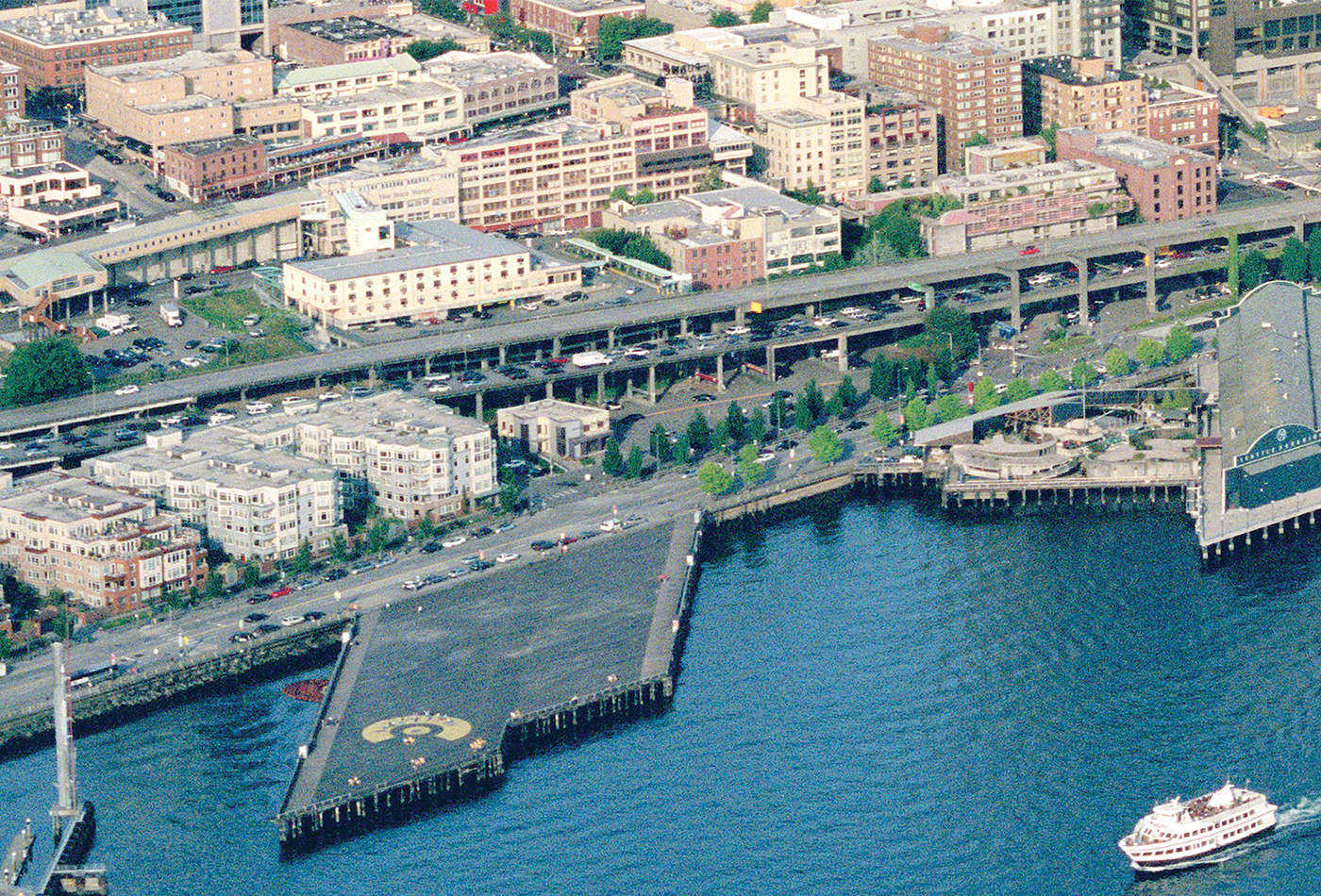
MARKET, WATERFRONT CONNECTION IN 2010
In 2010, if you were to walk along the Pike Place Market through the arcade of crafts, flowers, fruit and fish, north toward Victor Steinbrueck Park, you would come to the Desimone Bridge. That bridge connected the North Arcade of the Market to a parking lot just across from Western Avenue through a set of wooden stairs. The terminus of the bridge had a wonderful overlook to Elliott Bay over the Alaskan Way Viaduct.
If, on that journey you wanted to stroll further out to the beckoning water and the view beyond, you would walk down a set of wooden steps, through a gravel parking lot and continue down nearly 70 vertical feet of stairs through the hillside beneath the Alaskan Way Viaduct, landing sandwiched between a large residential building and office building. From there you would arrive at the Seattle Aquarium and the waterfront and the splendor of the Puget Sound with the mist and mountains beyond.
While this was one of multiple circuitous pathways between the Pike Place Market and the waterfront, this location presented an opportunity to create a more seamless link between the Market and the Puget Sound, long desired by many Seattleites.
A NEW FOCUS ON PEDESTRIAN ACCESS
In the fall of 2010, the future of this important connection would change with the city of Seattle assembling a team to create a vision for the Seattle waterfront. The city created a new office (Office of the Waterfront and Civic Projects) to oversee and deliver this immense design and construction effort. The city selected a unique team, pairing urban design and engineering firms as co-leads for this transformative program.
These efforts included a reimagination of the connection between Pike Place Market and the Seattle Aquarium. Together with the city of Seattle, valuable public input, and boards and commissions, this team envisioned and delivered Overlook Walk, which is open to the public today.
The demolition of the Alaskan Way Viaduct, which was damaged in the 2001 Nisqually earthquake and is now replaced by a tunnel beneath the city, was a part of this plan. It gave room for Overlook Walk and the waterfront to be built.
The Alaskan Way Viaduct was a structure built in 1953 and was both beloved and hated by Seattleites. It was beloved for its views of the Puget Sound, downtown Seattle and the mountains beyond. It was hated for the real and perceived wall it created between Belltown, Pioneer Square, Downtown Seattle and the waterfront.
In 2012, the city of Seattle approved a concept design that stretched between South Dearborn Street in the Stadium District to Bell Street in the Belltown neighborhood. This plan established the Overlook Walk project as a new grand connection between the Pike Place Market and the waterfront that would be a park as well as a pathway.
It would be a place to stay that included a playground, overlooks and plazas, as well as a network of three buildings to anchor the park to Pike Place Market and the waterfront. At the early stages of the Concept Design, these buildings were referred to as buildings “A”, “B” and “C”.
Building A was realized as the MarketFront, providing a pedestrian connection from the Desimone Bridge, Victor Steinbrueck Park and Western Avenue to Overlook Walk. Building B sits on the new Overlook Walk Bridge as the Café Pavilion. Building “C” became the Seattle Aquarium’s Ocean Pavilion (SAOP).
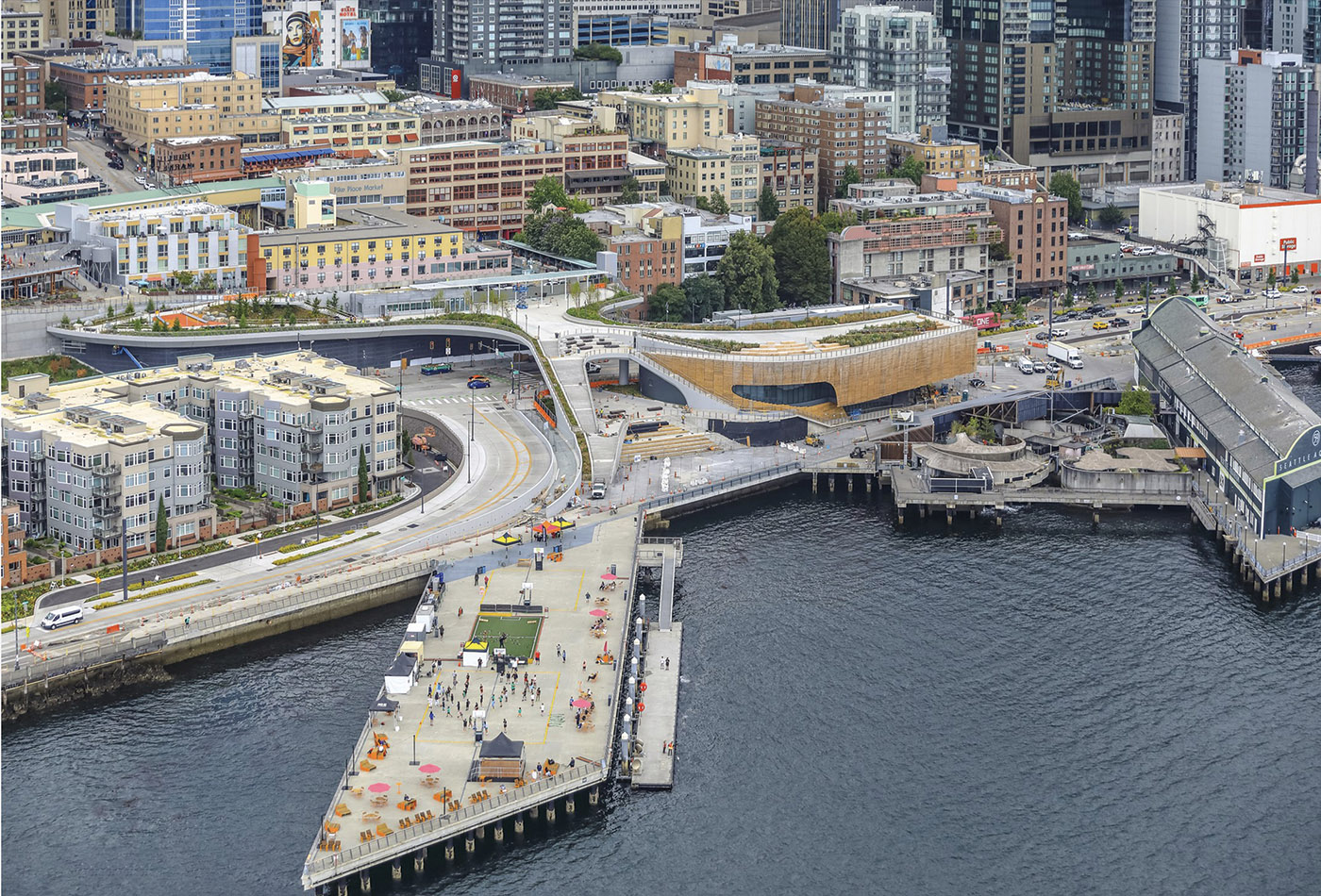
Overlook Walk binds these buildings together in a continuous pedestrian park that brings people down from the MarketFront to the waterfront through a series of gardens, playgrounds, plazas, overlooks, stairs and elevators. This walk helps pedestrians navigate 100 vertical feet from Pike Place Market and down the bluff that was in the past only accessible through a set of wood stairs. This new connection was the result of extensive coordination and detailed urban design and engineering solutions to achieve the welcoming and accessible connection it is today.
PIKE PLACE MARKET, WATERFRONT CONNECTION TODAY
If you were to walk along the Pike Place Market today, north toward Victor Steinbrueck Park, you would come to the Desimone Bridge, the MarketFront and the new Overlook Walk.
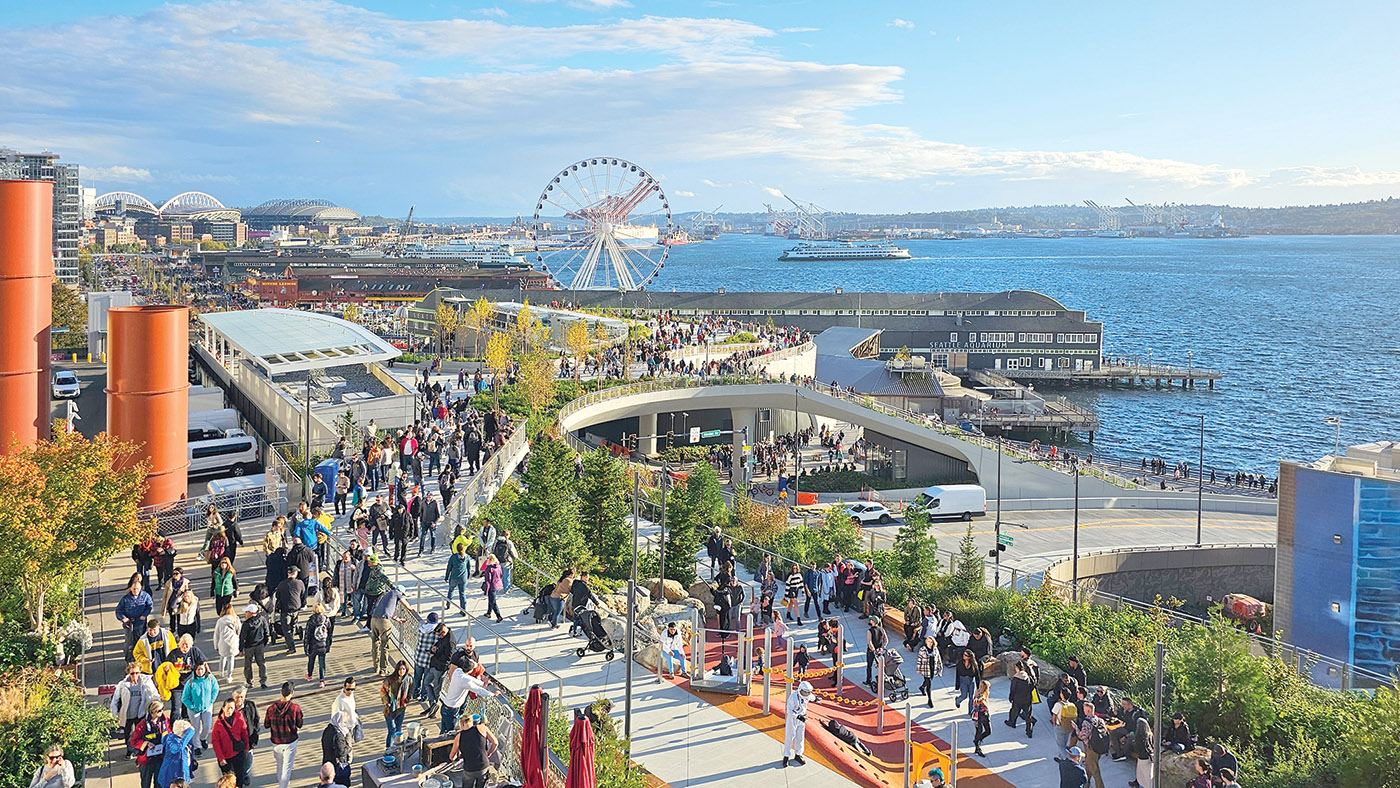
When entering Overlook Walk from MarketFront, there is a new overlook with 360-degree views projecting out from a planted bluff that has views of the downtown Seattle skyline, the mountains, the bay, the stadiums and Mount Rainier. From there you can take a staircase down or you can turn north to the Bluff Walk.
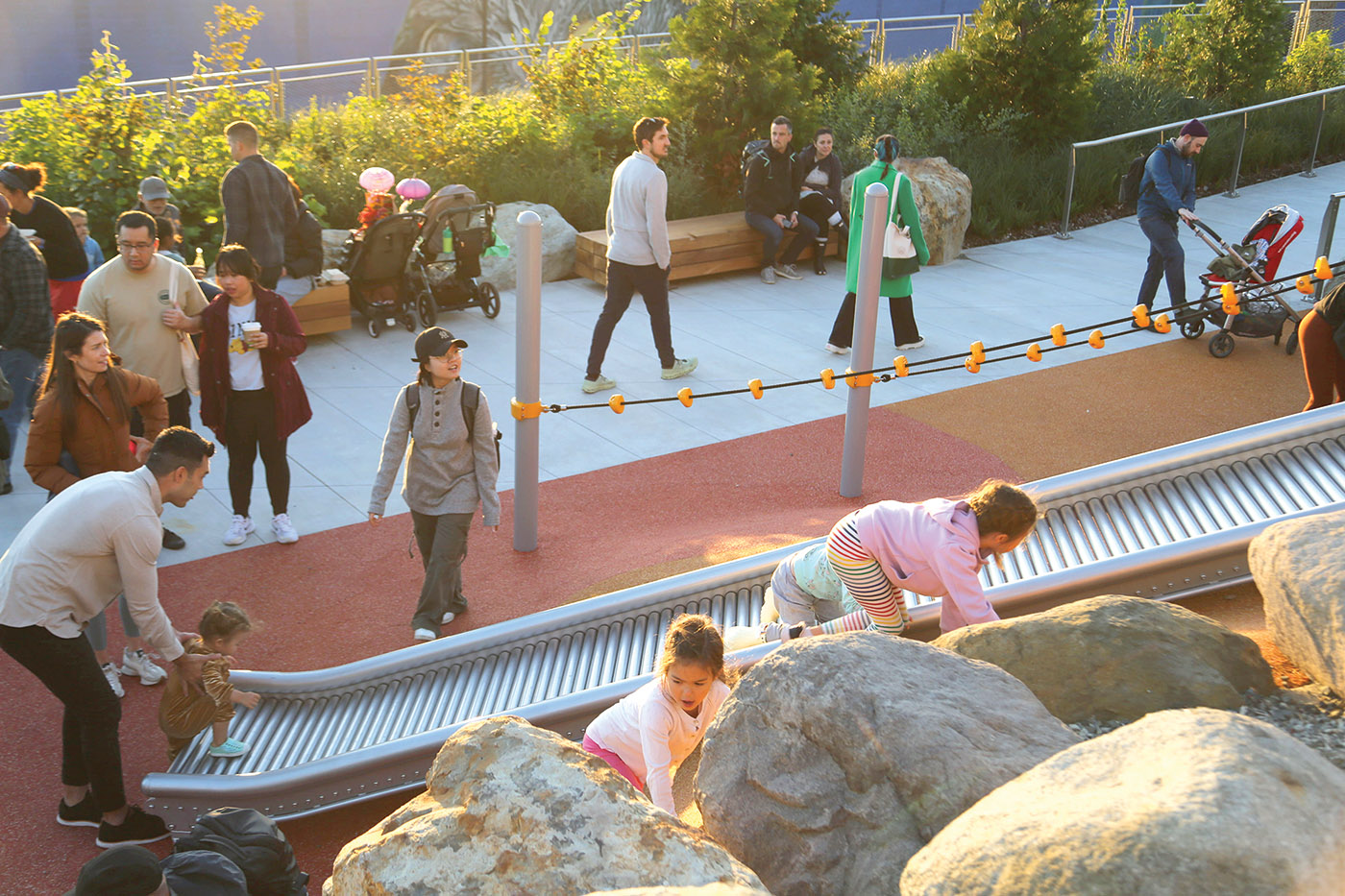
This walk is surrounded by plantings you might see on a mountain hike. Ferns and evergreen trees lie to your right and as you look toward the water you see something surprising, a red and orange slope down the hillside. This is the Bluff Walk play area nestled on the slope between two walkways.
If you walk down the path further, you’ll arrive at the northernmost viewpoint, the Bluff Viewpoint, and an overlook to the BNSF tunnel portal and the new Elliott Way multi-modal street that includes street trees and neighborhood gardens providing new connections from the waterfront into the Belltown neighborhood.
Turning south from that overlook, you’ll continue to descend the bluff, and you’ll reach the base of the playground. Flanking the playground are magnificent “glacial erratics,” boulders that were carried by glaciers and deposited in the Seattle area thousands of years ago, specifically selected from a local quarry for their size, color and shape. Just south of the Bluff Walk is the Overlook Pavilion, a space for a future concessionaire, and the Pavilion Canopy which provides an opportunity for rest and rain cover. The public seating under the canopy has wonderful views to Elliott Bay framed by two gracefully arched planters that guide your view to the water and sunset with a large plaza space between them.
This plaza sits atop the bridge; an elegantly tapered, hour-glass shaped structure that clear-spans over 100 feet across the Alaskan Way roadway and sidewalks below. This larger space beckons you westward to another overlook, where there are smaller, more intimate gathering spaces, with less noise and bustle.
From this overlook, you can go south to more public park space over the top of the Seattle Aquarium’s Ocean Pavilion, or west where you descend to the Salish Plaza. Behind the Salish Plaza, east of the roadway, is a new screen wall enclosing the space that will be the home to a forthcoming art installation by Ann Hamilton. The Salish Plaza itself will be home to a new indigenous art installation by MTK Matriarch nestled between two planters with ferns and salal and seating.
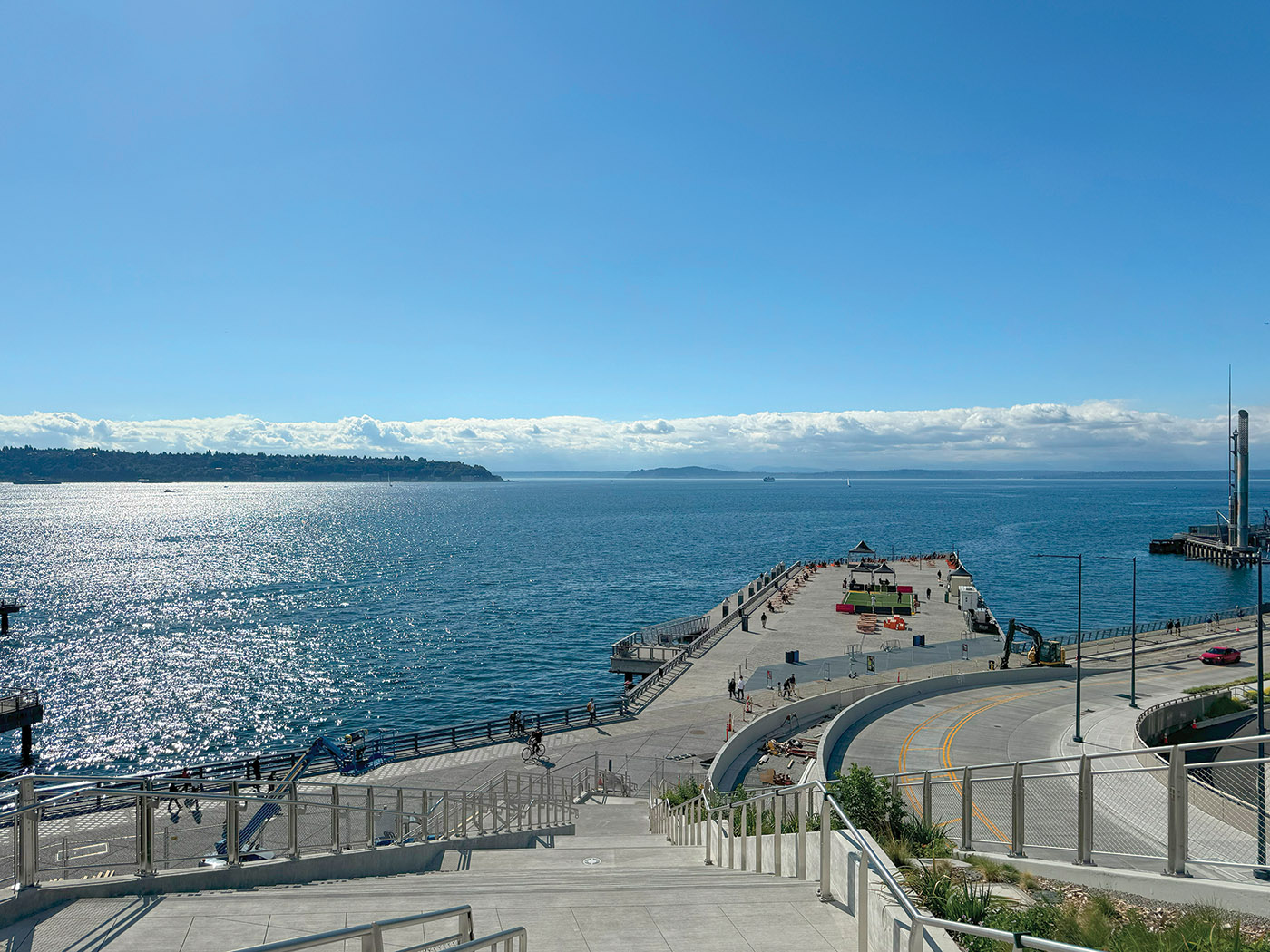
The Salish Plaza leads out to the Salish Steps, which cascade down to Waterfront Park where you have open views to Elliott Bay and Pier 62. These seating steps and all the wood used on Overlook Walk are sourced from local Western Red Cedars reclaimed from the forest floor and lake beds.
With the recent completion of Overlook Walk, residents and visitors alike now have a new and exciting way to walk between the Pike Place Market, the Seattle Aquarium, Waterfront Park, Pier 62 and destinations beyond. The opening of Overlook Walk is a significant milestone in the city’s long-standing efforts to connect downtown Seattle with its waterfront.
Andrew tenBrink is a landscape and urban designer with Field Operations. Andrew Barash is a civil engineer and project manager with Jacobs Engineering. They both have been working on the Seattle Waterfront project since 2010.
Other Stories: