 |
Subscribe / Renew |
 |
Contact Us |
| ► Subscribe to our Free Weekly Newsletter | |

Construction Bids
| home | Welcome, sign in or click here to subscribe. | login |


 print print  email to a friend email to a friend  reprints add to mydjc reprints add to mydjc |  |
 |
October 31, 2024

Cody
|
Seattle’s Central Waterfront revitalization hinges on lighting that transforms the space into a vibrant destination after dark. Beyond providing visibility, the lighting design enhances safety, supports social interaction and integrates with the waterfront’s urban design.
As Seattle’s Central Waterfront undergoes a transformative revitalization, the role of lighting becomes crucial in shaping the experience of the waterfront’s variety of spaces after dark. By carefully crafting a lighting design that not only supports safety but also enhances the user experience, the waterfront becomes more than just a transportation corridor or recreational area. It becomes an immersive nighttime destination, where lighting plays a pivotal role in creating social spaces and highlighting the design elements that define the waterfront’s new identity.
SHIFTING FROM DAY TO NIGHT

The lighting strategy for the Seattle Central Waterfront is centered on offering a distinct experience after dark, different from daytime activities. During the day, the waterfront thrives with natural light, animated by its connection to the water and the city’s urban landscape. However, as the sun sets, lighting becomes the key medium that reinterprets space. It accentuates design elements, supports social activities, and creates a sense of place that is distinct from the daytime experience.
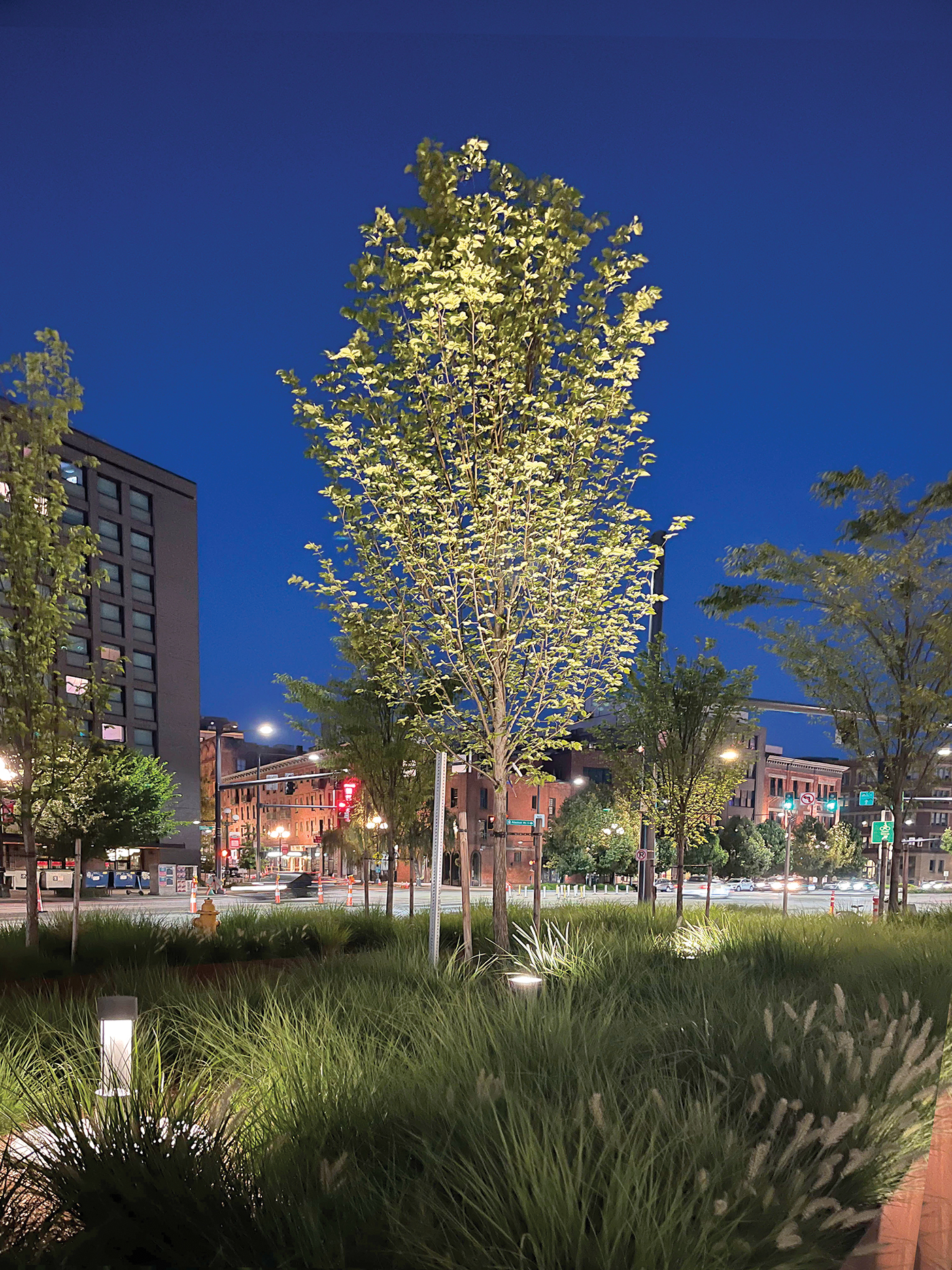
The lighting design achieves this transformation by creating a layered and dynamic illuminated environment. For instance, during the day, sunlight uniformly lights trees and lower-level plantings along the promenade, but the after-dark experience illuminates selected trees and highlights plantings with lantern-like elements.
While views to Elliott Bay dominate during the day, the water’s edge is a tranquil place at night, with lower light levels to support a quiet connection to the water while also reducing the impacts of lighting to shoreline habitats. Art installations are brought into a different focus through accent lighting, highlighting their important place in the waterfront landscape.
ENHANCING SAFETY AND SECURITY
Addressing safety and security are at the core of the waterfront lighting design. Knowing that “more light” isn’t necessarily “better light,” different lighting solutions are employed to address the varied needs of pedestrians, cyclists and drivers, ensuring that all users feel secure while navigating the area at night.
For pedestrians, light levels were carefully tuned to support a variety of lighting conditions for different activities, such as gathering, strolling, or pausing to enjoy the view. Lighting of selected trees in the Promenade planters prevent the creation of dark walls of vegetation between the pedestrian circulation and Alaskan Way.
Providing adequate illumination for navigation is supported by layers of lighting at social zones to support gathering and the natural surveillance of public spaces, enhancing perceptions of safety and security.
SUPPORTING GATHERING, COMMUNITY INTERACTION
One of the key goals of the waterfront lighting plan is to foster social interaction and create comfortable spaces for people to gather, both formally and informally. As the waterfront is designed to be a place of activity and relaxation, the lighting design supports this by ensuring that gathering spaces are well-lit, comfortable and welcoming after dark.
Areas such as the promenade and Overlook Walk are designed to encourage gathering and social interaction. These spaces are illuminated with pedestrian-scale lighting that creates intimate zones for socializing, while also providing enough visibility for safe navigation. The lighting is carefully modulated to create varying light levels for different spaces, offering a variety of environments for people to choose from, whether they are pausing to take in the view or sitting with friends in one of the public plazas.
Lighting in these social areas is also designed to support flexibility. For example, in open plaza spaces, the lighting fixtures are designed to provide ample illumination without obstructing the open space. This allows the open areas to be used for a variety of activities, from evening strolls to large public events. The lighting design ensures that these spaces remain functional after dark while maintaining the welcoming atmosphere that encourages community interaction.
INTEGRATING LIGHTING WITH URBAN DESIGN
One of the main drivers of the lighting design is to integrate into the urban design elements of the waterfront. From highlighting the architectural features of new public spaces, to illuminating landscape elements and highlighting key art installations, lighting reinforces the waterfront’s identity as a social and cultural destination. The lighting plan employs subtle techniques, such as integrating lighting into plantings and pathways, to ensure the design remains cohesive while enhancing visibility and comfort.
For example, the promenade’s design differentiates between higher activity plazas at intersections with the east-west street grid and the connecting walkways along each block. Plazas are defined with luminous pedestrian scaled columns that provide higher light levels and uniform illumination, while quieter, lower scaled bollards define Promenade pathways.
These different techniques create a consistent rhythm and patterning of light along the length of the Promenade, creating a clear circulation route that feels safe and inviting. Illumination of selected trees between the promenade and Alaskan Way helps to prevent the creation of dark, isolated spaces, while enhancing the natural beauty of the landscape.
The lighting plan also strategically places light at varying heights and intensities to ensure that the waterfront’s features are illuminated in ways that add depth, texture and interest, without overwhelming the experience.
ENHANCING WAYFINDING AND NAVIGATION
Clear and intuitive wayfinding is essential for any urban environment, especially one as expansive as the Seattle Central Waterfront. The lighting design supports this by creating a hierarchy of light that helps guide users through space and ensures that pathways and transitions between zones are easily navigable.
In pedestrian areas, the lighting is designed to provide both clear directional cues and a sense of safety. The design enhances the visual interest of pathways while maintaining visibility using lower lighting levels, while at major intersections and transition points, brighter, more prominent lighting fixtures are used to signal direction and draw attention to key circulation routes and decision points. s
The lighting plan also creates clear visual connections between the waterfront and the city beyond. By carefully illuminating east-west connector streets and major pedestrian routes, the lighting design ensures that the waterfront feels accessible from the city, encouraging people to move freely between the urban core and the water’s edge, even after dark.
The lighting strategy for the Seattle Central Waterfront plays a crucial role in transforming the space into a vibrant and engaging destination after dark. By focusing on the creation of different experiences between daytime and nighttime, integrating lighting into the urban design and supporting social gathering, the lighting design ensures that the waterfront remains a dynamic public space for all.
Jill Cody is a principal at Dark Light Design, with 28 years of project experience and a passion for designing for the public realm. Her projects include the Pike Place MarketFront, Seattle Ferry Terminal and Seattle Central Waterfront.
Other Stories:


