 |
Subscribe / Renew |
 |
Contact Us |
| ► Subscribe to our Free Weekly Newsletter | |

Construction Bids
| home | Welcome, sign in or click here to subscribe. | login |


 print print  email to a friend email to a friend  reprints add to mydjc reprints add to mydjc |  |
 |
June 25, 2026

Nabozny
|
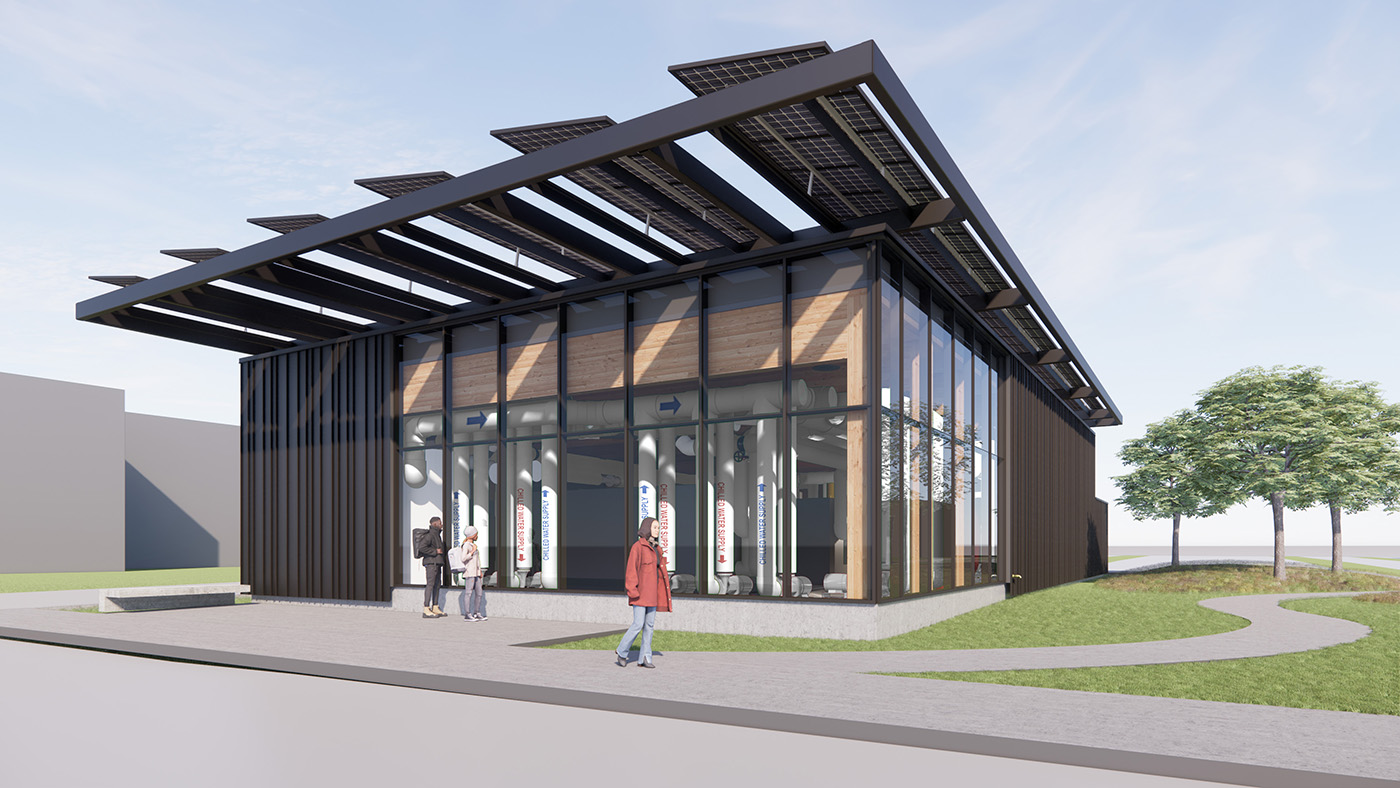
Set to open this fall, Central Washington University’s new GeoEco Plant joins just a handful of geothermal plants worldwide that are explicitly designed for visitors to look inside and see energy conversion happening in real-time. This brand-new facility serves as a transparent “living laboratory” with large glass windows allowing students and the public to safely watch low-temperature energy exchange with the Ellensburg Aquifer in an operational facility.
Central Washington University (CWU) is uniquely situated for this system because Ellensburg sits on top of a large underground aquifer, with water that stays at a consistent temperature all year long. In the summer, this aquifer will function as a heat sink to cool the air in connected buildings. In the winter, the aquifer will warm up the cold surface air, which will allow CWU to heat buildings without the need to burn fossil fuels.
The facility will initially heat and cool four major campus buildings, including CWU’s new North Academic Commons (NAC). Designed by the same team and built across the street from the GeoEco Plant, the NAC demonstrates how future CWU academic facilities align with, and benefit from, this evolving energy system.
“CWU’s GeoEco Plant is more than a single project,” noted Tom Golden, principal at NAC Architecture. “It represents a shift in how universities can approach decarbonization not as a constraint, but as an opportunity to rethink systems, spaces, and student engagement.”
A SMALL PLANT WITH OUTSIZED IMPACT
CWU’s GeoEco Plant represents a transformative step toward a carbon-neutral campus. As the first node in a planned geothermal network, the facility redefines how CWU will heat and cool its buildings, moving away from fossil fuels toward an electrified, low-carbon future. At just 3,800 square feet, the project delivers outsized impact, pairing innovative energy infrastructure with ambitious performance goals and establishing a replicable model for campus-wide decarbonization.
As institutions across the country grapple with how to transition aging energy systems, CWU’s approach demonstrates how targeted infrastructure investments can catalyze long-term change. Rather than incremental upgrades to existing systems, the university is rethinking its district energy strategy from the ground up, leveraging geothermal exchange, electrification, and phased implementation to align operations with climate commitments in a fiscally responsible model.
FROM FOSSIL FUEL DEPENDENCE TO ELECTRIFICATION
Ninety-five percent of CWU’s emissions are currently driven by natural gas—based heating systems, underscoring the scale of its decarbonization challenge. CWU’s approach is a bold transition away from combustion-based heating to electrified systems powered by low- and zero-carbon energy sources such as hydropower, wind, solar and nuclear.
This shift is a fundamental reconfiguration of campus infrastructure. Electrification allows buildings to operate without on-site fossil fuel combustion, opening the door to deep carbon reductions while improving long-term efficiency and resilience.
The GeoEco Plant is the first step in this transition. As additional geothermal nodes are accomplished over time, the network will eliminate 100% of Scope 1 emissions and reduce overall campus emissions (Scope 1 and 2) by up to 95%, aligning with university and statewide climate goals. This phased approach illustrates a scalable framework for decarbonizing large, complex campuses without requiring immediate system-wide replacement.
INFRASTRUCTURE AS CATALYST AND CLASSROOM
Each geothermal node in CWU’s network relies on two deep wells —one for extraction and one for injection — enabling a continuous thermal exchange with the underlying aquifer. At CWU, these wells extend 1,000 feet below ground, drawing on the stable temperatures of the Ellensburg Aquifer to heat and cool campus buildings.
Rather than consuming water, the system recirculates groundwater to the aquifer after transferring energy through a dedicated heat exchanger that isolates the groundwater from the building systems. The water is returned without chemical alteration, with only a controlled temperature change. This approach minimizes environmental impact and enables highly efficient energy transfer through a six-pipe heat pump and groundwater heat exchange system.
The GeoEco Plant houses this initial infrastructure, serving as both a functional utility and model for future expansion. While small in footprint, it is designed to support multiple buildings including the new North Academic Commons, and to scale over time, ultimately serving up to 500,000 square feet of campus space.
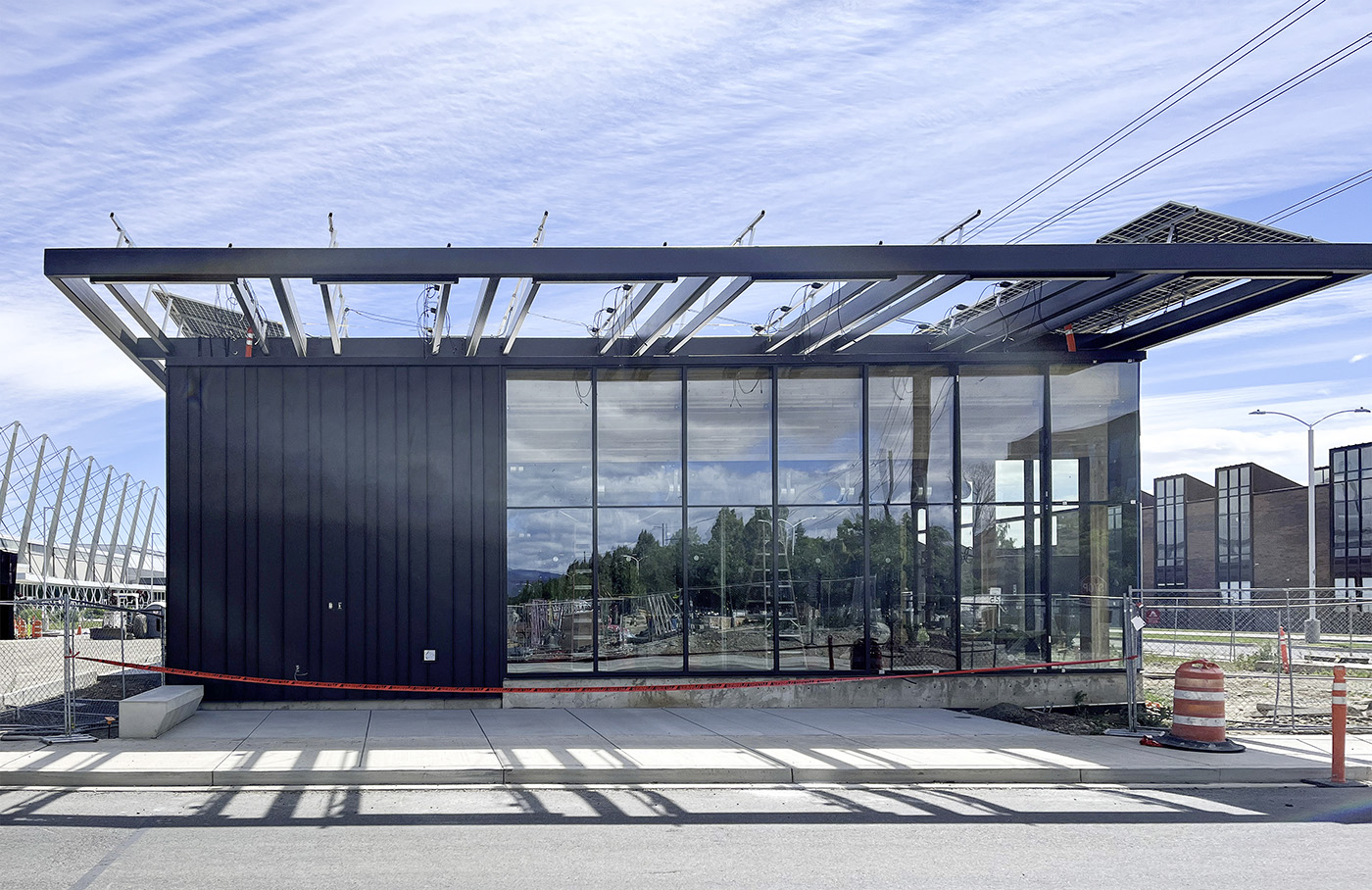
The facility has been conceived not only as infrastructure, but also as an educational asset. Large windows provide visibility into the system’s operations, transforming the plant into an experiential learning environment where students and visitors can engage directly with the mechanics of decarbonization. A mesh LED screen overlays the glazing, remaining transparent when inactive but coming to life with real-time performance data and educational content when illuminated. This layered transparency reinforces CWU’s commitment to integrating sustainability into both physical and academic environments.
The building itself embodies these values. Constructed from cross-laminated timber, it reduces embodied carbon while showcasing renewable materials. Bifacial photovoltaic panels generate electricity from both top and underside surfaces, contributing to the campus grid while maximizing energy capture. The facility is also pursuing the International Living Future Institute’s Zero Energy and Zero Carbon certifications, setting a new benchmark for high-performance infrastructure on campus.
ACADEMIC FACILITIES MODEL LOW-CARBON GROWTH
Across the street, the North Academic Commons (NAC) demonstrates how new academic facilities can align with, and benefit from, this evolving energy system. Set to open alongside the GeoEco Plant, the 105,000-square-foot building will serve as a new home for CWU Humanities and Social Sciences, providing flexible, interdisciplinary learning environments organized around a central mass timber atrium.
The NAC realizes CWU’s bold strategy of replacing outdated, energy-intensive buildings with high-performance alternatives. The demolition of two older facilities, combined with the introduction of geothermal heating and cooling, is projected to reduce operational carbon emissions by approximately 33,000 metric tons over 50 years.
“The GeoEco Plant at CWU is not only the first step in electrifying the university’s heating infrastructure, but also a roadmap for institutions across the state and the nation seeking to make the same transition,” said Anthony Schoen, principal for Mechanical Systems at MW Engineers. “The success of this project was made possible by a dedicated team, and like a chain, every link was just as important as the next.”
INNOVATION THROUGH PARTNERSHIP
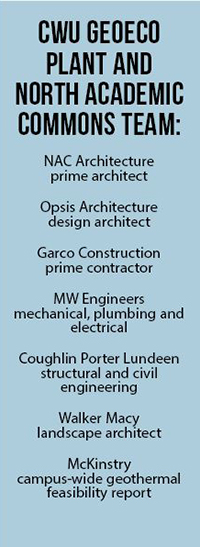
The GeoEco Plant and North Academic Commons are the result of a highly coordinated effort between the university, public agencies, designers and regional partners. Funded by the Washington Legislature, the project reflects a broader public commitment to reducing emissions in higher education infrastructure while supporting student experience and academic growth.
Design and construction brought together a robust, multi-disciplinary team, including NAC Architecture as prime architect, Opsis Architecture as design architect, MW Engineers for mechanical systems, and many additional engineering and construction partners. The use of cross-laminated timber sourced from Yakama Nation Forest Products further highlights the project’s emphasis on regional collaboration and sustainable materials.
This integrated delivery model aligned infrastructure, architecture, and institutional goals to address performance, pedagogy, and place-making simultaneously. The result is not just a building or a plant, but a coordinated system that operates at both technical and organizational scales.
LOOKING AHEAD
As CWU advances its geothermal network over the coming decade, the GeoEco Plant establishes a new foundation for campus infrastructure built on electrification, efficiency and long-term adaptability. In doing so, CWU offers a compelling model for other institutions, demonstrating that even a small facility, strategically deployed, can drive meaningful change across an entire campus.
Korin Nabozny is an associate principal at NAC in Seattle focused on design and campus planning for higher education.
Other Stories:


