 |
Subscribe / Renew |
 |
Contact Us |
| ► Subscribe to our Free Weekly Newsletter | |

Construction Bids
| home | Welcome, sign in or click here to subscribe. | login |


 print print  email to a friend email to a friend  reprints add to mydjc reprints add to mydjc |  |
 |
June 25, 2026

Cork
|
The Haggett Hall replacement is the final major project envisioned in the University of Washington’s 2008 Seattle Campus Housing Master Plan, a long-term initiative that has transformed the student residential experience on the Seattle campus. Designed by Mahlum in collaboration with TenBerke Architects and delivered by an integrated design-build team led by Andersen Construction, the project replaces 800 student beds while creating a new model for student wellness, accessibility and community. GGN is the landscape architect.
Scheduled for completion in 2027, Haggett Hall will serve as the capstone of a decade-long effort to modernize housing on UW’s North Campus, completing a network of residential communities connected by accessible pathways, shared amenities and a strong relationship to the campus landscape.
LIVING IN THE FOREST
Haggett Hall is the fifth new or replacement residence hall completed within the North Campus over the past eight years. Together with Hansee Hall to the north, McMahon Hall to the south, and the recently completed McCarty, Oak, Spratlen, and Oliver Halls, the project helps create a cohesive residential district embedded within one of the most heavily wooded portions of the campus.
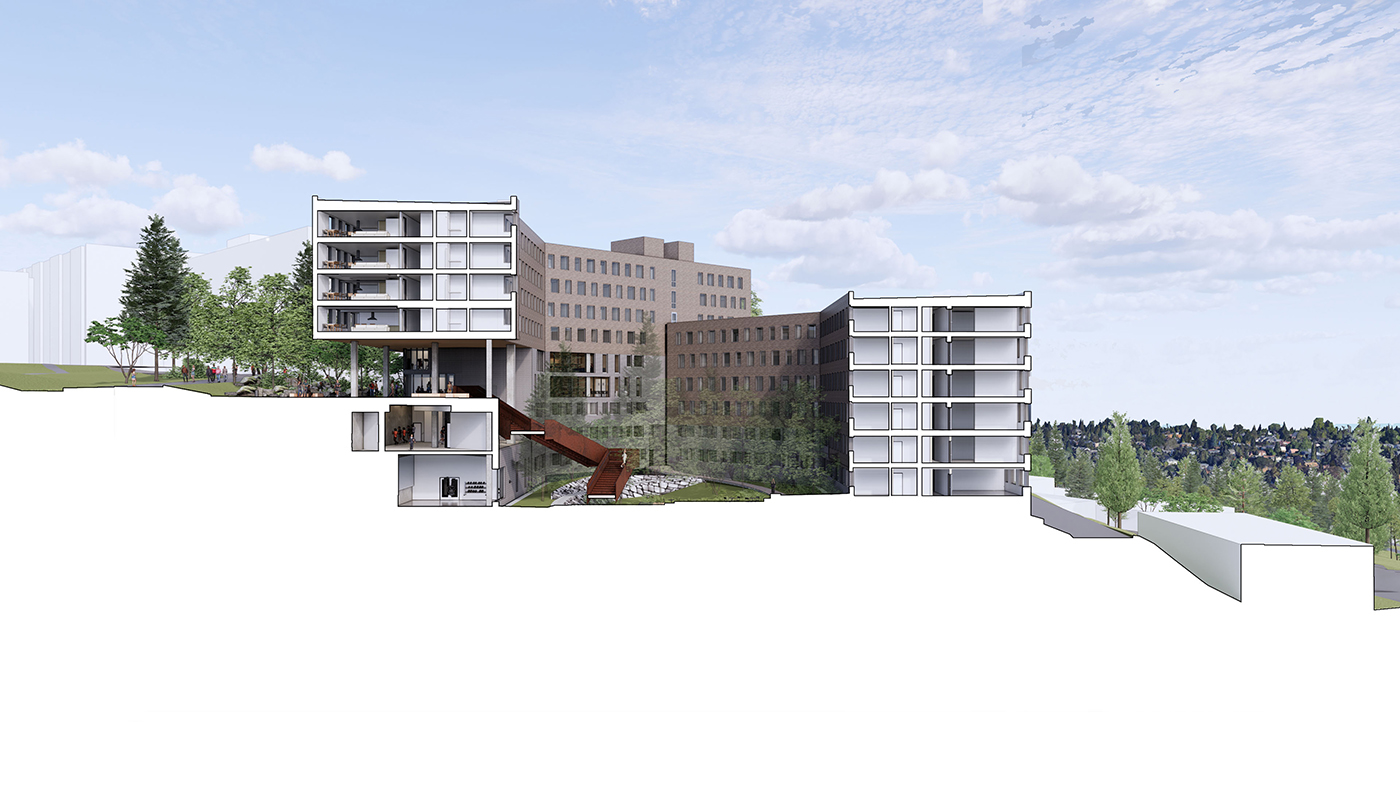
While Oak and Spratlen Halls redefined Denny Field, and Oliver Hall introduced a dining facility serving more than 4,800 North Campus residents, a key piece of the campus circulation network remained unfinished: the Mid Slope Path, an accessible pedestrian route linking the residence halls with the academic core.
The demolition of the original 1960s-era Haggett Hall towers created an opportunity to complete that vision. The site also allowed the University to establish a new accessible connection through the steeply sloped landscape, ultimately linking North Campus to the Burke-Gilman Trail.
The challenge was considerable. With more than 40 feet of grade change across the site, tight adjacencies to existing buildings, and required upgrades to a critical fire lane, the university identified the location as one of the most complex development sites on the Seattle campus.
The design responds by embracing the terrain rather than fighting it. Along Little Canoe Channel — the roadway connecting North Campus to Campus Way — the building is carved away to form an open-air Portal that frames views into the forested courtyard and toward Lake Washington and Mount Rainier beyond. This covered outdoor room functions as both a gathering space and a key circulation hub, improving connections between the residence halls and the intramural and athletic areas of East Campus. From the Portal, students can access a new exterior stair or elevator that provides access to the lower campus landscape and connection to the Burke-Gilman Trail. Together with improvements to Little Canoe Channel and the Mid Slope Path, the project significantly enhances accessibility across a previously difficult section of campus.
DESIGNING FOR WELLNESS
Each residence hall on North Campus includes a shared amenity available to all residents, a strategy that promotes community while maximizing operational efficiency. Haggett Hall was designated as the home of a new health and fitness center, expanding on a successful model established on West Campus more than a decade ago.

The design team used this programmatic requirement as the foundation for a broader vision centered on student well-being. Rather than treating wellness as a single destination within the building, the project integrates opportunities for physical activity, social connection, mental restoration, and engagement with nature throughout the site and within the residence hall.
At the heart of the project is a landscaped courtyard designed as an urban forest. Rainwater from the building’s roofs is directed into a central bioretention pond, creating a naturalized landscape that supports stormwater management, seasonal habitat and outdoor gathering. Native conifers, shrubs, boulders, and nurse logs reinforce the character of the Pacific Northwest landscape, providing residents with a quiet setting for reflection and relaxation.
The project’s commitment to active transportation is equally evident in the new Bike Hub. Located adjacent to a major campus bicycle route, the facility provides more than 180 bicycle parking spaces, repair workstations, and informal gathering areas for cycling enthusiasts. Unlike traditional bike storage rooms hidden deep within residential buildings, the Bike Hub occupies a highly visible, daylit location that celebrates cycling as an integral part of campus life.
Within the residence hall, a series of smaller residential neighborhoods fosters belonging and connection. Student rooms are organized into wings that share lounges, kitchens, study spaces, and private phone rooms creating opportunities for interaction at a more intimate scale. Larger community amenities — including game rooms, music rooms, meeting spaces, and shared kitchens — support a wide range of social and academic activities.
HUSKY HAVEN: MIND, HEART AND BODY
The centerpiece of the project is Husky Haven, a three-story health and wellness center designed around the interconnected dimensions of student well-being: mind, heart and body.
At the entry level, Husky Haven introduces a different kind of wellness environment — one focused on mental and emotional well-being. A collection of contemplative rooms, reflection spaces, and wellness suites offers students a range of environments for quiet retreat, mindfulness, personal reflection, or one-on-one conversations with counselors and peer-support staff. Designed to provide refuge from the intensity of academic and social pressures, these spaces create opportunities for students to pause, recharge, and reconnect with themselves and others.
Strength-training spaces occupy the lower courtyard level, while cardio and movement functions are located on the middle floor, including an outdoor yoga terrace overlooking the landscaped courtyard. These active spaces are linked by a dramatic interior stair that encourages movement and visual connection throughout the facility.
Together, the facility acknowledges a growing understanding within higher education that student success depends not only on physical health, but also on emotional resilience, belonging and access to supportive environments.
When completed, Haggett Hall will do far more than replace an aging residence hall. It will complete a major chapter in the evolution of the University of Washington’s North Campus, strengthening connections between people, landscape and community, while establishing a new benchmark for student-centered residential design.
Mark Cork is a partner at Mahlum Architects.
Other Stories:


